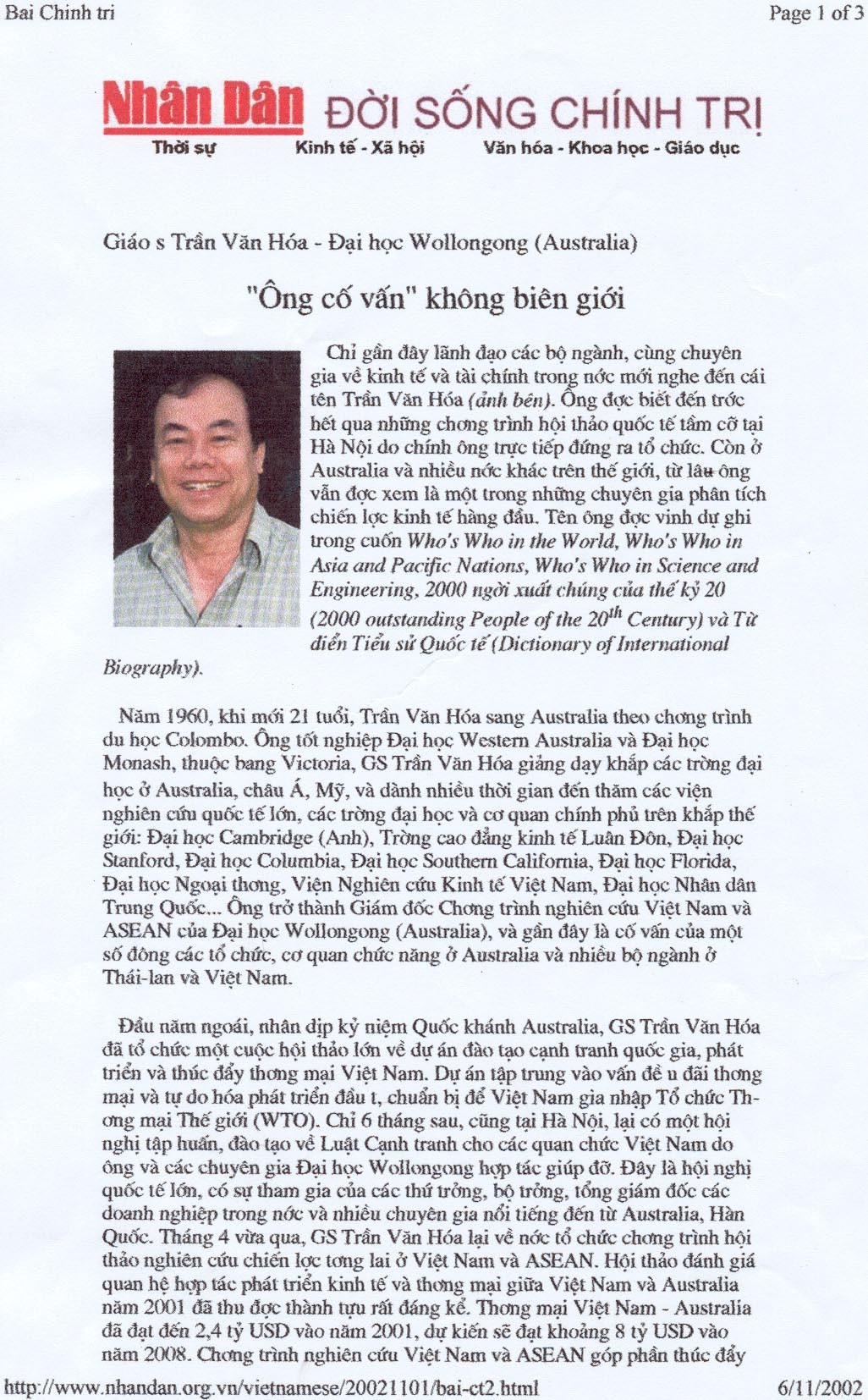
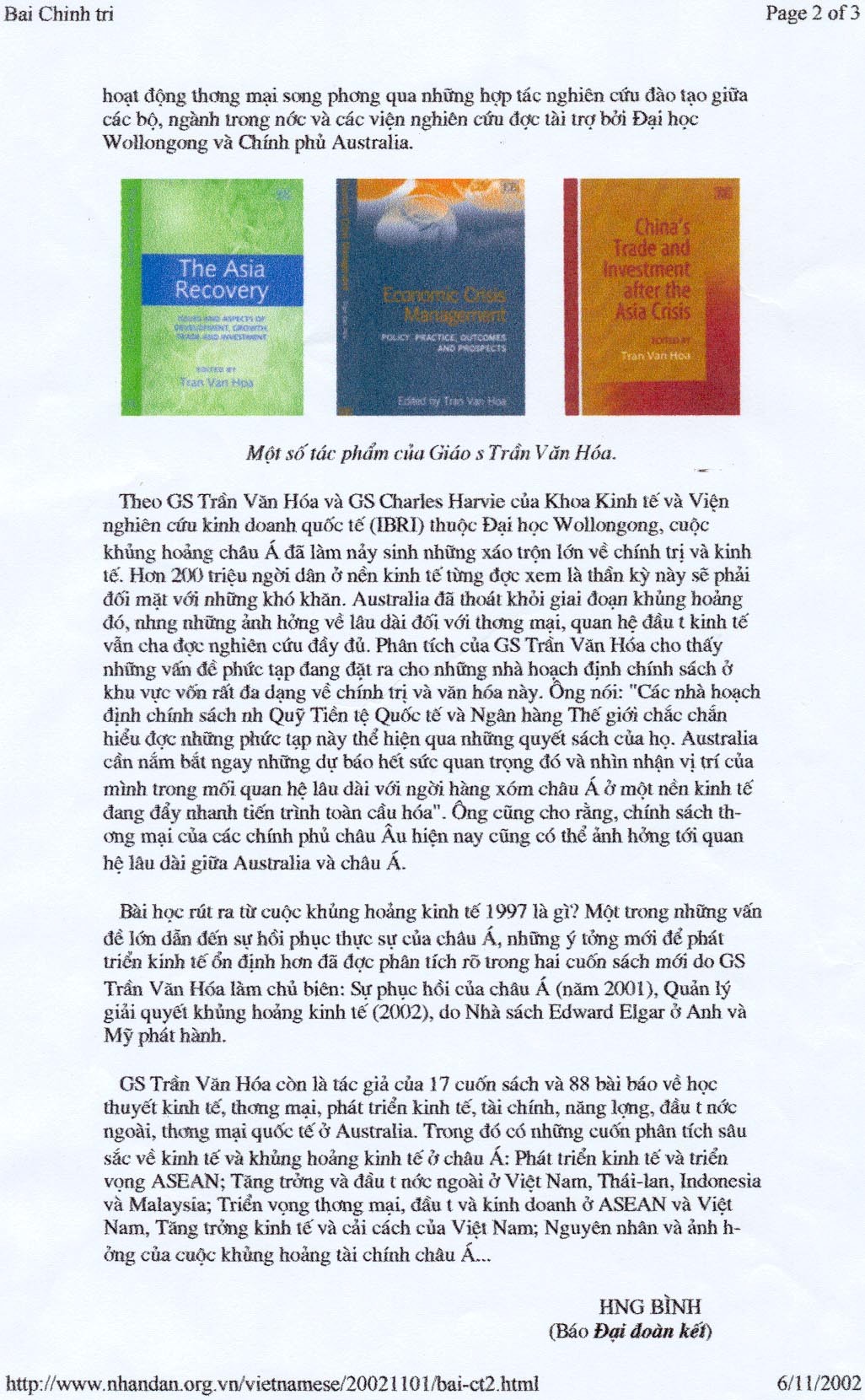
TRAN VAN HOA
B.Ec (Hons), M.Ec., Ph.D.
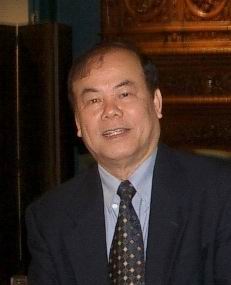
Professor, College of
Business, Victoria University, Australia
Professor, Faculty of
Business, University of Wollongong, Australia
Director, Vietnam and East Asia Summit Research Program
PO Box 14428, Melbourne VIC 8001, Australia
Phone: 613 9919 1972, Fax: 613 9919 1350
Email: [email protected], [email protected], [email protected]
Honorary Professor, National Economics University, Hanoi, Vietnam
Honorary Professor, National Advanced
Training Institute (NATI), Ministry of Trade, Vietnam
Executive and Editorial Board Member, Asian Forum on Business Education,
Thailand
Editorial Board Member, International Economics Studies (Isfahan
University), Iran
INTERNATIONAL LISTING
|
Who's Who in the World |
Who's Who in Science and Engineering |
|
Who's
Who in |
2000 Outstanding People of the 20th Century |
|
Who's
Who in |
1000 Great Intellectuals of the 21st Century |
|
Dictionary of International Biography |
Australian Who's Who |
|
Living
Legends |
Australian
Directory of Professors |
INTERNATIONAL AWARD & RECOGNITION
Association of
the Korean Economic Studies (AKES) 2004 Best Paper Prize for the article Tran
Van Hoa (2004),"Korea’s Trade, Growth of Trade and the
World Economy in Post-crisis ASEAN+3 Free Trade Agreement: An Econometric and
Policy Analysis", Journal of the Korean Economy, Vol. 5, No. 2, pp. 73-108.
For Tran Van Hoa's
Recent Profile in Vietnamese
please click the site below:
Article profiled in Vietnam's Nhan Dan
or (if the above has been moved)
Go to last page of this website
BUSINESS AND CONSULTING EXPERIENCE
|
|
|
|
NSW |
|
|
|
AusAID |
|
Ministry of Commerce ( |
Ministry of Trade ( |
|
Ford Foundation ( |
ACIL-Cardno Australlia |
|
United Nations UNESCAP |
International Consultants Centre ICC, Melbourne |
|
|
United Nations Development
Program ( |
|
International
Development Research Centre ( |
|
AREAS OF RESEARCH
|
International Business and Trade in Asia |
Development Economics and Growth in Asia |
|
Economic Policy Modelling |
Business Forecasting in Asia |
|
Business and Public Policy in Asia |
ASEAN Economies and its
Enlargement (East Asia |
|
New Asian Regionalism |
Welfare Economics |
|
Energy Economics |
Consumer Demand Studies |
|
Econometric Theory and Analysis |
Production Studies |
|
International Finance |
Competition Policy in Asian Economies |
|
Macroeconomic Policy |
Transition Economies in |
|
Asian Free Trade Agreements and WTO |
Household Production and Economics |
|
Climate Change and
Growth in |
Corruption
and Anti-corruption in |
|
Pro-Poor Development and
Growth in |
CO2
Emissions and Economic Development in Asia |
AREAS OF TEACHING
|
International Business |
International Finance |
|
Applied and Theoretical Econometrics |
Econometric Modelling and Forecasts |
|
Business Economics in |
Energy Economics |
|
Competition Policy in Asian Economies |
Trade and Investment in |
|
Microeconomics |
Economics for Transition
Economies |
RECENT BOOKS ON ASIAN ECONOMIES
by TRAN
VAN HOA
1
Tran Van Hoa (ed)
(1997), Economic Development and Prospects in the ASEAN: Foreign
Investment and Growth in Vietnam, Thailand, Indonesia
and Malaysia. London: Macmillan.
2
Tran Van Hoa (with C
Harvie) (1997), Vietnam’s Reforms and Economic Growth, London: Macmillan.
3
Tran Van Hoa (ed) (1999), Sectoral Analysis of Trade, Investment and
Business in Vietnam, London: Macmillan.
4
Tran Van Hoa and C.
Harvie (eds) (2000), Causes and Impact of the Asian Financial Crisis, London:
Macmillan
5
Tran Van Hoa (ed) (2000), Prospects for Trade, Investment and Business in
Vietnam and East Asia, London: Macmillan.
6
Tran Van Hoa (ed) (2000), The Asia Crisis: The Cures, Their Effectiveness
and The Prospects After, London: Macmillan.
7
Tran Van Hoa,
Vietnam: Market Intelligence and Business Analysis, London: Macmillan, in
preparation.
8
Tran Van Hoa, (2000)
The Social Impact of the Asia Crisis, London:
Macmillan.
9
Tran Van Hoa (2000),
China's Trade and Investment After the Asia Crisis,
London: Edward Elgar.
10
Tran Van Hoa (2001),
The Asia Recovery, London: Edward Elgar.
11
Tran Van Hoa (2002),
Economic Crisis Management, London: Edward Elgar.
12
Tran Van Hoa (2003),
Competition Policy in Major Asian Economies, London: Edward Elgar.
13
Tran Van Hoa and C.
Harvie (2003), New Asian Regionalism: Responses to Globalisation and Crises,
New York: Edward Elgar.
14
Tran Van Hoa (with C
Harvie), The Economic Development in Transition Economies, London: Edward
Elgar, in preparation.
15
Tran Van Hoa, P Q
Thao, V T Dung and L H An (2004), Competition Law and
Policy in Major Economies in Asia and Vietnam (in Vietnamese), NATI, Ministry
of Trade, Hanoi.
16
Tran Van Hoa (2005),
Household Production. Consumer Behaviour and Economic Policy, London: Ashgate.
17
Tran Van Hoa and N V
Lich (2006), ASEAN+3 and Its Impact on Vietnam's Economy (in Vietnamese), World
Publishing
House, Hanoi, Vietnam.
18
Tran Van Hoa and N V
Lich (2007), Business Opportunities in Vietnam After WTO Membership, World
Publishing
House, Hanoi, Vietnam.
19
Tran Van Hoa and N V
Lich (2007), WTO Impact on Regional Vietnam, World Publishing House, Hanoi,
Vietnam.
20
Tran Van Hoa and C
Harvie (2008), Regional Trade Agreements in Asia, London and New York: Edward
Elgar.
2
RECENT WORK & ACTIVITIES
FIRST VIETNAM GLOBAL LEADERS FORUM
Paris 30-31 March 2019
Tran Van Hoa was invited to attend the First Vietnam Global Leaders Forum taking place in Paris at Salomon de Rothschild on 30-31 March 2019. The Forum was organised by the Association of Vietnamese Scientists and Experts Global (AVSE Global), a global agency set up in France (founder: Prof Nguyen Duc Khuong) to help with activities by Vietnamese academics, businesses and scientists worldwide to assist Vietnam's economic development, brandname products, and international competitiveness enhancement. The AVSE Global regularly holds international events in different countries to support these activities.
Understanding what drives the performance of foreign investment enterprises in Vietnam
Warsaw School of Economics, Warsaw, Poland, 14 September 2018
Tran Van Hoa attended the 2018 Econometric Research in Finance Network (ERFIN) workshop on 14 September 2018 in Warsaw, Poland, to present his recent work on the determinants of the high performance of foreign investment enterprises in Vietnam. This recent work uses updated data from Vietnam National Office of Statistics and is an extension of his previous work which has received wide international interest and references. The workshop was organised annually by the prestigious Warsaw School of Economics to showcase and disseminate recent econometric research in finance and related areas. About 50 academic and researchers from 20 countries participated in the workshop and 26 papers were presented and discussed. The Warsaw School of Economics also publishes its professional journal Econometric Research in Finance where selected papers presented at the workshop are published.
CGE Modelling of Japan's ODA Impact on the AEC Economies
Japanese Association of Applied Economics, Tokai University, Tokyo, 28-29 October 2017
Tran Van Hoa participated in the Japanese Association of Applied Economics Autumn Conference at Tokai University in Tokyo on 28 October 2017 to present with Dr Kitti Limskul their paper Japan's ODA Impact on the AEC Economies: A CGE Modelling Analysis. The paper is an extension of their econometric paper on Japan's ODA and the CLMV Countries presented at the CU-ASEAN Symposium on 8 August 2017 at Chulalongkorn University in Thailand. The Tokai paper is being prepared for publication as a monograph by an international publisher.
While in Japan, Tran Van Hoa also gave a seminar at Saitama University on 2 November 2017 on Vietnam's Dynamic Growth, Regional Trade Relations, Opportunities, Challenges and Causality, and a special lecture to international postgraduate students on Econometric Modelling: An Overview.
Japan's ODA in CLMV Economies: Effectiveness and Polittical Economy
Vietnam Academy of Social Sciences, Hanoi, 29-30 June 2017
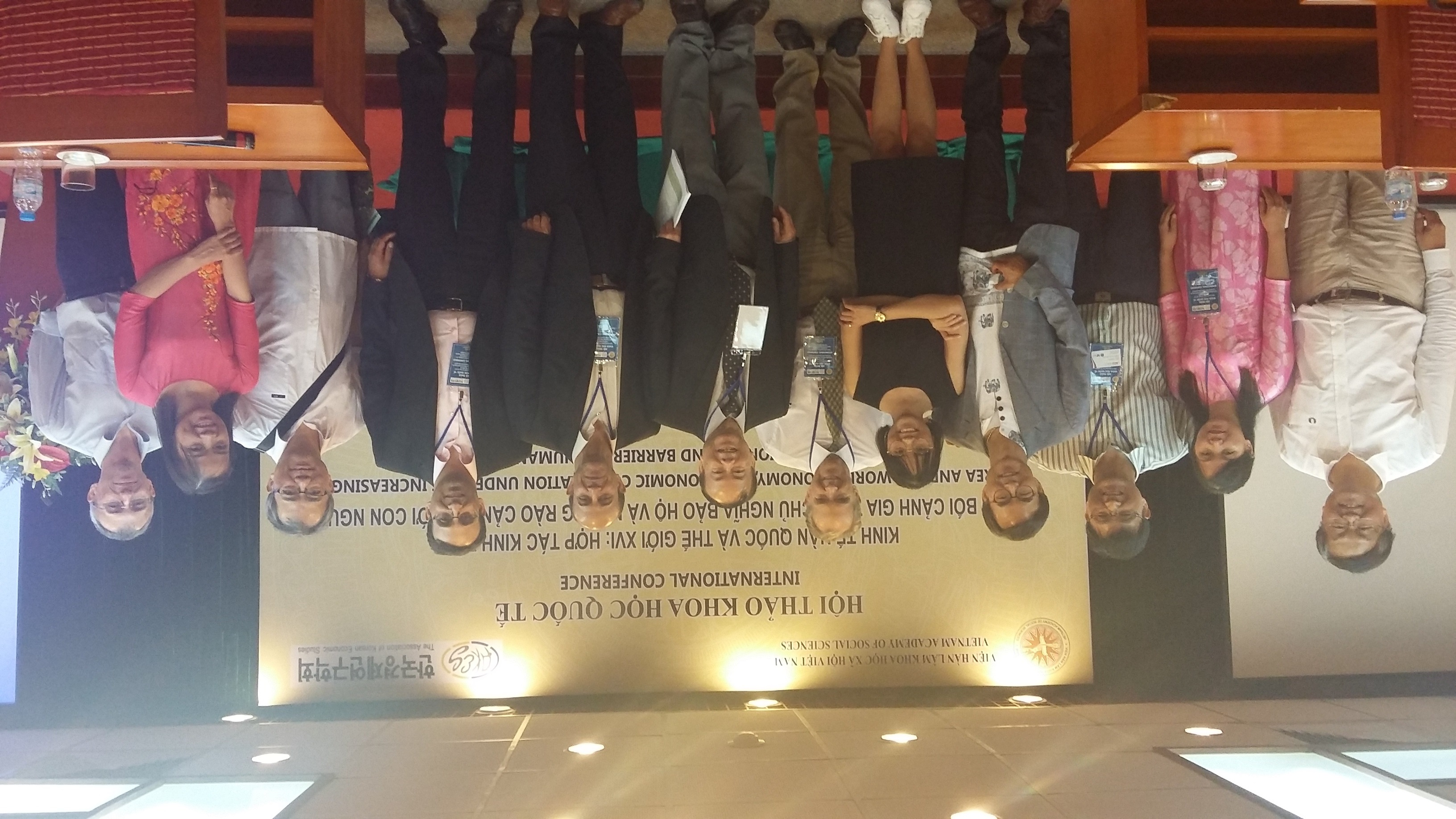
Tran Van Hoa attended the Korea and the World Economy XIV international conference in Hanoi on 29-30 June 2017 to deliver his joint paper (with Kitti Limskul) on Japan's ODA in the CLMV (Cambodia, Laos, Myanmar and Vietnam) Economies: Aid Effectiveness and Political Economy. The conference was organised by the Association of Korean Economic Studies (AKES), hosted by Vietnam Academy of Social Sciences (VASS) and oficially openned by the Chairman of VASS and the President of AKES. More than 70 experts and postgraduate students particiapted in the conference which covered a wide range of topics from climate change, poverty, social welfare and income distribution to monetary and financial policy and foreign trade. In the paper Prof Tran presented his econometric research findings on the weak effectiveness of Japan's declining ODA to the CLMV countries in recent years and on how these can be accommodated by political economy of foreign aid since the beginning of the Marshall aid project after WWII or by long-term prospect and supply side considerations. The findings are useful for policy making by important new Asian donors such as China, Korea and Thailand and their aid outcome, investment and co-operation expectations.
In the photo below are some key members of the conference (from left to right), Prof Komail Tayebi (Isfahan University, Iran), Prof Tran Van Hoa (Victoria University, Australia), Prof Shin-ichi Fukuda (Tokyo University, Japan), Prof Chung-Moo Koo (Kangwon National University, Korea), Prof Kar-yiu Wong (Washington University, USA), and Prof Hsu Chen-Min (National Taiwan University, Taiwan).
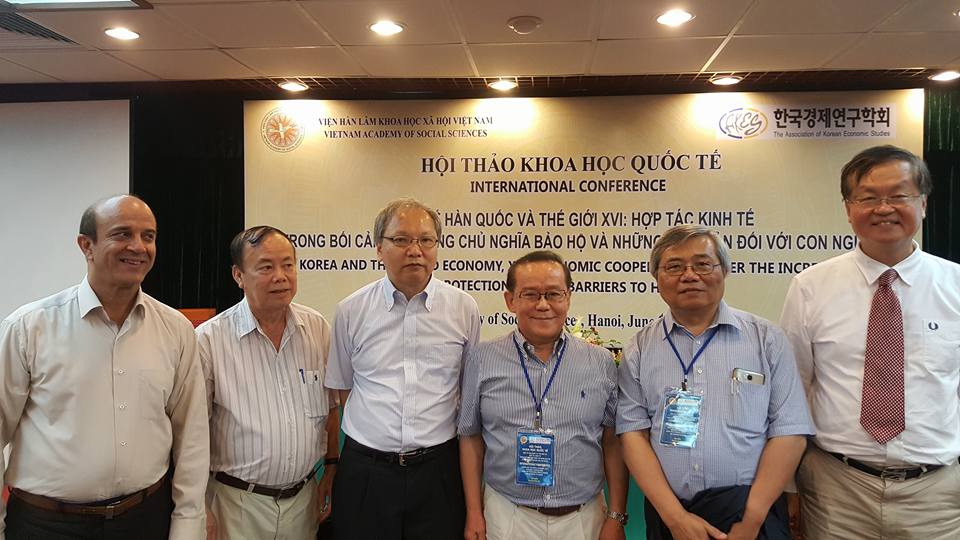
In the photo below are some participants at the openning of the conference at VASS headquarter in Hanoi (Prof Tran, 7th from left).
CONVENTION ON HOCHIMINH CITY SUSTAINABLE DEVELOPMENT
Hochiminh City, 14-16 November 2016
Tran Van Hoa was invited to participate in the Convention, organised by Vietnam Ministry of Foreign Affairs and National Committee for Overseas Vietnamese, to attract global inputs to assist the sustainable development of Hochiminh City, the vibrant commercial centre with big investment, urbanisation, and environment issues of Vietnam. Tran Van Hoa's contribution was a paper on Optimal Investment Strategies for FDI Enterprises in Vietnam: An Econometric Analysis in which strategic recommendations based on econometric modelling with 2001-2014 Vietnam enterprises survey data were offered for FDI business management. About 500 delegates from 29 countries attended the convention. Representing the Government of Vietnam at the Convention included Prime Minister, Deputy Prime Minister, Minister for Foreign Affairs and Senior National and Hochiminh City Government Officials.
UNITED NATIONS ECONOMIC COMMISSION FOR AFRICA (UNECA) AND IDIAN OCEAN RIM ASSOCIATION (IORA) WORKSHOP ON REGIONAL TRADE AGREEMENTS
Ebene, 4-6 November 2015
Representatives of the 20 countries in the IORA region participated in the workshop on the Contributions of Preferential Trade Agreements to Equitable and Sustainable Trade. The workshop was jointly organised by the UNECA and IORA (led by Prof V N Atri, Chair of Indian Ocean Studies), and took place on 4-6 November 2015 in Ebene, Mauritius. The main objective of the workshop was to review the proliferation, benefits and challenges of preferential and regional trade agreements that have been widespread globally and especially their implications for similar agreements and co-operation in the IORA region. Tran Van Hoa was invited to prepare a paper on the Economic Impact of Regional Trade Agreements based on Econometric Evidence. The paper provided a new approach to impact analysis with improved features on outcomes and credibility over current approaches, and was importantly based on economic integration theory, the fundamental structure of preferential and regional trade agreements. Application of the new approach to China to study the economic impact of trade agreements on the country's economic growth and trade was also provided.
MEKONG RIVER SUB-REGION RESEARCH COLLABORATION
College of Business, Victoria University, Melbourne, 13 July 2015
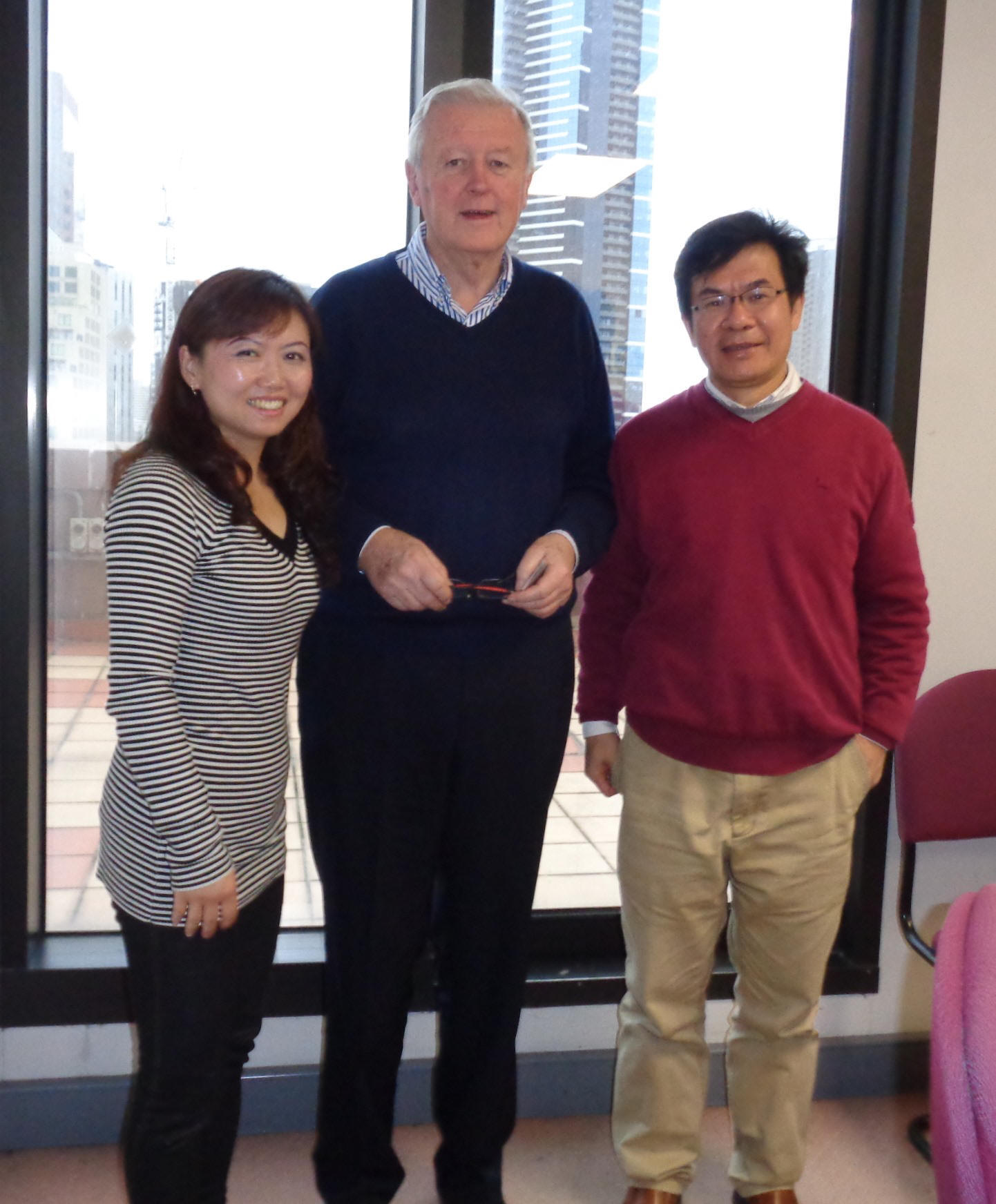
The interest in the Mekong River Subregion (MRS) that involves five ASEAN economies (Cambodia, Laos, Myanmar, Thailand and Vietnam) and China has a long history and robust regional appeal. It was initiated by Australia’s Department of Foreign Affairs and Trade (DFAT) and has had a focus for action plans in the Asian Development Bank. The current funding by Canada’s International Centre for Development Research (ICDR) to Kunming University of Science and Technology (KUST), Yunnan, China, to carry out research on the impact of China’s FDI in the region is a new and interesting funding initiative from North America. Prof Li Erping and Associate Prof Bin Xiong from the Department of Management and Economics, KUST, visited Prof Tran Van Hoa, College of Business, Victoria University, in Melbourne, on 13 July 2015. The visit was to exchange ideas and to explore future research and training collaboration between Australia and the MRS on broader issues of regional integration not only in the MRS but also in the ASEAN generally. The prospects of these potential activities in the near future and with the further support of national and international sponsors are considered good.
In the photo below are, from left to right, Associate Prof Bin Xiong, Prof Peter Sheehan, Research Director, Victoria Institute for Strategic Economic Studies (VISES), College of Business, Victoria University, and Prof Li Erping.
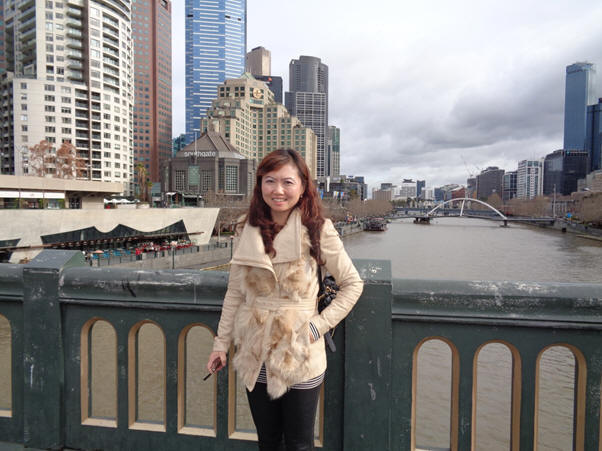
Below is a photo of Associate Prof Bin Xiong with a Melbourne Landmark, the Yarra River.
ENERGY SUBSIDY REFORMS IN THE ASEAN ECONOMIC COMMUNITY
27 Feb-1 March 2015, Chulalongkorn University, Thailand
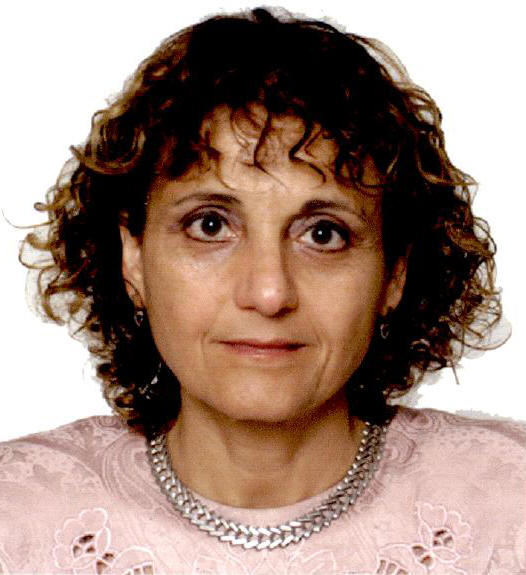
Prof Tran Van Hoa and Associate Prof Kitti Limskul attended as senior experts the Energy Market Integration Forum at Princess Pathunam Hotel, Bangkok, during 27 Feb - 1 March 2015. The Forum was organised by the Asian Studies Centre (ASC), Faculty of Economics, Chulalongkorn University, and led by Prof Nawal Karmel (see photo below), Visiting Professor at Chulalongkorn University, with the support from the ASC and Norway Department of Foreign Affairs. The objectives of the Forum were to gather energy academic and government experts from the ten ASEAN countries to discuss the use of advanced econometric modelling and computable general equilibrium to explore the effects of energy subsidy reforms including compensation policy on economic development, poverty, the environment and regional integration in these countries. The focus of the project was the first of its kind for the totality of the ASEAN region and its research findings by young emerging energy experts representing the region would greatly benefit capacity building and energy policy-making in the ASEAN Economic Community. Experts from the ten ASEAN countries and senior officials from the ASEAN Energy Centre and related organisations in Thailand and the US participated in the Forum.
ASEAN-AUSTRALIA YOUTH SUMMIT 2014
William Angliss Institute, Melbourne 11 October 2014
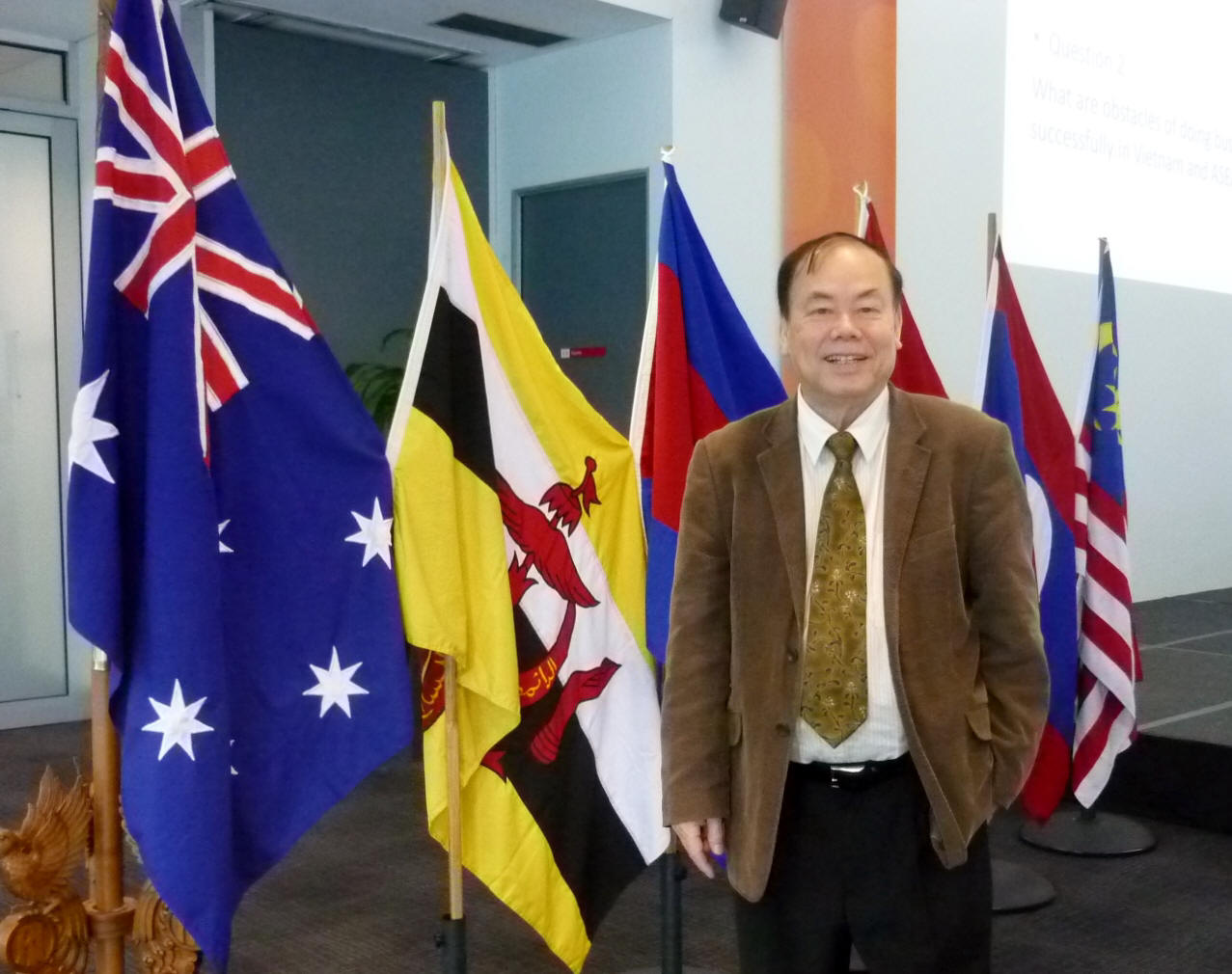
Tran Van Hoa attended the Third ASEAN-Australia Youth Summit at the William Angliss Institute in Melbourne on 11 October 2014 to deliver a keynote address Globalisation and Impact on Business Performance in Vietnam and the ASEAN Countries. The Summit was organised by the ASEAN Students Association in Australia which has been established by international students to enhance further the relationship between Australia and the ASEAN region with a special focus on the person-to-person level. This focus is an important supplement to the government-to-government and business-to-business levels which currently exist formally and informally. Invited speakers included senior government officials, eminent economists, social scientists and political economy experts. Consular representatives from major ASEAN countries in Melbourne and about 100 students participated in the conference.
In the photo below is Prof Tran Van Hoa among the ASEAN flags at the William Angliss Conference Hall.
THE ASIA-PACIFIC ECONOMIC ASSOCIATION: THE THIRD JOINT CONFERENCES
Korea Institute of International Economics and Industry (KIET), Seoul, 18-19 September 2014
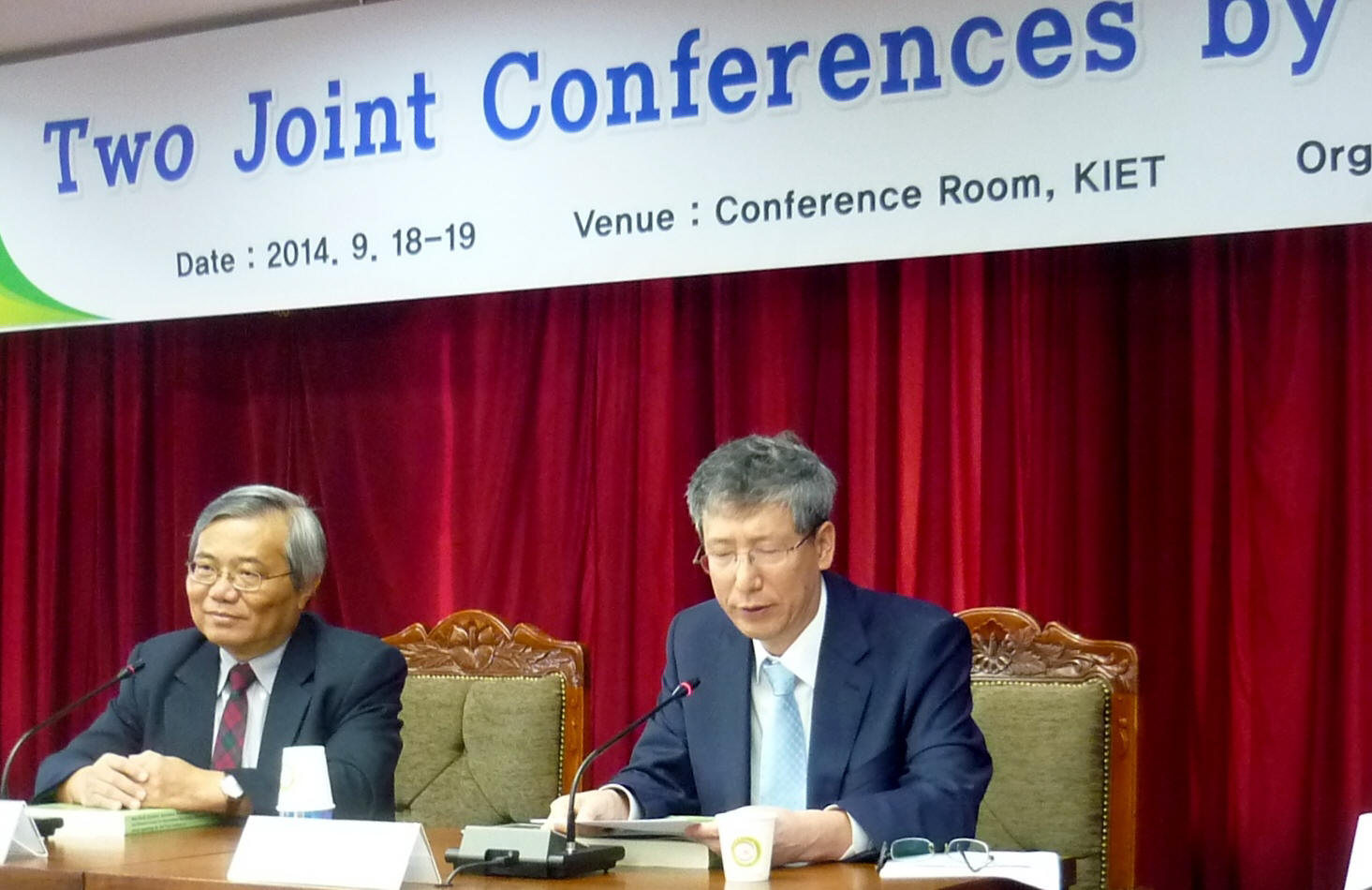
Tran Van Hoa attended the Third Twin (Joint) Conferences of the Asia-Pacific Economic Association (APEA), taking place on 18-19 September 2014 at the KIET Conference Hall in Seoul, to present the paper Trade, Growth and CO2 Emissions in China: Evidence from an Econometric Integration Model. The Conferences were organised by the APEA with sponsorship from KIET, a Korea think-tank, to look at major issues and current research on China and the world. About 30 senior academics from 12 countries in Asia and Europe and senior government and Asian Development Bank officials participated.
In the photo below was taken at the opening of the Conferences in the KIET Conference Hall. From left to right, Prof Karyiu Wong (APEA President) and Prof Kim Dosoon (KIET President).
WHAT CAUSES MIGRATION AMONG THE ASEAN COUNTRIES?
Chulalongkorn University, Bangkok, Thailand, 9-10 August 2014, and
Ministry of Labour, Invalids and Social Affairs (MOLISA), Hanoi, 11-12 August 2014, Vietnam
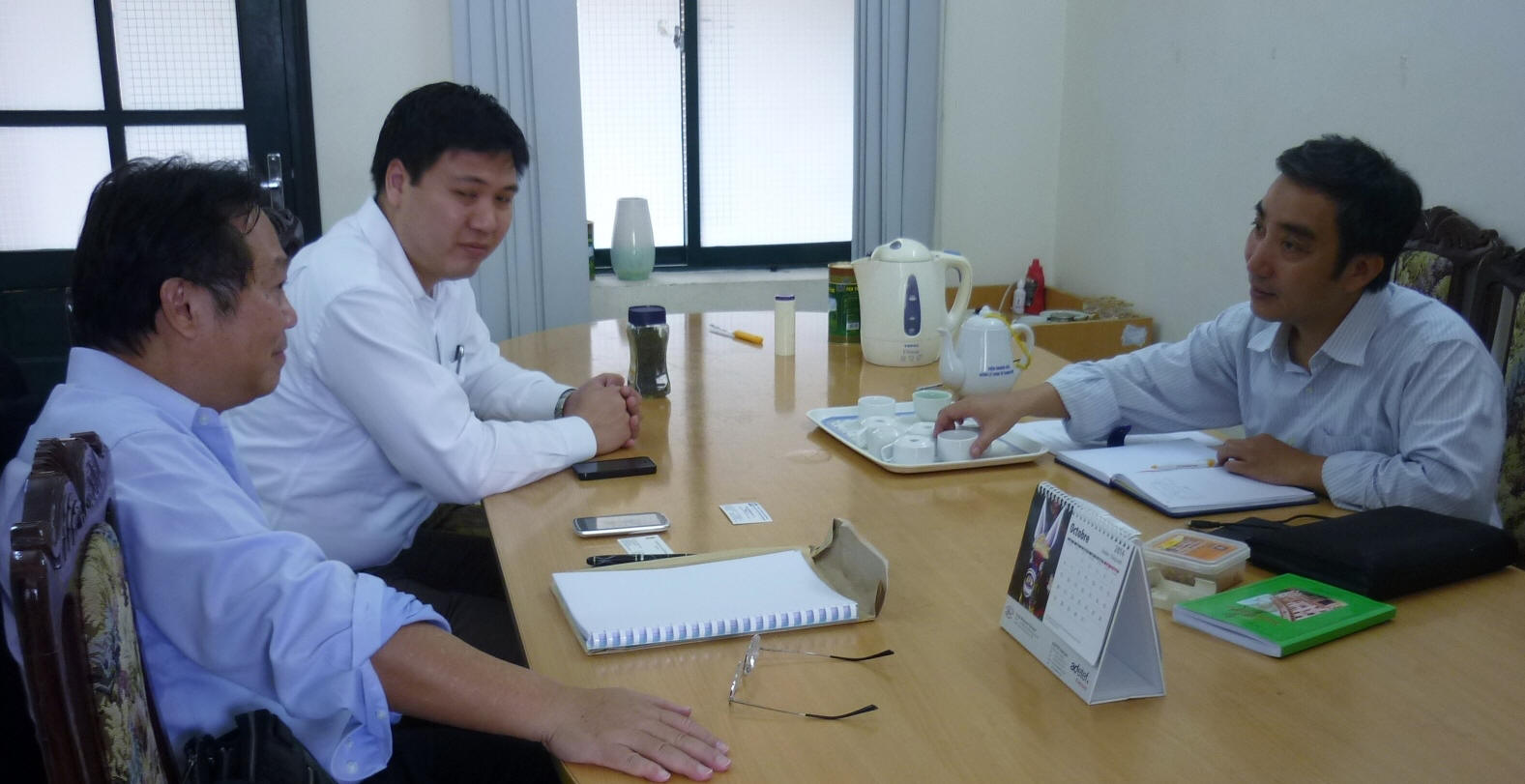
Recent migration among the ASEAN countries and with relevance to Australia in one case has caused enormous regional political, social and economic concerns and national policy changes at the highest level of government. While the causes of the surging inter-country migration are numerous from approved business people and students to informal asylum seekers and illegal economic migrants, a rigorous study of the fundamental causes of inter-ASEAN plus migration from an econometric modelling perspective with long time-series ad cross-section data (available from the Asian Development Bank) is currently lacking. Prof Tran Van Hoa participated in a new and important NESDB-funded project on Inter-ASEAN migration causality, led by Assosiate Professor Kitti Limskul, Director of Chulalongkorn Econometric Modelling Forecasting Program and former Vice-Minister of Education and Finance. The project was based at Chulalongkorn University in Bangkok, Thailand.
Associate partners of the project include senior academics and government officials from Thailand (Thammasat University), Vietnam [Central Institute for Economic Management (CIEM) and the Ministry of Labour, Invalids and Social Affairs, MOLISA] and Australia (Victoria University and the University of Wollongong. A report has been prepared by Prof Limskul and submitted to the project sponsor, Thailand’s National Economic and Social Development Board (NESDB). A discussion paper has also been prepared by Prof Tran Van Hoa for information and feedback.
The photo below records a meeting at the Central Institute for Economic Management (CIEM), Ministry of Planning and Investment between the NESDB Project Leader, Associate Prof Kitti Limskul, Dr Nattapong Nattapong, Thammasat University, Thailand , and Dr Nguyen Manh Hai, Director of Public Policy Department, CIEM, in Hanoi, on 12 August 2014.
VIETNAMESE DIASPORA AND AUSTRALIA-VIETNAM BUSINESS
2 January 2014, Tho Tho, Melbourne
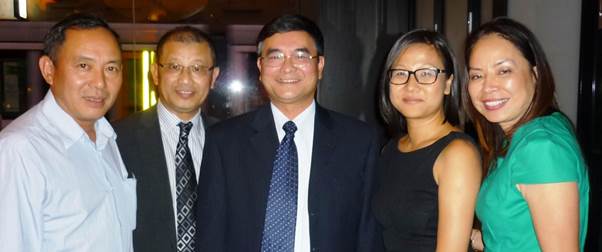
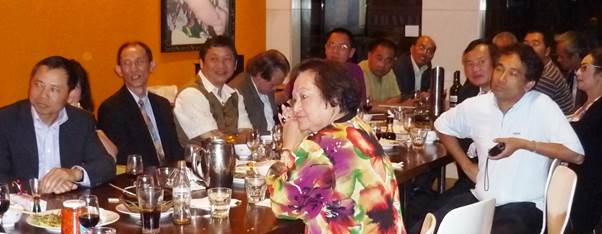
Prof Tran Van Hoa attended the farewell dinner at Tho Tho, Mebourne, on 2 January 2014, in honour of HE Hoang Vinh Thanh, Vietnamese Ambassador to Australia, at the conclusion of his three-year posting in Canberra. The dinner was organised by the Vietnamese Business Association of Australia (VBAA) which was set up in 2010 by Vietnamese businesses in Victoria to use their profile and successes to promote and foster business and relations between Australia and Vietnam for mutual benefits. VBAA follows the model of ethnic diaspora that uses its human resources and comparative advantages to help build strong and prosperous trade, business and cultural relations between the adopted country and its origin country. The model has been used successfully in other countries by major diasporas (e.g. Chinese, Indian, and Jewish) around the world. VBAA members include business people and academics. Ambassador Thanh has been actively associated with VBAA since its launch at the Marriott Hotel in Melbourne in 2010. The dinner was attended by the VBAA executive members and more than 30 Australian and Vietnamese business people and academics. At the dinner, Ambassador Thanh was made a permanent honorary executive member of VBAA to continue his contribution to the activities of the association.
In the photo below are some participants at the farewell dinner,
from left to right, Mr Nguyen Van Thuong (businessman), Mr Tran Ba
Phuc
In the photo below are some other participants at the farewell
dinner.
EDUCATION AND DEVELOPMENT IN VIETNAM
14-15 December 2013
Pullman Hotel, Hanoi, Vietnam
Prof Tran Van Hoa
attended, as an invited key speaker, the Inaugural Vietnam National Alumni Conference taking
place on 14-15 December 2013 at the Pullman Hotel in Hanoi. The conference was
organized to celebrate the 40th Anniversary of the Australia-Vietnam
Diplomatic Relations by the Australian Embassy and Australia Awards (Endeavour Scholarships and Fellowships), and
sponsored by a number of national and international institutions and
corporations. These included Vietnam Ministry of Education and Training (MOET)
and RMIT Vietnam. The purposes of the conference for nationally selected
higher-education participants were education and development and to foster
collaboration between high-profile academics, high-achievement alumni and
tertiary institutions in Australia and Vietnam and to explore future directions
for mutual benefits.
The focus themes of the
conference were wide-ranging covering agriculture, economic integration, education,
environment, health and human resources. Seven eminent
scholars representing six Australian universities with expertise and active
support in these fields (Melbourne, Sydney, Queensland, Queensland University
of Technology, Curtin and Victoria University via College of Business
Centre for Strategic Economic Studies) were invited to participate and to
lead discussions.
Prof Tran Van Hoa
delivered a keynote paper on the theme “Economic Integration” with analysis and discussion on the opportunities and challenges of the
currently politically high-focus
Trans-Pacific Partnership for Australia and Vietnam economic and trade
relations. He was subsequently
interviewed by three
national print media outlets and Vietnam National TV Channel 10 on these issues and their prospects.
The conference
was attended by more than 550 participants who were some of the 20,000
Vietnamese graduates from Australian universities and who are holding high
positions in Vietnam. Active debates followed all paper presentations. The
conference’s activities were nationally televised. Conference proceedings are
being prepared for publications for wide dissemination by the conference
organizers.
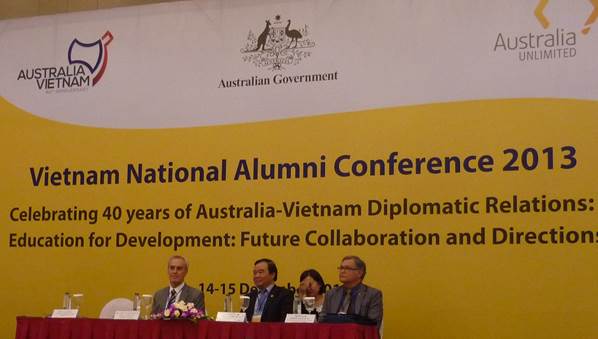
In the photo
below taken at the launch of the VNAC2013 conference are, from left to right, Mr Phillip Stonehouse (Charge d’Affairs, Australian
Embassy, Hanoi), HE Tran Quang Quy, (Vice-Minister, Vietnam Ministry of
Education and Training) and Prof Geoff Gallop AC (Dean, Graduate School of
Government, University of Sydney, and former Premier of Western Australia).
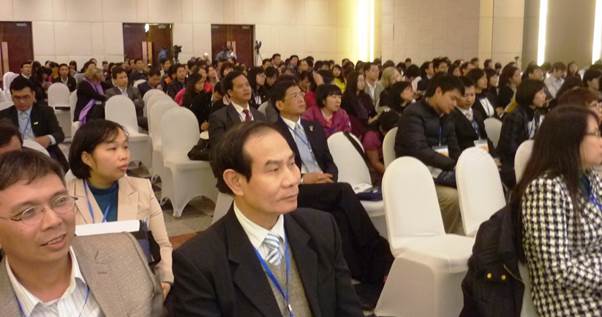
In the photo below are some of more than 550 participants at
the conference at Pullman Hotel, Hanoi.
Following the VNAC2013
conference, Tran Van Hoa also attended, as an invited key discussant, the International Conference on Private Sector Development
in Vietnam with Australian Experience at the nationally top-ranked Foreign Trade University in Hanoi.
OPPORTUNITIES
FOR REGIONAL ECONOMIES IN THE ASIAN CENTURY
7-8 August 2013, Melbourne Convention and
Exhibition Centre
Tran Van Hoa attended the conference Victoria
and the Asian Century on 8-9 August 2013 at the Melbourne Convention and
Exhibition Centre. The conference was organised by Victoria
University, Melbourne University Asialink Centre, Committee
for Melbourne, and the Age (Fairfax Media). Several distinguished Australian speakers from the
academia (eg, Prof Ed Byrne, Monash University Vice-Chancellor), state and
federal governments (the Hon Bill Shorten, MP), the media (eg, John Garnaut,
The Age) and the business community (eg, Mark Laurie, PricewaterhouseCoopers)
presented their studies and perceptions on the effects of major Asian economies
(chiefly China) on the regional (state) economies (mainly Victoria) and their
important policy implications. More than 250 people participated in the
conference.
Most of these presentations pointed out rightly the
opportunities for regional economies in the Asian century. It was noticed
however that not much was focused on why, given that deeper engagement between
these economies and Asia was important, there have been continuing delays, at
the government level, in the completion of important bilateral trade negotiations
in the region such as the Australia-China, Australia-Japan and Australia-Korea
free trade agreements. In addition, significant obstacles to this engagement
caused by regional and global financial crises and natural disasters, while
reflected in statistical data and policy forums, had also been neglected.
ASIA-PACIFIC ECONOMIC FORUM (APEF)
CONFERENCE XI:
International Banking, Foreign Trade and SME Financing in the
Asia-Pacific
Tehran 18-20 December 2012
The APEF XI conference took place in
Tehran on 18-20 December 2012. It was sponsored by a consortium of institutions
including the University of Isfahan, University of Tehran, the Monetary and
Banking Research Institute, Iran Research Organisation for Science and
Technology, and a number of corporations. More than 130 academics and experts
from six countries and postgraduate students participated in the conference.
Fourteen papers and two keynote addresses covering a wide range of topics from
banking, finance, access to SME finance in East Asia, the role of foreign
direct investment in enterprise performance, the state of trade multilaterism,
Asia-Pacific trade relations, economic development, youth unemployment in
Korea, and entrepreneurship and globalisation were presented and discussed.
Tran Van Hoa delivered a paper on analysing and modelling the causes of
high-growth high-profit enterprises in developing countries facing intense
globalisation with a focus on foreign-invested companies in Vietnam.
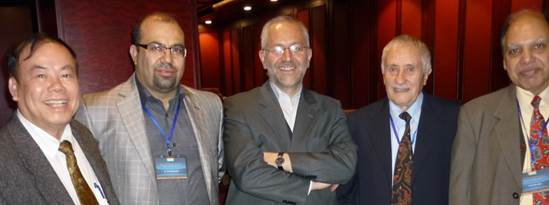
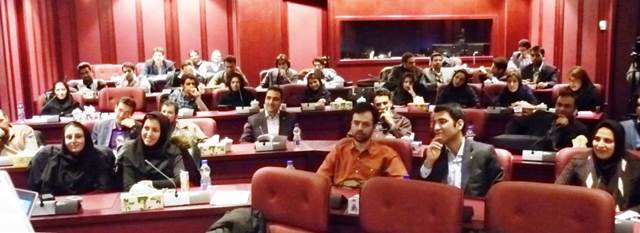
In the photo below are some key members of
the APEF XI Program Committee, from left to right, Prof Tran Van Hoa (Director,
Vietnam and East Asia Summit Research Program, Australia), Dr Ali Hasanzadeh,
(Deputy Director, MBRI), Dr Farhad Nili (Director, MBRI), Prof Peter Lloyd
(APEF President, Melbourne University), and Prof V N Atri (Kurukshetra
University, India).
In the photo below are some of the
participants at the Conference.
THE
FUTURE OF ECONOMICS
Victoria University, Australia, 12-15 July 2012
Tran Van Hoa participated as Co-chair of the Scientific Committee in the Australian Economic Society's 41st Annual Conference, hosted by the Centre for Strategic
Economic Studies, Victoria University, at its Flinders St Campus and the
Federal Squares on 12- 15 July 2012. Due to the declining trend in economics
enrolments at universities world-wide in spite of the still deep influence of
the field on government policy making and management, the theme of the
Conference was selected appropriately by the Conference Committee as The Future of Economics: Research, Relevance
and Policy. More than 250
papers were submitted to the Conference covering the five major fields of
General Theory, Climate Change and Resources, Microeconomic Policy,
Macroeconomic Policy, and Welfare Issues. After a rigorous peer-review process,
more than 180 papers were subsequently accepted for presentation and publication
as a conference proceedings volume (Editors: Prof Tran Van Hoa and Dr Jamie Doughney). Ten distinguished national and international speakers
including a Nobel Prize winner and more than 400 people participated in the conference.
IMPACT OF CHINA’S EXPORTS & GROWTH ON
AUSTRALIA, INDONESIA, THAILAND & VIETNAM
13 December 2011, Vietnam Institute for
Trade, Ministry of Industry and Trade, Hanoi
Tran Van Hoa attended the final workshop
for the Australian Research Council-funded Project
China’s Exports and Growth and Major East Asia Summit Economies: Exploring
Policy Responses for Policy Analysis that took place on 13 December 2011 at
the headquarter of Vietnam Institute for Trade in Hanoi. The workshop was
organised by the VIT (Partner Industry) with
the collaboration of the Centre for Strategic Economic Studies,
Victoria University (Administering Organisation), and
TradeData International P/L (Melbourne, Partner
Industry) to report on the final findings of the project’s
2009-2011 research. Representing China at the workshop to give the country’s
opening-up perspective and its implications for China-Vietnam economic and
trade policy was Prof Junfang Xi from the prestigious
Shanghai Jiaotong University. In his report, Prof Tran Van Hoa
presented a picture of historical economic and trade movements between China
and Australia, Indonesia, Thailand and Vietnam, and illustrated how these statistics
are related to the rise of China’s exports and growth and the resulting policy
concerns of these in major South East Asian and Oceania economies.
Policy recommendations were then derived from an econometric modelling study
using the endogenous growth and trade theory approach. Over 40 government
experts and university academics participated in the workshop.
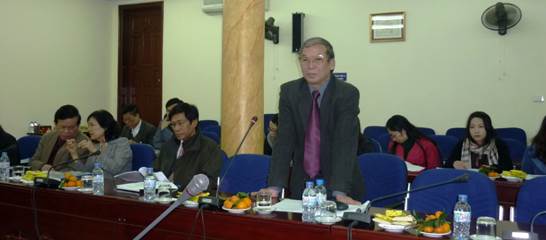
In the photo, VIT Director-General, Prof Dr Dinh Van Thanh (standing),
welcomed the participants and opened the workshop
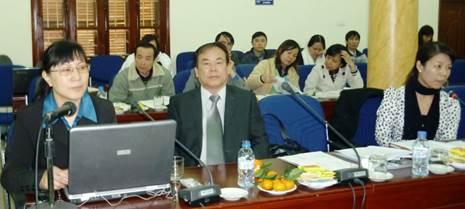
In the photo below are Prof Xi (1st, front row, Shanghai
Jiaotong University, China), Prof Tran Van Hoa (2nd, front row), and
some participants
8TH CONFERENCE ON SME AND THE
GLOBAL ECONOMY
9-11 November 2011, Khon Kaen University,
Nong Khai Campus, Thailand
Tran Van Hoa attended the 8th
Conference on the SMEs in a Global Economy: Rising to the Global Challenges – Entrepreneurship
and SME Development in Asia to deliver his keynote address Causality
and Growth Enterprises: Entrepreneurship and Globalisation.
The Conference was organised by Khon Kaen University, Nong Khai Campus, and
took place on 9-11 November 2011.
The Conference was initiated in 2002 by the University of Wollongong and was
followed by subsequent series of such conferences in Malaysia, Japan, China and
Thailand, besides Australia. It has attracted co-organisers from the University
of Senshu (Japan), Beijing Information, Science and Technology University
(China), and Universiti Teknologi, MARA (Malaysia). The
aim of the Conference is to bring together professionals,
workers in universities, entrepreneurs, practitioners and scholars from all
around the world to provide a platform to discuss and analyse the prospects,
challenges and opportunities faced by the regional SMEs in the wake of
globalisation.
More than 60
experts and postgraduate students from eleven countries (Australia, China, Germany, India, Iran, Laos,
Malaysia, Saudi Arabia, Thailand, United Kingdom and Vietnam)
participated in the 8th Conference. The topics presented and hotly
discussed included SME financing, SME development in Asia, the
causes of growth enterprises in Vietnam, the global financial crisis and SMEs,
critical issues facing SMEs and practical policy measures,
among others.
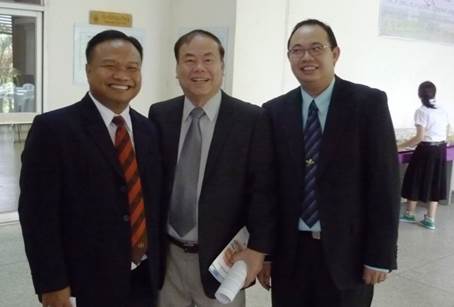
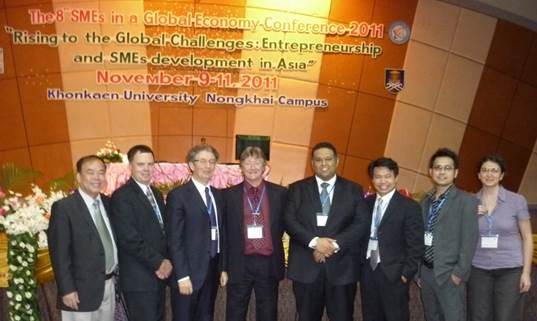
In the photo below taken before
the Conference’s Opening Ceremony in the Khon Kaen University Nong Khai Campus
conference hall are, from left to right, Dr Surapon Saensouk (Director, Nong Khai
Campus, Khon Kaen University), Prof Tran Van Hoa, and Dr Thanet Wattanakul (Head, Department of
Economics, Nong Khai Campus, Khon Kaen University, and Conference Organiser).
In the photo below are some
participants at the Conference: (from left to right) Prof Tran Van Hoa (1st), Dr Michael Schaper (2nd, Deputy Chair, Australian
Competition and Consumer Commission), Prof Robert Blackburn (3rd, Kingston University, UK,
and Editor-in-Chief, International Small Business Journal), Assoc Prof Charles Harvie (4th, Conference Advisory Board
Member and Head, School of Economics,
University of Wollongong, Australia), and Assoc Prof Phouphet Kyophilavong (6th, National University of
Laos).
ASIA-PACIFIC ECONOMIC FORUM: INTERNATIONAL
TRADE, ENTREPRENEURSHIP AND CRISES
18-20 October 2011, Faculty of Entrepreneurship,
University of Tehran
Tran Van Hoa attended as a Program
Committee member and presented a paper on Trade and Entrepreneurship in Growth
Enterprises at the 10th conference of the
Asia-Pacific Economic Forum (APEF) that took place on 18-20 October 2011
at the University of Tehran, Iran. The theme of the conference was International Trade and Entrepreneurship: Issues for
Post-crisis Sustainable Development in Asia. The conference was organised jointly
by Dr Mostafa Razavi, Faculty of Entrepreneurship, University of
Tehran, and Prof Komail Tayebi, University of Isfahan,
in collaboration and with the sponsorship from the Center for International Scientific Studies and
Collaboration, Science and Technology Park, Ports and Marine Administration of Guilan
Province, and Isfahan Chamber of Commerce and Industries & Mines.
The conference was significant as it was
the APEF’s 10th anniversary meeting and the original APEF focus on
international trade, investment, economic integration and growth has been extended
to entrepreneurship and management and their inter-linkage in a global context.
More than 70 experts and postgraduate students
from international organisations (Asian Development Bank and Bank of China)
and ten countries (Australia, China, France, India, Indonesia,
Iran, Korea, New Zealand, Philippines and the US)
participated and presented their research papers on various aspects of trade,
economic development, crises and entrepreneurship. A session of PhD thesis proposals
was also organised for presentation and feedback as part of the conference’s
training focus.
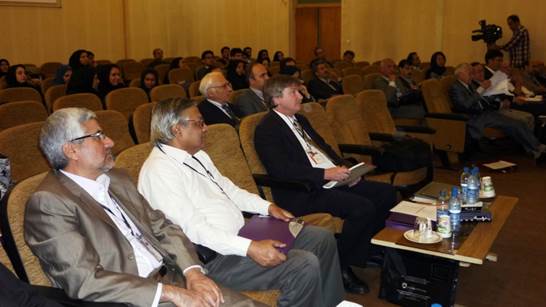
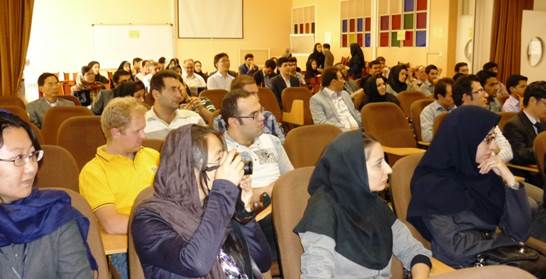
In the photos below
are some participants at the Opening Ceremony in the UT
Scientific Technology Park Hall (photo 1) and in a
conference session in the Faculty of Entrepreneurship Conference Hall (photo 2).
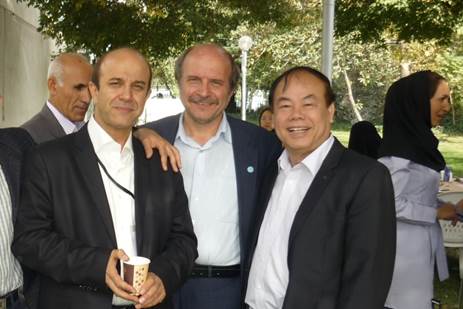
Below is a photo of
the conference session break taken in the Faculty of Entrepreneurship garden. From left to right, Prof Komail Tayebi (Faculty
of Administrative Sciences and Economics, University of Isfahan), Dr Mostafa Razavi (Dean, Faculty of Entrepreneurship,
University of Tehran), and Prof Tran Van Hoa.
AFTA TAX TREATY & AUSTRALIA-VIETNAM
COMPREHENSIVE PARTNERSHIP
Hanoi, 13 April
2011, Ministry of Industry & Trade
Tran Van Hoa
attended a workshop on 13 April 2011 at the Institute for Trade (VIT) to
discuss the progress reports of a 2011-2012 research project Global Crises, Economic Integration and
Australia-Vietnam Comprehensive Partnership funded by the Academy of the Social Sciences in Australia
(ASSA), International Science Linkage scheme. The project
is a joint research between the Centre for Strategic Economic Studies (CSES) at
Victoria University and the VIT to support Australia’s innovation competitiveness internationalization
and research path of new doctoral graduates in the region. Participating at the workshop was Prof E Phijaisanit, Faculty of Economics, Thammasat
University, who presented a paper on the
implications of AFTA tax treaties on government tax revenue and on appropriate
policy options. Over 30
government officials from the MOIT and the Ministry of Finance attended the
workshop.
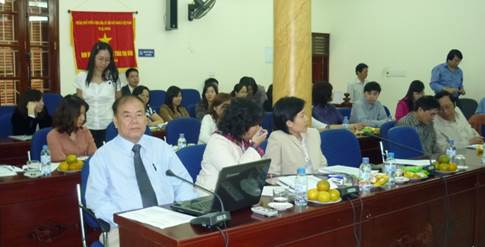
In the photo below are some
participants (front row, Tran Van Hoa, 1st, and Prof Phijjaisanit, 3rd)
at the workshop.
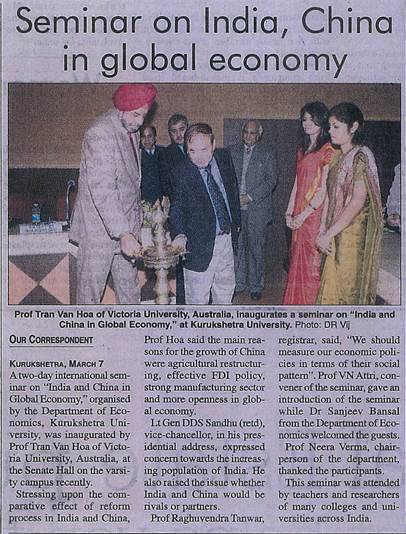
INDIA & CHINA IN GLOBAL ECONOMY
Kurukshetra University, India, 3-14 March
2011
India and China have recently emerged as
two major political and economic powers in Asia with growing global influence.
Studies and policy analysis of these two countries and their strategic
comparison have become intensive worldwide and specially in the East Asia
Summit region. Early in March, Tran Van Hoa visited a number of universities in
India for collaborative research, research development and to participate in a
number of conferences on various themes of current national and international
significance. These include the focus on India and China and also on India and
the ASEAN and their role and importance in global economy.
During 3-14 March,
he visited the Department of Economics at Kurukshetra University in Haryana,
India, as a Visiting Professor, to give special lectures to postgraduates and
to contribute to the development of the Research Institute for
India-China Studies being prepared by Prof V N Atri,
co-ordinator of the Indian Government Special Assistance Program.
While there, he was also a Guest of Honour and gave an Inaugural
Address on “India and China: Regional Rivals or
Partners?” at the international conference on “India
and China in Global Economy”, organised by the Deparment and taking
place on 4-5 March. Over 250 experts and students
participated in the conference, and the proceedings and subsequent interviews
were widely reported in the media.
During
March. Tran Van Hoa also gave a Keynote Address
and was a Policy Panelist at the international conference on “Changing
Structure of International Trade and Investment” taking place on 2-3 March at Jamia Millia Ismalia
University in Delhi. He was also a Keynote Speaker at the
national conference “Development and Inclusive Growth”
organised by Kurukshetra University College on 10-11 March,
and a Guest of Honour and Keynote Speaker at the national conference on “The
Global Recession and Growth” on 13 March and organised by the University
College at Meerut University in Meerut, UP.
Below is a piece in the Tribunes on the International Conference at
Kurukshetra University 4-5 March 2011.
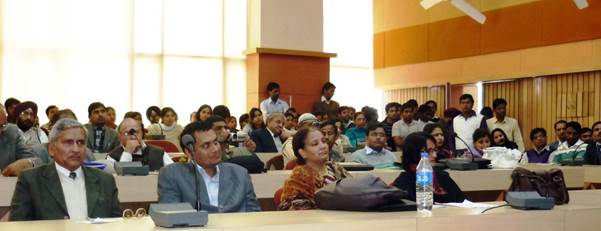
The photo below taken at the Inaugural
Session of the conference at Kurukshetra University Senate Hall
shows some of the participants.
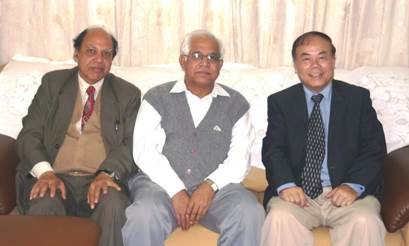
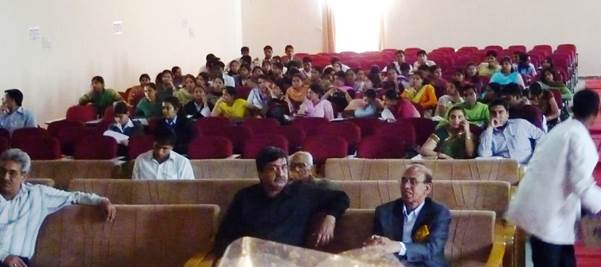
The photos below show a meeting with
Meerut University Vice-Chancellor, Prof K N Tangeni (centre) with Prof V N Atri
(1st), and some of the participants at the
Meerut University College conference.
PRACTICAL ISSUES WITH CLIMATE CHANGE POLICY IN
DEVELOPING COUNTRIES
Melbourne, 24 February 2011
The Centre for
Strategic Economic Studies (CSES) and Tran Van Hoa have been involved in a
number of years in extensive research and policy analysis on energy and climate
change issues. Collaboration by a number of countries in Asia with the CSES on
these issues is currently active. On 24 February, Tran Van Hoa and CSES staff hosted a 10-member
delegation of Vietnam Ministry of Natural Resources and Environment (MONRE) to discuss various practical issues on
climate change, mitigation and compensation in Vietnam and the appropriate
lessons from Australia. A lively exchange of
information, policy, regional responses, and the difficulties involved in
practical implementation of climate change policy in Vietnam and Australia was
generated and well discussed and received. A follow-up of the issues discussed
and future collaborative arrangements have also been agreed to.
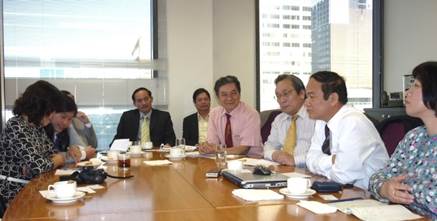
The photo below taken
at the Meeting Room at CSES shows some members of the MONRE delegation during
discussion.
ASIA-PACIFIC ECONOMIC FORUM (APEF) IX
INTERNATIONAL CONFERENCE
Renmin University of China, Beijing, 28-29
October 2010
Tran Van Hoa participated in the APEF
IX International Conference taking place at
Renmin University of China (RUC) on 28-29 October 2010.
The conference was in a series of annual APEF conferences on contemporary
international economic, trade and investment issues, founded by a select group
of academic and government experts at the Kangwon National University in
Chunchoen, Korea, in 2001. The APEF IX conference had the theme The
Global Financial Crisis and East Asia Economic Development,
and was organised by Prof Zhao Yanyun, Dean of the School of Statistics at RUC.
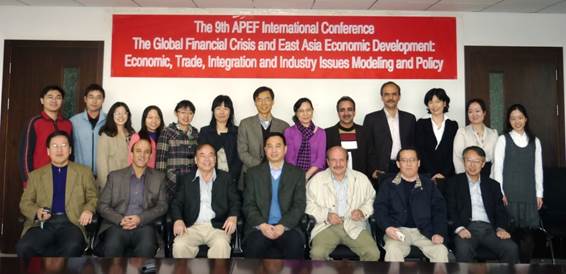
In the photo below
taken at the end of the conference in the Ming De Building at RUC are, from left to right, sitting, Prof
John Junggun Oh (1st,
Korea University and East Asia Monetary Institute), Prof
Komail Tayebi (2nd,
University of Isfahan, Iran), Prof Tran Van Hoa (3rd), Prof Zhao Yanyun (4th), Prof Mostafa Razavi ((5th, Dean, Faculty of Entrepreneurship,
University of Tehran, Iran), Prof Chung-mo Koo (6th, Kangwon National University, Korea),
Prof Eiji Ogawa (7th ,
Dean, Faculty of Economics, Hitotsubashi University, Japan) and some
of the participants (standing).
KOREA
ENGAGEMENT WITH THE ASEAN
KIEP, Seoul, Korea 7 October 2010
Tran Van Hoa was invited to participate
in an international conference on The Changing Landscape of the ASEAN and
Korea-ASEAN Co-operation to present a paper on
Korea-ASEAN Co-operation: Challenges and Opportunities. The
conference was organised by The Korea Institute for International
Economic Policy (KIEP), a research department of Korea’s Prime
Minister, with the sponsorship from the National Research Council for Economics,
Humanities and Social Sciences (NRCS). Its objectives were to get together
prominent experts from Korea and major ASEAN countries including Australia to
review the current state of development in the ASEAN, their co-operation with
Korea, and to offer an effective way forward. Over 30 experts and students
participated.
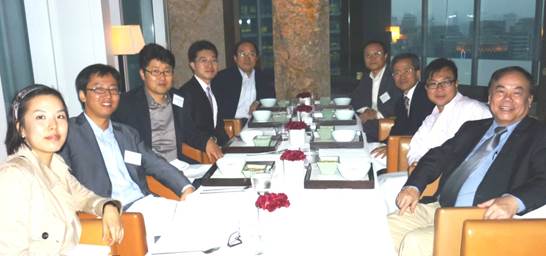
In the photo below
taken at the Park Hyatt Hotel in Seoul at the end of the conference are Prof
Tran Van Hoa (extreme right) some of the key participants.
CHINA
AND THE WORLD ECONOMY
Peking University, Beijing, 16-17 Sept 2010
Tran Van Hoa attended the China
and the World Economy conference at Peking University to
deliver his paper (co-authored Prof Zong Ming Tang, Shanghai Jiaotong
University) on China’s exports and their impact on regional
economies. The conference was jointly organised by Peking University and
Oxford University to present new research on China and
its major contemporary micro, macro and finance issues. Over 70 academics,
government officials and other experts from China and several other countries
in Australasia and the European Union participated and discussed their
findings. A total of 40 papers were presented at symposia and scientific
sessions.
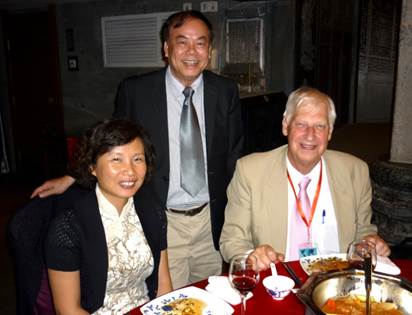
In the photo below taken at the conference gathering
are, from left to right, Dr Xiaolan Fu (Oxford
University and Conference Co-organiser), Prof Tran Van Hoa, and Prof John Knight (Oxford
University).
IMPACT OF CHINA’S GROWTH AND EXPORTS ON VIETNAM INDUSTRIES &
THAILAND ECONOMY
25 August 2010, Ministry of Industry and
Trade, Hanoi
The growing economy of China and its
ever rising exports to the world have generated serious impact concerns by
leaders in world economy and especially in the major economies (such as
Australia, Indonesia, Thailand and Vietnam) in the East Asia Summit region.
Prof Tran Van Hoa (Chief Investigator) and Vietnam Institute for Trade (VIT, Partner
Investigator) organised their six-monthly research progress workshop on 25 Aug
2010 at the VIT Headquarters in Hanoi to report and discuss their 2009-2011 ARC
Linkage-funded research work on these impact issues but
especially with respect to Vietnam’s industrial sectors and Thailand’s trade and economy.
The workshop was attended by more
than 40 experts from the MOIT and notably by Prof Dr
Kitti Limskul of Chulalongkorn University, Thailand, where he
is Director of the Econometric Forecasting Modelling Research Program and the
highly-respected Masters of Arts in Labour Economics and Human Resources
(MALHR). Dr Limskul was also Thailand’s Vice-Minister of Education and
then Finance in the Government of Thailand and his insightful inputs for a major
economy in the East Asia Summit group were particularly relevant and
appreciated.
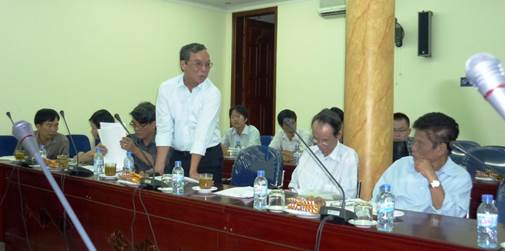
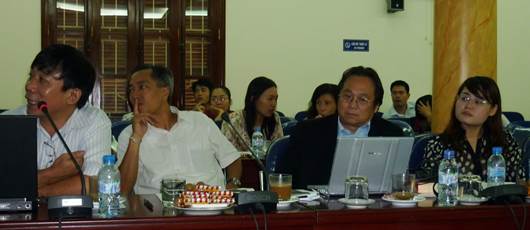
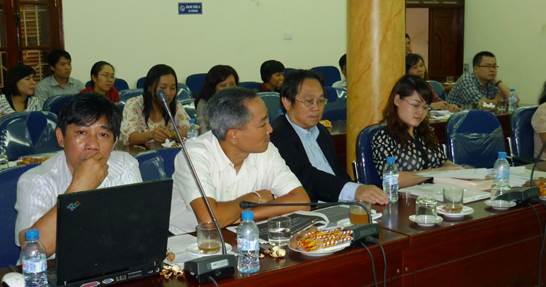
In the photos
below taken at the workshop were the Opening Address by VIT
Director-General, Assoc Prof Dr Dinh Van Thanh (standing, photo
1), Prof Dr Kitti Limskul (3rd front row, photo 2),
and some other participants (photo 3).
AUSTRALIA-VIETNAM BUSINESS &
TRADE PROMOTION
3 July 2010, Marriott Hotel, Melbourne
Tran
Van Hoa attended as an Executive Member the Inaugural Meeting of the Vietnamese Business Association of Australia
(VBAA) at the Marriott Hotel in Melbourne on 3 July 2010. Other VIP guests include H.E. Hoang Vinh Thanh, Vietnam Ambassador to
Australia, senior staff from Vietnam Consulate-General in Sydney, Vietnam Trade
Office (VTO), Vietnam Airlines, and major Vietnamese business executives in
Melbourne. More than 100 people attended the
Meeting. Currently, VBAA has 200 business members and 50 associate members.
The
VBAA has been established to meet the needs of Vietnamese-Australian and
Vietnamese business people to promote and strengthen bilateral SME businesses
and trade between Australia and Vietnam for mutual benefits. Australia-Vietnam relations have grown
in the past three decades and their two-way trade has increased rapidly in
recent years, reaching nearly $A7 billions in 2009 (according to the Australian
Department of Foreign Affairs and Trade). This imbalance bilateral trade has however been in favour of
Vietnam. A purpose of
VBAA is to rectify to some extent this deficit trade for Australia. In its
operation, VBAA will co-operate closely with the VTO in Sydney which is an
official office representing Vietnam Ministry of Industry and Trade (MOIT)
trade promotion in Australia. The VBAA, together with the Australia-Vietnam
Chamber of Commerce (based in New South Wales), are two important business
organisations in Australia in the area of Australia-Vietnam trade promotion.
In
the photos below taken at the
Marriott Hotel are H.E. Hoang Dinh Thanh and Prof Tran Van Hoa (left to right,
photo 1), VBAA President (Mr
Tran Ba Phuc, photo 2),
VBAA Vice-President (Mr
Phan Van Danh, photo 3),
some VBAA Executive
Members (photo 4),
and some other participants at the Inauguration Meeting (photo 5).
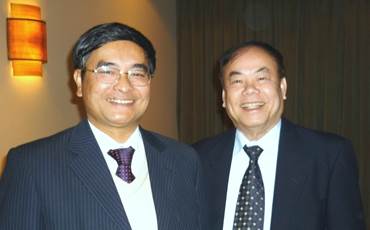
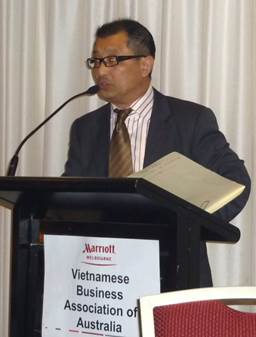
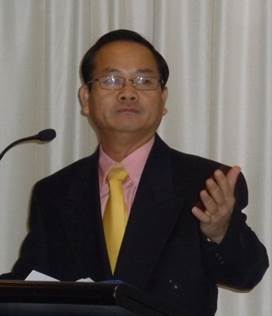
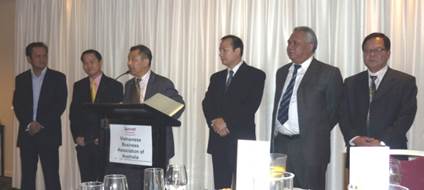
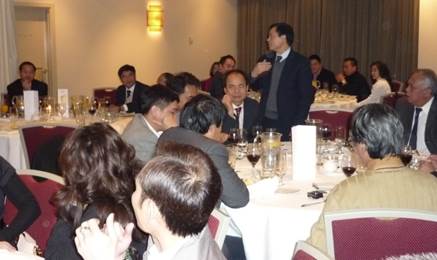
GREENHOUSE GAS MANAGEMENT IN THAILAND
Melbourne, 3-5 May 2010
Tran Van Hoa welcomed Dr Kitti
Limskul, Member of the Board of Directors, Thailand Greenhouse Gas Management
Organisation (Public Organisation), who led a delegation of Thailand’s senior
climate change experts to Australia to inspect CCS facilities and to exchange
ideas on aspects of climate change adaptation and mitigation programs and
possible collaboration in the two countries. Dr Limskul is a Professor at
Thailand’s prestigious Chulalongkorn University, and, for the past 25 years,
Director of its Econometric Modelling and Forecasting (EMF) Program. During his
recent secondment from Chulalongkorn University, he was also Thailand’s
Vice-Minister of Education and Finance. While in Melbourne, Dr Limskul also
discussed future research collaboration with Prof Tran Van Hoa and RMIT
University staff on climate change issues and human resource management.
The photo below records Dr Limskul’s visit to Melbourne during
the break of the CCR workshop on CCS at the Novotel.
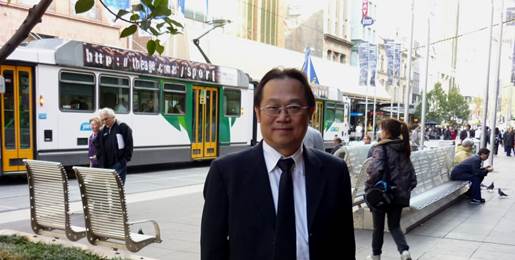
ENGAGING WITH VIETNAM
Monash University, Melbourne 23-24 February 2010
Tran Van Hoa attended the conference Engaging
with Vietnam: An Interdisciplinary Dialogue to deliver his keynote address
Australia-Vietnam Economic, Trade and External Relations and their Regional
Prospects. The conference was organised by Dr Phan Le Ha of the
Faculty of Education and sponsored by the Deputy Vice-Chancellor, Prof
Stephanie Fahey, both of Monash University. Distinguished participants included
Madam Ton Nu Thi Ninh, former Vietnam Ambassador to Belgium and Luxembourg,
Head of Mission to the European Union in Brussels, and Vice-Chair, Foreign
Affairs Committee, the 11th National Assembly of Vietnam (2002-07);
senior academics from Australia’s and Vietnam’s universities; and executives
from national organisations such as the ABC. At the conference, a strong presence
of Vietnamese scholars and students, and Vietnam experts was noted, and a wide
range of topics and research projects on education, training, management,
economics, trade, and external relations between Australia and Vietnam was presented
and discussed.
In the photo below taken at Monash
University Conference Centre, 30 Collins St, Melbourne, were (from left to
right), Associate Professor Dr Pham Quang Minh, Dean,
Faculty of International Studies, Vietnam National University; Dr Phan Le Ha,
Conference Organiser, Faculty of Education, Monash University; Prof
Stephanie Fahey, Deputy Vice-Chancellor (International), Monash University;
and Prof Tran Van Hoa.
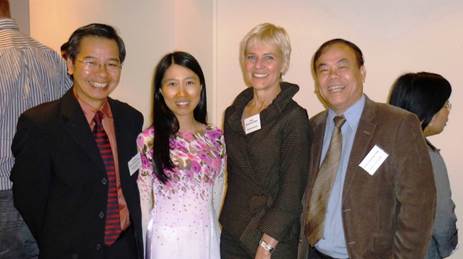
LEADER IN ENGAGEMENT WITH ASIA
University of Melbourne, 18 February 2010
Tran Van Hoa was invited to attend, on 18 February 2010, the 20th
Anniversary Cocktail Reception of the University of Melbourne’s Asialink network.
The event was to mark a landmark in the network’s history and in which Prof
Ross Garnaut (Australia’s foremost expert on Australia-Asia engagement and
climate change issues) was invited to deliver his keynote address Relations with China as a Global Power. More than 70 senior business
executives, consular representatives, and former and current senior academics
from the University of Melbourne (including the Chancellor, two
Vice-Chancellors, several Deans), and other institutions participated in the
event.
In the photos below taken at the event’s location,
Freehills, Melbourne, are (photo 1, from left to right) Prof Ross Garnaut (Vice-Chancellor Fellow, University of
Melbourne), Jenny McGregor (Chief Executive Officer of Asialink) and Tran Van
Hoa; and (photo 2), Jenny Mcgregor and Asialink Chaiman, Sid Myer, on the podium, and some of the participants.
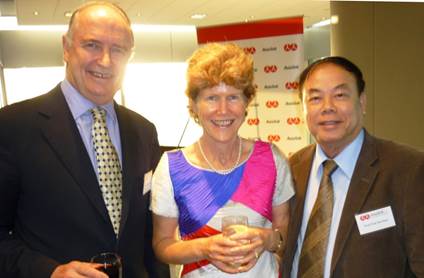
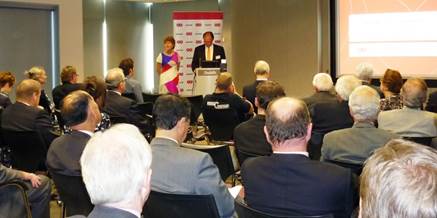
DOES CHINA GAIN FROM IMPORTS FROM
AUSTRALIA AND VIETNAM?
Vietnam Institute for Trade, 29 Jan 2010, Hanoi
While recent strong growth of China’s exports has
generated geo-political concern to policy-makers world-wide, the country’s
trading partners also hope to export more to China. But do
exports by China’s major regional trade partners in the East Asia Summit region
such as Australia and Vietnam to the country contribute to its economic growth? These are
some major issues for research, dissemination and debate in a new major
Australian Research Council (ARC)-funded 2009-2011 project which has the
international collaboration of Vietnam Institute for Trade (VIT), Ministry of
Industry and Trade, Centre for Strategic Economic Studies (CSES), Victoria
University (Australia), and Tradedata P/L (Melbourne).
At the VIT workshop on 29 Jan 2010 in Hanoi to report on
the ARC research progress for the second half of 2009, Tran Van Hoa presented
some of his research findings to show that, in spite of expectations otherwise,
China’s
imports from Australia and Vietnam in the past two decades have had only a very
negligible effect on its economic performance. One explanation for this finding is
attributed to the small share of imports from these two countries to China in a
global context. The perspective from Australia, Indonesia, Thailand and Vietnam
on the effect of China’s exports to them will be a focus for research during
2010.
In the photos
below taken at the ARC-based workshop organised by VIT in Hanoi on 29 Jan 2010
are some participants
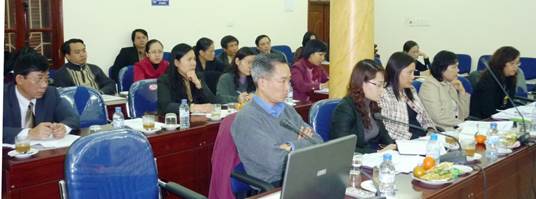
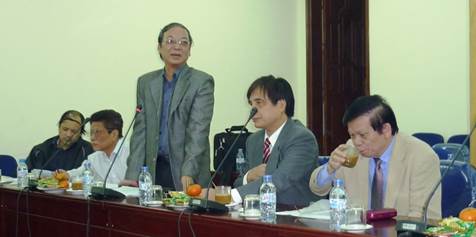
and VIT senior
staff and guest speaker: (from left to right) Dr Nguyen Van Sinh (Senior Expert, VIT),
Dr Nguyen Van Thang (Senior Expert, VIT), Prof Dr Dinh Van Thanh (Director-General of VIT), Prof Dr Tran Thien
Khiem (Director, Vietnam Institute of Economics), and Prof Dr Nguyen Van Lich
(former Director-General of VIT).
ECONOMIC INTEGRATION IN ASIA:
THE GLOBAL FINANCIAL CRISIS AND BEYOND
Keio University, Tokyo, 28-29 November 2009
The global financial crisis (GFC) has, through recent increasing
economic integration and globalisation, started in the US but created
world-wide economic and financial turmoil for developed and especially
developing countries world-wide but especially in Asia, where many economies
have depended on exports and trade in capital and services for their high
development and growth. These
GFC and post-GFC issues and policy responses and choices for East and West Asia
were
explored and discussed by an
international panel of renowned economics and trade experts at the 8th
Asia-Pacific Economic Forum (APEF) conference. The conference was organised by Prof Fukunari Kimura, Faculty of Economics, Keio University and Chief Economist, East Asia Summit
Research Institute (ERIA), and with the financial support from Keio University
and the Keio-Kyoto Global COE Program.
APEF is a new international economics society, founded at the
National Kangwon University in Chunchoen, South Korea, in 2001. Its aim is to
carry out and disseminate original and high-quality research on contemporary and
leading-edge issues in international trade, development and growth, economic
integration, economic and trade policy, external relations and political
economy in the Asia-Pacific region. Its membership includes academic and government economic experts from
major countries in North America, the European Union, West Asia or the Middle
East, Asia (East Asia, South East Asia, the Subcontinent) and Oceania. Since its founding, the APEF has
its annual conferences in rotation in its members’ countries. Several proceedings
of the previous APEF conferences have also been published in book form from
international publishers (eg, Edward Elgar, UK).
In the photo below taken at the G-SEC Conference Room, East Building,
Mita campus, Keio University, are some participants at a conference session
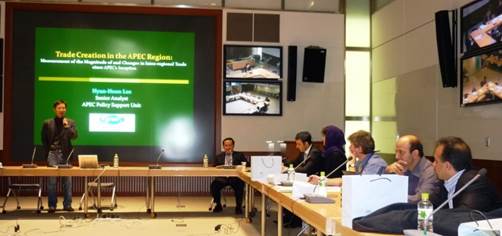
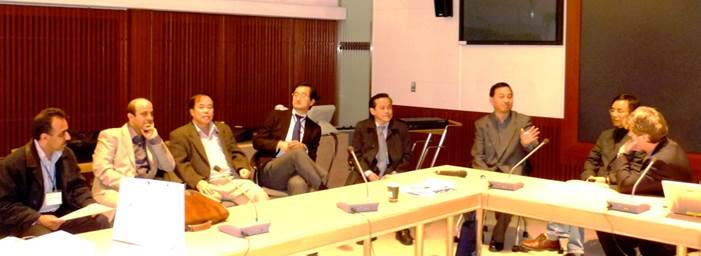
In the photo below recording the APEF 2009
Executive Meeting are (from left to right), Prof Mosayeb Pahlavani (Dean, Faculty of Economics, University of
Sistan and Baluchestan, Iran), Prof
Seyed Komail Tayebi (Head, Department of Economics, University of Isfahan,
Iran, and Editor, Journal of International Economics - Iran), Prof Tran Van Hoa, Prof Fukunari Kimura,
Prof Chung-Mo Koo (Kangwon National University, Korea), Prof Zhao Yanyun (Dean, School
of Statistics, Renmin University of China, Beijing), Prof Huyn-Hoon Lee (Senior
Economist, APEC Research Unit, APEC Secretariate, Singapore, and Professor and
former Dean, Kangwon National University, Korea), and Prof Charles Harvie (Director,
Small Business and Regional Research Centre, University of Wollongong,
Australia).
INTERNATIONAL DEVELOPMENT RESEARCH CENTRE (IDRC) AND SOUTH EAST
ASIA’S ECONOMIES
AND ENVIRONMENT
17-18 November 2009, Hanoi, Vietnam
Prof Tran Van Hoa was
invited to attend and deliver a Plenary Session Speech “CO2 Emissions-Economic Growth Trade-off
in Vietnam and China for UNFCCC/IPCC Climate Change Policy Analysis” at the
32nd Biannual Workshop of the International Development Research
Centre (IDRC), Economy and Environment Program for South East Asia (EEPSEA), in
Hanoi on 17-18 November 2009.
The Workshop, taking place at the Intercontinental Hotel,
West Lake, was sponsored and organised by the EEPSEA Directorate (based in
Singapore). It is an important event in the EEPSEA yearly activity calendar
where the EEPSEA Directorate and senior economists, consultants, resource
staff, EEPSEA-funded researchers, and other distinguished experts formally meet
to discuss final and interim reports, and new research proposals presented by
academics, government officials and NGO and other researchers in major countries
in the South East Asia region including China and Mongolia (SEA Plus). At the Workshop,
new research themes and direction, and new advances in supporting research and
training technology were also discussed by international high-reputation keynote
speakers. More than 70
experts from the SEA Plus region, and Australia, Canada and the US,
participated in the Workshop.
Founded in May 1993 by David Glover from Canada and currently
managed by a Director (Dr Herminia Francisco), the EEPSEA has received
funding support from a Sponsors Group (currently IDRC, CIDA and Sida) to assist
in research and training capacity enhancement activity on environmental and
resource economics with strong practical policy relevance for young academics,
researchers and upcoming leaders in the SEA Plus region. The EEPSEA has also
earned an enviable reputation in this region for its contribution to research
and training in these fields.
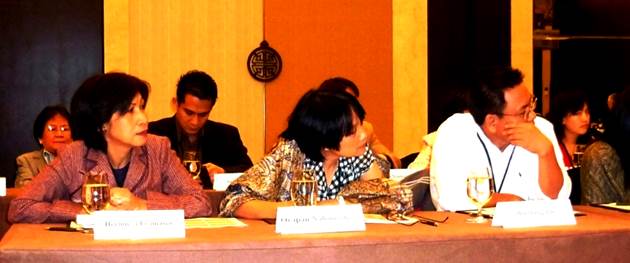
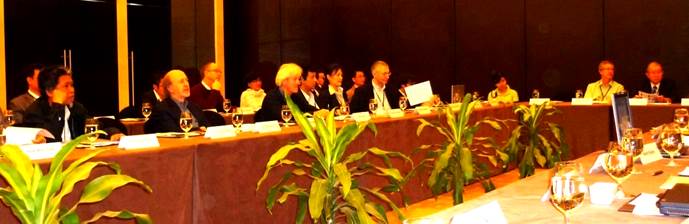
In the photos below taken at the Workshop,
Intercontinental Hotel Ballrooms 2-3, are (Photo 1), from left to right, front
row, Dr Herminia Francisco (EEPSEA Director, Philippines), Dr Orapan
Nabangchang (EEPSEA Senior Economist, Thailand), and Dr Bui Dung The (EEPSEA
Senior Economist, Vietnam), and (Photo 2) some key resource staff and Plenary Session
speakers from Canada, the US, and Australia.
In the photo below taken at the Farewell Dinner at the Sheraton Hotel
in West Lake are, from left to right, Prof Tran Van Hoa, Dr Herminia Francisco, and Associate Professor Dr Nguyen The Chinh (Deputy Director-General, Vietnam
Institute for Strategy and Policy on Natural Resources and Environment
(ISPONRE), Vietnam Ministry of Natural Resources and Environment) .
CLIMATE CHANGE, CO2 EMISSIONS AND ECONOMIC DEVELOPMENT IN VIETNAM
Tran Van Hoa attended the Economic
Analysis of Climate Change Workshop on 26 Sept 2009 in
In his paper, Prof
Tran Van Hoa introduced a new econometric model of CO2 emissions-growth of
In the photos below taken at the
workshop venue, The Flower Garden Hotel in
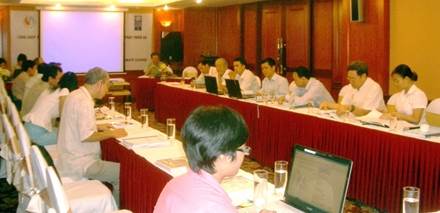
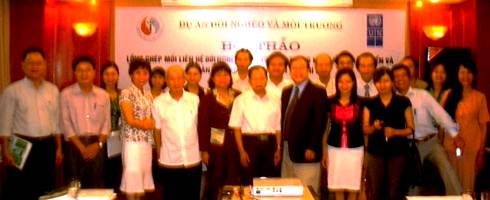
In the photo below taken at the ISPONRE
Headquarter in Hanoi where future climate change policy and strategy
research development and collaboration between ISPONRE and CSES (Victoria University)
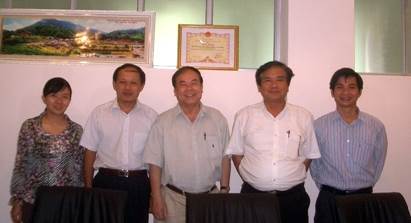
were discussed are, from left to right, Dr Nguyen Van Tai, 2nd place
(Director-General, ISPONRE), Prof Tran Van Hoa, 3rd place, and
Associate Prof Dr Nguyen The Chinh, 4th place (Deputy
Director-General, ISPONRE)
Vietnam Institute for Trade,
Recent strong growth of
The official launch of the ARC 2009-2011 project (the fifth at VIT in the past 15 years) took place at the VIT Headquarter in
Hanoi on 14 July 2009 where the project’s first ARC and VIT-funded and scheduled
workshop to report work in progress in 2009 was also organised. The launch was
co-chaired by Prof Tran van Hoa and attended by
Before the launch, Prof Tran Van Hoa and Prof Dr N V Lich
participated in the official completion and final report of another ARC-VIT funded
2004-2008 project “ASEAN+3 FTA and Its Impact on Australia-Vietnam Trade”. The output of this project includes
three books and numerous journal articles and reports which have been widely
disseminated and communicated at workshops, conferences and professional
journals.
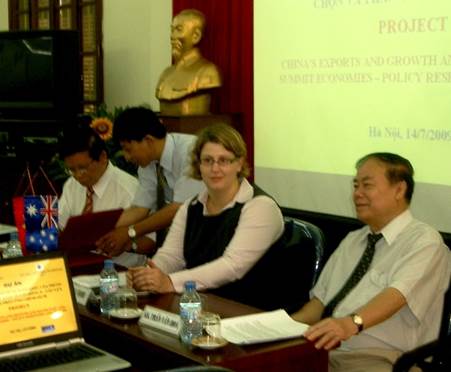
In the photo below taken at the 2009-2011 ARC project launch
ceremony at VIT Headquarter are, from left to right, Prof Dr N V Lich (VIT Director-General and ARC Industry
Partner), Mr H T Thanh (VIT ARC Projects Director), Ms Vanessa Wood (Australia’s Vice Ambassador – Deputy Head of Mission, to
Vietnam), and Prof Tran Van Hoa.
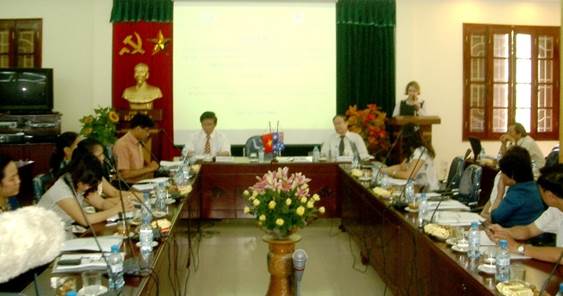
In the photo below also taken at the 2009-2011 ARC ceremony at VIT
Headquarter during the speech by
CORRUPTION AND ANTI-CORRUPTION POLICY IN
Tran Van Hoa attended the International Conference
on Evidenced-based Anti-corruption Policy in
Eminent speakers included Mr Abhisit
Vejjajiva (Prime Minister of Thailand), Mr Panthep Klanarongran (NACC
President), Justice Fabio De Pasquale (Chief
Prosecutor, Ministry of Justice, Italy), Ms Annnette Dixon (Country
Director, World bank, Thailand), Dr Richard Messick (World
Bank, Washington D.C, USA), Dr Jean-Pierre Verbiest (Country
Director, Asian Development Bank, Thailand),
Dr Juree Vichit-Vadakam (Director, Transparency International,
Thailand), internationally notable and distinguished academics
and business cummunity, and Commissioners from the national
anti-corruption commission agencies from major countries in the Asian region.
These agencies include the NACC (
As a true international venue for scholarly and practical policy
information, discussion and debate on what is often known as the dark side of
humanity and its activities driven essentially by personal greed and interest
at all three levels of government or
state, corporate and individual governance or management, the conference
attracted a very wide range of papers and speakers covering important
theoretical abstract and practical policy topics of interest to both rich and
developed as well as poor and developing economies alike. These topics include
(1) How to Prosecute High-Level Politicians, (2)
Variety of Corruption and Its Changing Face, (3)
Methodological Conflict in Corruption Perspective and
Activities, (4) Corruption as a Catalyst of Human Rights
Violation in Civil Societies, (5) United Nations Convention Against Corruption
2003, (6) Business-based and Ethics-based Government
Governance and Corruption, (7) Evaluation of Corruption Indicators, (8)
Corruption and Anti-corruption Policy in
Semi-authoritarian as well as Democratic Countries, (9)
Can Income and Assets Declarations by Politicians
Minimise Corruption?, (10) Uses of IT To Reduce Corruption, (11)
Corruption and Integrity in the Agricultural Sector, (12)
the Myth of the Low Development and High Corruption
Nexus Perception on Asia, (13) Government and Corporate Resistance to
Anti-corruption Policy, and (14) the Role of Anti-corruption Agencies in
Major Developing Countries in Asia. The Conference papers will be uploaded on
the NACC website for wider dissemination. Some papers may be published
in the NACC Journal after a peer-review process.
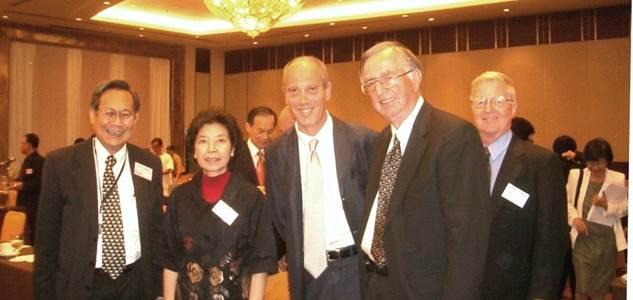
In the photo below taken at the conference
are, from left to right, (first) Prof Medhi Krongkaew
(Commissioner,
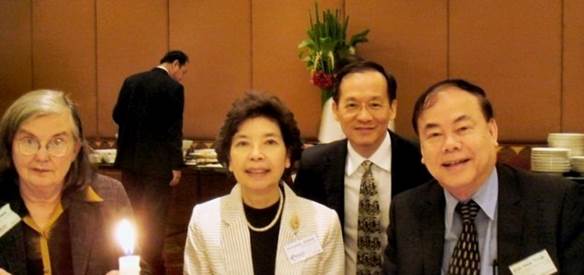
In the
photo below taken at the NACC Conference Dinner at Siam City Hotel are, from
left to right, Ms Annette Dixon
(Country Director, World Bank, Thailand), Prof
ASIAN COMMUNITY: FINANCIAL CRISIS AND ECONOMIC INTEGRATION IN
21
March 2009,
Tran Van Hoa attended the international
symposium on financial crisis and economic integration in East Asia
taking place at
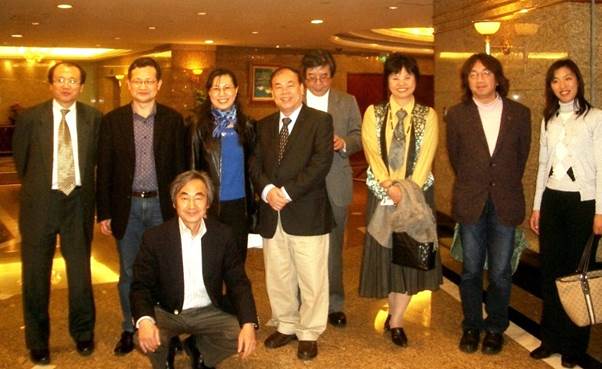
In the photo below taken at the symposium
reception dinner at the Central Hotel in Shanghai are, from left to right, Prof
Junfang Xi (3rd, standing), Prof Tran Van Hoa (4th,
Director, Vietnam and East Asia Summit Research Program, Centre for Strategic
Economic Studies, Victoria University, Australia), and Prof Akira Takamasu (7th,
Kansai University and Asian Community Research Center, Osaka Sangyo University,
Japan).
GROWING AUSTRALIA-VIETNAM TRADE RELATIONS INSPITE OF GLOBAL FINANCIAL
CRISES
Marriott Hotel,
Tran Van Hoa attended on 6 March 2009 the
workshop and ambassadorial reception at the Marriott Hotel in Melbourne to
discuss the Ministry of Industry and Trade (MOIT) report on the WTO
and Australia-Vietnam Trade Relations and to exchange ideas on ways and means to
improve these relations. The event was hosted by the
In the photo below taken at the
Marriott Hotel are, from left to right, Ms Nguyen Quynh Anh (1st place) , Europe
Market Department, MOIT; Prof Tran Van Hoa (4th); H.E. Nguyen Thanh Tan (5th), Vietnam Ambassador to Australia; Mr
Vu Van Quang (6th), Deputy Director-General, Europe
Market Department, MOIT; and Mr Nguyen Van Chi (10th), Commercial Consul, Vietnam Trade Office in Sydney,
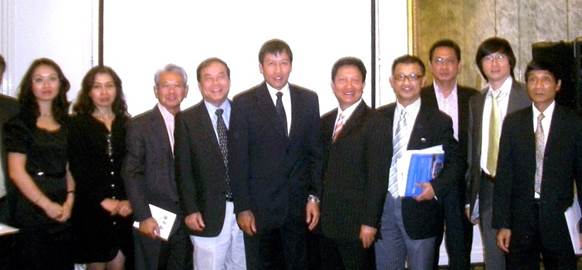
Australia.
PROMOTING
EAST & WEST
2-7 November 2008
Universities of
Sistan & Baluchestan,
During the first week of November 2008, Tran Van Hoa participated in a
series of APEF (Asia-Pacific
Economic Forum) VII conferences at three well-known universities in
The local organisers
involved in the preparation of the APEF VII conference are Prof Seyed Komail
Tayebi of the University of Isfahan and Dr Mosayeb Pahlavani of the University
of Sistan & Baluchestan in Zahedan, and numerous pan-university and institution
associates. As a significant recognition of the importance of the conference
and its theme in the East and
More than 1300
senior government officials, business people, university staff and students
attended the Opening Ceremony and Keynote Speeches of the APEF VII conference at the University Sistan &
Baluchestan in Zahedan. Experts
from over 10 countries
in Asia, India, Iran, other Middle East countries, Oceania and the European
Union participated to deliver 38 selected research papers (out of a total of 100
papers submitted for presentation) covering a wide range of topics on trade,
economics, finance, technology and management in East and West Asia, and the impact of the current global financial
crisis. Prof Tran Van Hoa delivered his
keynote speech emphasizing the opportunities and challenges of deepening East
and
A prominent session of the APEF VII conferences at the University of
Sistan & Baluchestan and the University of Isfahan was a Roundtable where keynote speakers and the audience participated
in discussions on major contemporary issues of interest to future policy in
East and West Asia. The issues raised at the session included energy supply,
demand and prices, the importance of small and medium-size enterprises, the
current interest by academic and institutional experts and policy-makers on the
architecture of regional trade agreements in the Asia-Pacific region, and most
importantly, the impact
of the US subprime or global financial crisis (GFC) on both developed and
developing economies world-wide. In his discussions, Prof Tran Van Hoa stated that it is too early to assess the wide-spread and deep
damages of GFC,
but he gave an overall evidence-based picture of the potential economic,
financial, ideological and political damages of the GFC in all big and small
economies which many times surpass the decades-long gains from trade
liberalisation and growth, and reform. He also pointed out fortunately that
good and appropriate policy can attenuate these damages and spur future
development and growth, and recommended regional and global co-operation in
finding appropriate solutions on these. In his discussions, Prof Peter Lloyd,
of the Grubel-Lloyd Intra-trade Index fame, also concurred that a rethink of laisser-faire or extreme
capitalism as a model
of modern economic management policy with government support may be necessary.
Prof Ahmad Akbari emphasised the effects of the GFC on economic slowdown and oil revenue of the
OPEC and their contagion to other sectors of
the economy (eg, education in
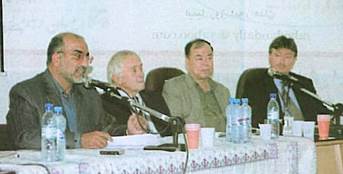
The photo below records a Roundtable session at the
In the
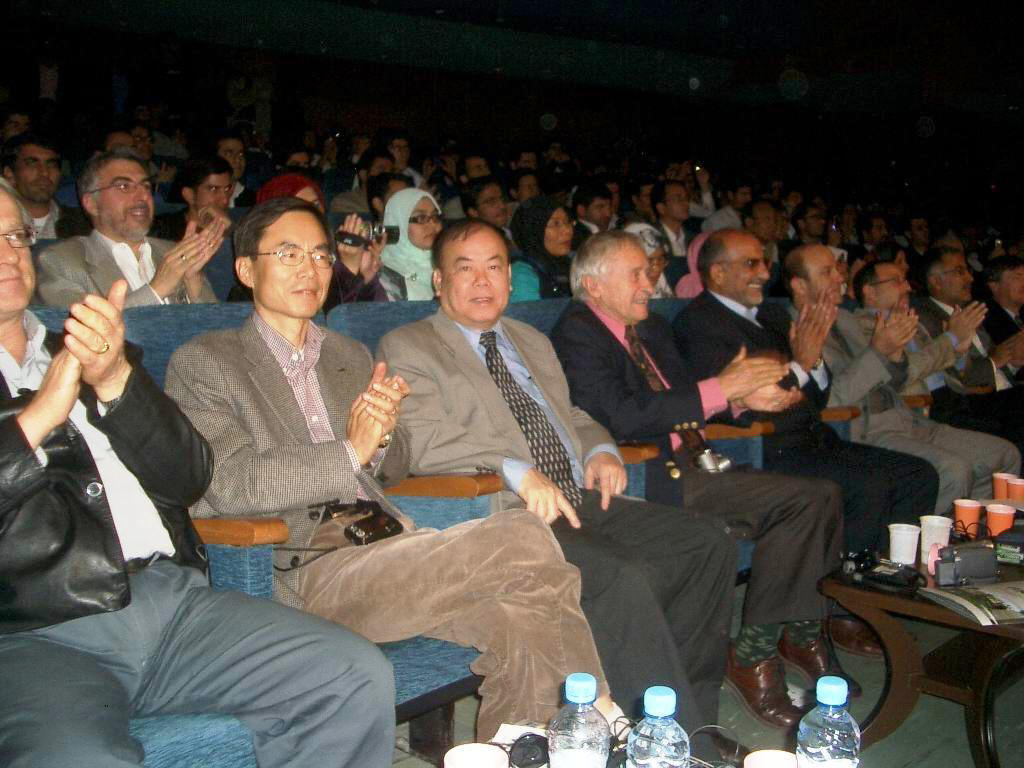
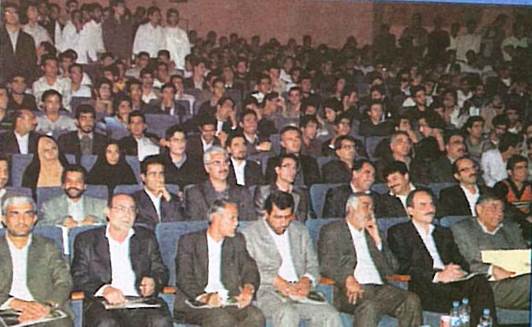
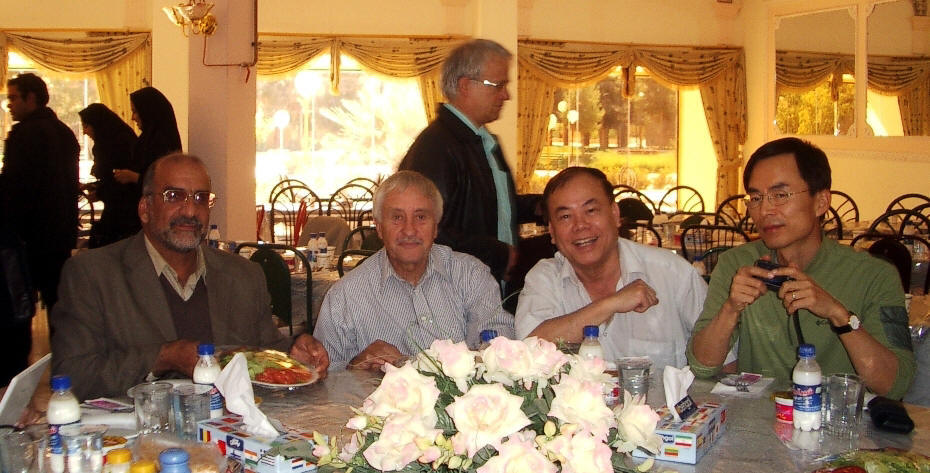
two photos below taken at the Opening Ceremony and Keynote Speeches in the
Ferdowsi Hall on campus at the University of Sistan & Baluchestan in
Zahedan are some of the 1300 VIP guests and participants.
Some Key Speakers at the APEF VII conference in Zahedan (photo below).
From left to right, sitting, Prof Ahmad Akbari; Prof Peter Lloyd; Prof Tran Van
Hoa; and Prof Hyun-Hoon Lee, Dean of Asia-Pacific Academy and an APEF Founding
Member, Kangwon National University, Korea.
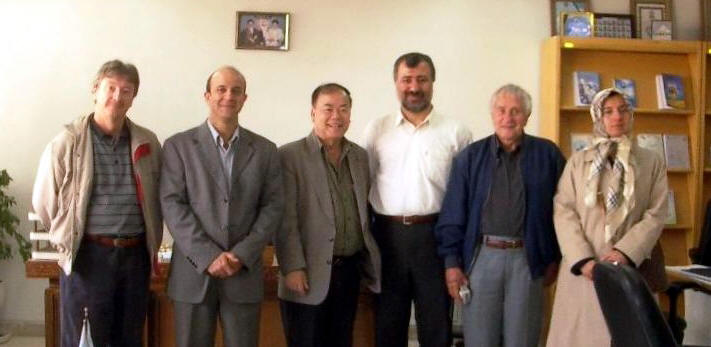
In the photo below taken at the Office of the Vice-Chancellor,
University of Isfahan, are, from left to right, Prof Charles Harvie; Prof
Komail Tayebi, University of Isfahan and APEF Local Chair; Prof Tran Van Hoa;
Prof Hossein Harsij, Vice-Chancellor, University of Isfahan; Prof Peter Lloyd;
and Dr Nazende Ozkaramete Coskun, Bikent University, Turkey.
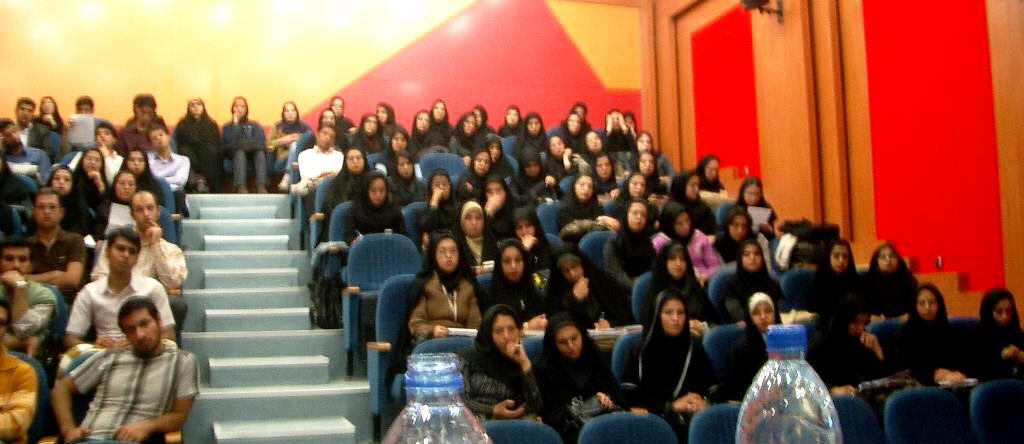
The
photo below shows some of the audience at the APEF VII conference taking place
at the
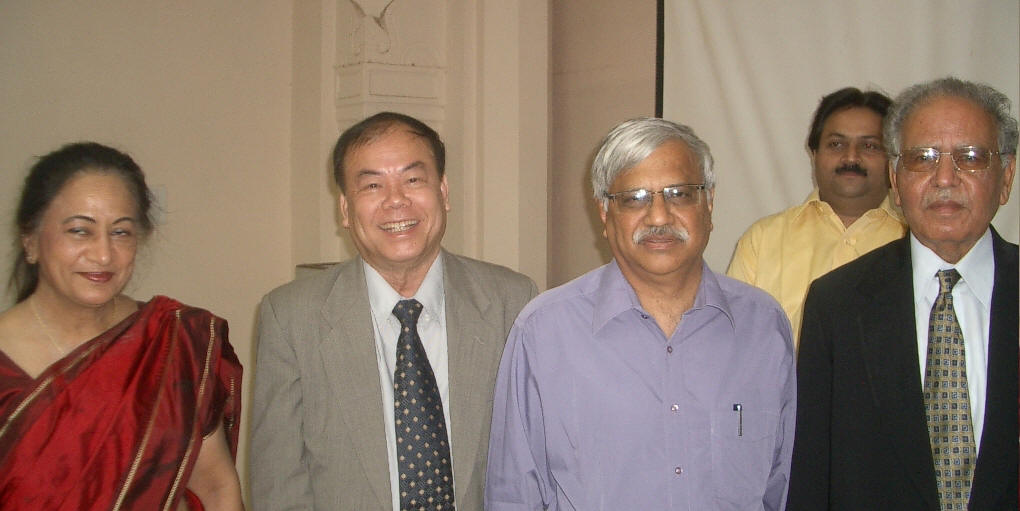
ECONOMIC,
TRADE AND POLITICAL ISSUES, AND PRIORITY
25-30 September
2008,
Tran Van Hoa participated recently in three
important high-level academic and policy meetings in
In the photo below taken in the historic
North Hall, Allahabad University, at the end of the Valedictory Session are some
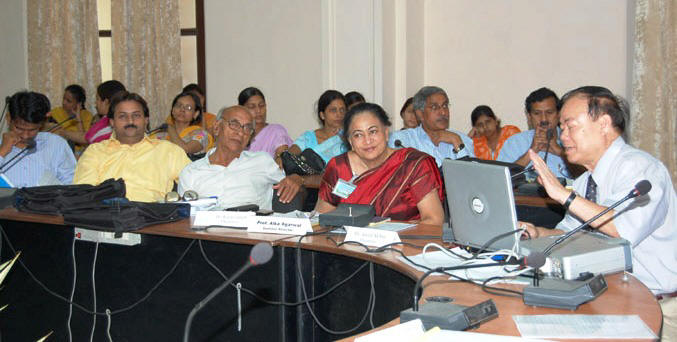
keynote speakers at the conference (from left to right front row, Prof Alka Agarwal, Chair and AU Council Member, Department of Economics, Allahabad
University; Prof Tran Van Hoa; Prof
Rajen Harshe, Vice-Chancellor, Allahabad University; Chief Justice (retired)
Shri Prakash).
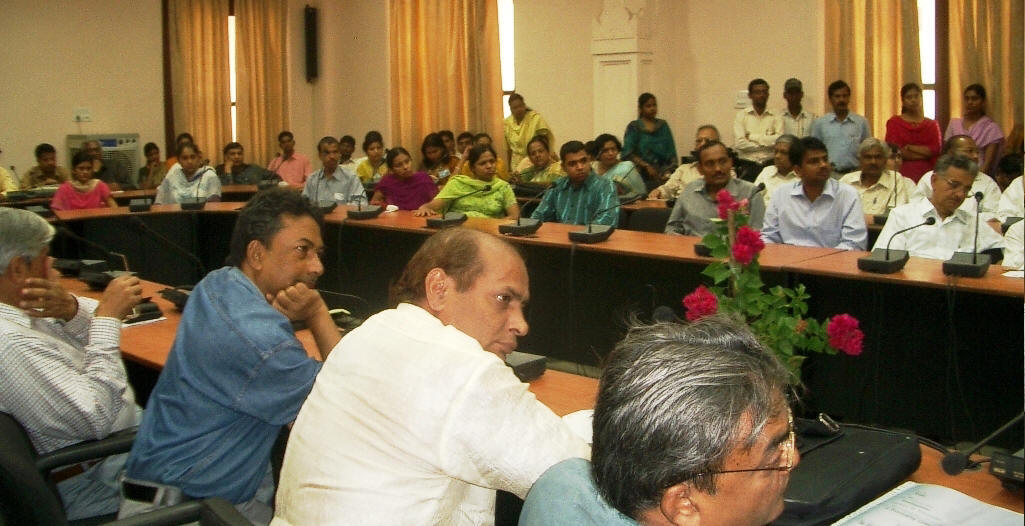
And some of the participants at the
conference during the keynote address by Tran Van Hoa.
Prof Tran Van Hoa also participated in a high-level policy RIS-ADB conference Emerging Asian Regionalism: ASEAN-India FTA and Beyond, taking place on 29 Sept 2008 at the
Viceregal, Claridge Hotel, New Delhi, to present his key panel address on India and the ASEAN. The conference was jointly organised by RIS (Research
and Information System for Developing Economies, India’s government-funded top
think-tank) and the ADB (Asian Development Bank) and attended by H E Dr Jairam Ramesh, Minister
of State for Commerce and Power, Dr M Kawai, Dean, ADB Institute in Tokyo,
India's elite government officials and academics, and international embassy and
business representatives.
In his address, Tran Van Hoa gave an account of the recent past record of
India-ASEAN-World economic and trade relations, and, using the recent findings
based on his endogenous gravity theory, explored these relations’ opportunities, obstacles, and prospects within
the framework of a plurilateral India-ASEAN FTA, and the East Asia Summit FTA
as proposed currently by the 16 EAS leaders. At the conference, the ADB launched its new publication Emerging
Asian Regionalism: A Partnership for Shared Prosperity, in which some aspects of integration of
production, trade, financial markets, and FDI in the ASEAN Plus were
particularly paid attention to. The conference was widely reported by the
media.
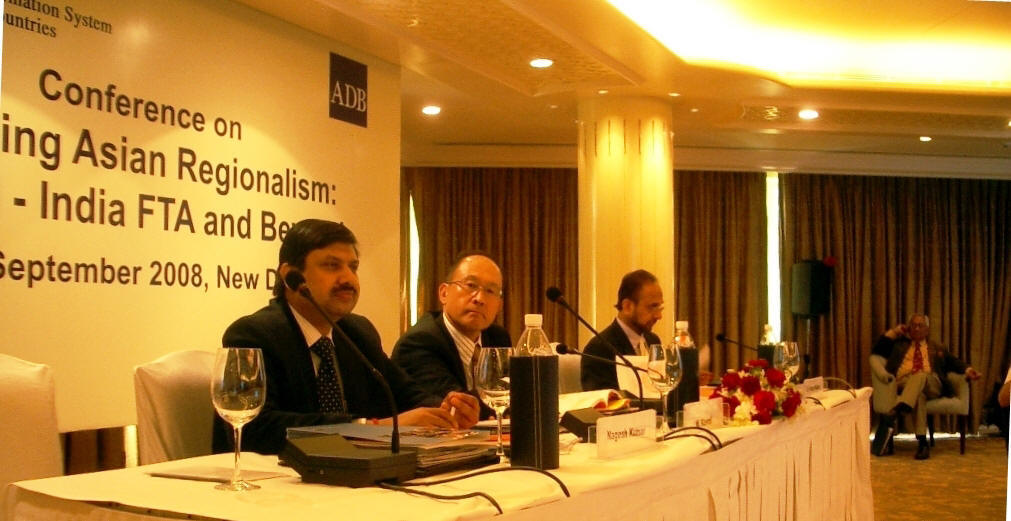
In the photos below taken at the Viceregal
Hall, Claridge Hotel, in New Delhi, during the RIS-ADB conference are some
keynote speakers (Dr Rajesh
Kumar, Director-General, RIS; Dr M Kawai, Dean, ADB Institute; Dr Srinivasa
Madhur, Director, OREI, ADB).
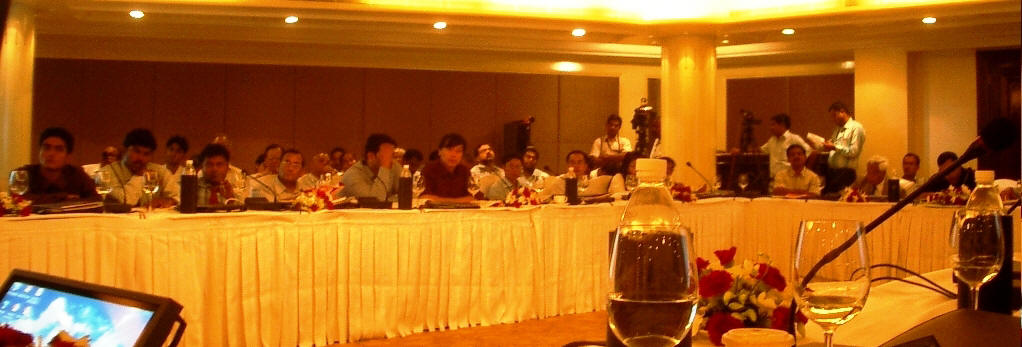
And some of the participants.
In New Delhi, Professor Tran Van Hoa also gave a seminar on
30 Sept 2008 to staff and postgraduate students of the Centre for International Trade and Development of the Jawaharlal
Nehru University (India’s
top university) to
talk about the development of his endogenous gravity theory and its
applications to India’s and ASEAN’s economic and trade issues particularly in a
present climate of energy and financial crises, and to offer possible
solutions. The visit to the JNU was organised by Prof B B Bhattacharya, JNU Vice-Chancellor
and a noted economist and adviser to
In the photo below taken at the JNU seminar
are, front row, Prof
Tran Van Hoa and Prof Geeta Agarwal (Chairperson, CITD), and some postgraduate students.
20-21
June 2008
Korea
Institute of Public Finance,
Tran
Van Hoa attended the
Korea and the World Economy Conference VII in Korea during 20-21 June 2008 to deliver his research paper
on the currently proposed
Australia-Korea Free Trade Agreement, and to discuss papers at a plenary session on Official Development Assistance -
Korea and the Developing Countries. The conference (in the series established at
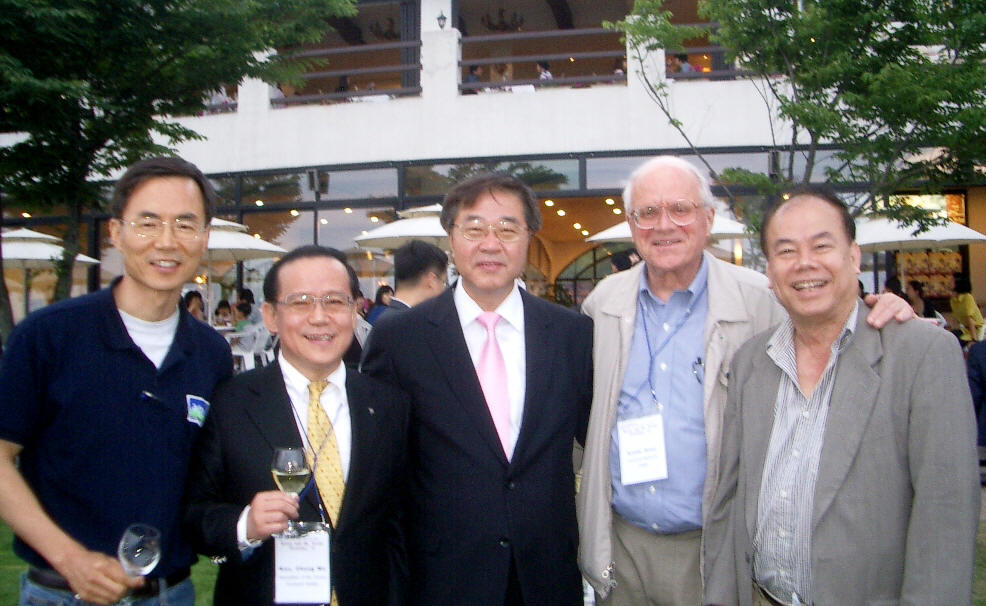
In the photo below at the farewell function at the Santorini in
Chunchoen are (from left to right) Prof Huyn-Hoon
Lee (Dean, Asia-Pacific Co-operation Academy, Kangwon
National University;
local organiser), Prof Chung-Moo Koo (President, AKES;
local organiser), Dr Bongkee Hahn (Vice Governor, Gangwon Provincial Government), Prof Sven W Arndt (Claremont McKenna College, USA), and Prof Tran Van Hoa.
INNOVATION
& TECHNOLOGY IN
POLICY MODELLING TRAINING FOR ACADEMICS AND GOVERNMENT OFFICIALS
2 May 2008,
While the role of econometric modelling for policy analysis (using say
the methods of growth regression, panel regression,
structural equation modelling, and CGE/GTAP) has been recognised and used in most developed and
Western countries world-wide, an appropriate modelling methodology with more
credible or realistic outcomes for use by corporate and government
policy-makers in both developed and developing countries alike is still to be
developed. A new development with improved features and outcomes in this field
is the Generalised Gravity Theory proposed in
2002 and used successfully since by Tran Van Hoa (eg, see the Journal of the Korean Economy, 2004) in many practical applications on economic, trade,
FDI and service studies in Asian economies (eg, China, India, Japan, Korea, Thailand, and Vietnam)
in recent years. This advanced modelling tool has now
been officially adopted by the Government of
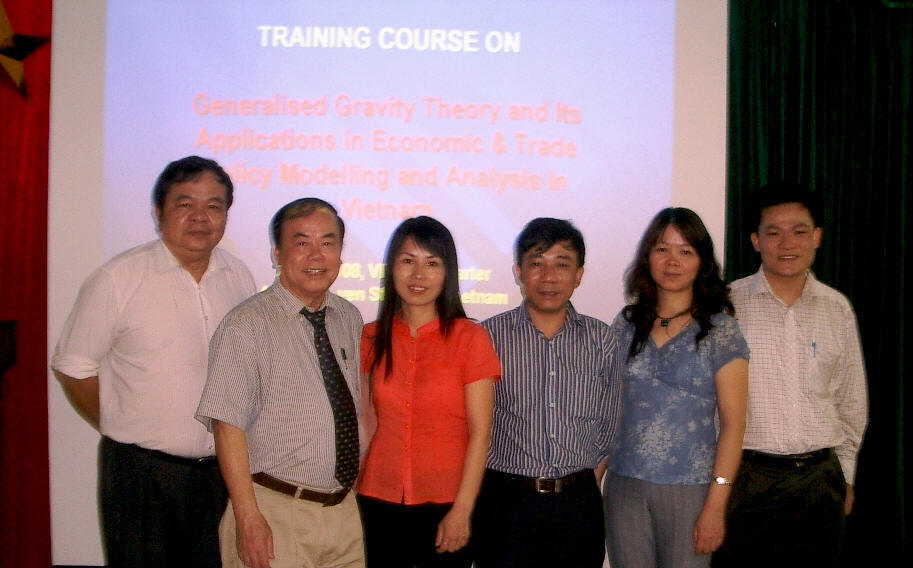
In the
photo below taken at the training course are Prof Tran Van Hoa (second from left) and some participants.
INNOVATION
AND TECHNOLOGY
AND
THEIR IMPACT IN DEVELOPING ECONOMIES
21-23 April 2008, United
Tran Van Hoa attended the Second Conference of Micro Evidence
on Innovation in Developing Economies (MEIDE), on 21-23 April, 2008, at the
Renmin University of China in Beijing, to deliver a paper on the Impact
of Innovation &Technology Public Expenditure on Development in China and
India: An International Comparative Study, and to chair a session. The
Conference was jointly organised by the
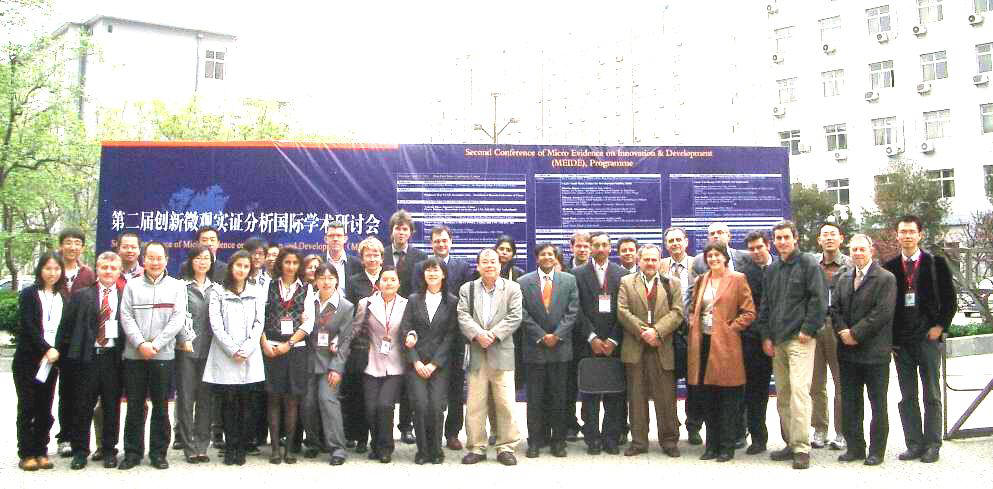
In the
photo below taken at the end of the conference and in front of the Run Run Shaw
Conference Centre at
BASIC
PUBLIC SERVICES EQUALISATION IN
AN
INTERNATIONAL CONFERENCE
China Institute
for Reform and Development (CIRD), 22-23 Feb 2008,
Tran
Van Hoa was invited to attend the international conference Basic Public Services for 1.3 Billion
People during 22-23 Feb 2008 in Haikou to present his paper on China's Education and Development and Its Comparative
Efficiency Competitiveness with one of China's major economic and trade rivals
in the region, India. The
conference was organised by one of China's think-tanks, the China Institute for Reform and Development
(CIRD), and with the collaboration of China International Centre for Economic and
Technical Exchanges (CICETE) and the United Nations Development Program
(China). A wide range of 'hot'
topics on major aspects of public services in China, covering education, health
care, rural and regional development, urban-rural gaps, legal foundation, tax
reform, and social security, were discussed and debated by more than 250 senior academics and
government officials (including two Vice Ministers) from all over China and 17
international experts (eg, from Australia, France, Sweden, the UK), UNDP
Resident Representative and Senior Economist. The conference proceedings were nationally televised and reported by 21 mass media
networks. In his paper and
discussions, Prof Tran Van Hoa emphasised the importance of not only public services
input and capacity equalisation but, more significantly, their outcomes and
efficiency evaluation (a new policy research direction mentioned at the
conference by the UNDP
(China) Representative, Mr Khalid Malik, and endorsed by Vice-Minster of National
Population and Family Planning Commission, Dr Zhao Baige), and the relevance of regional competitiveness (in
this case, India's education and health care) in a globalised economy where
China is playing an increasingly influential role.
In the photo below taken at the
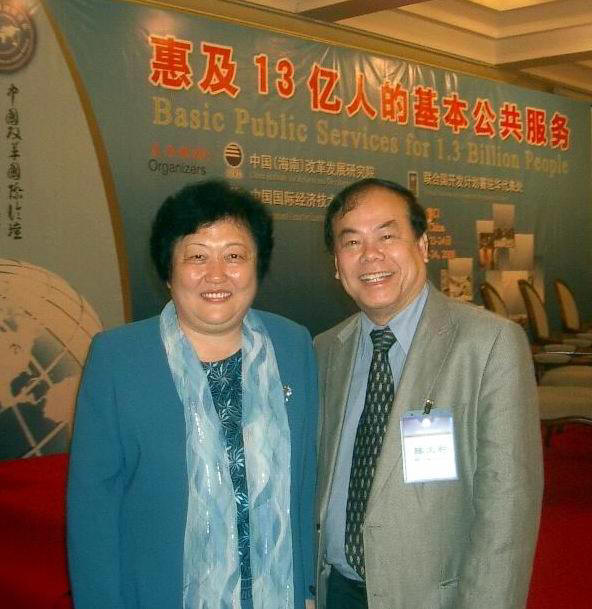
Two photos showing some of the national and international participants
at the Conference.
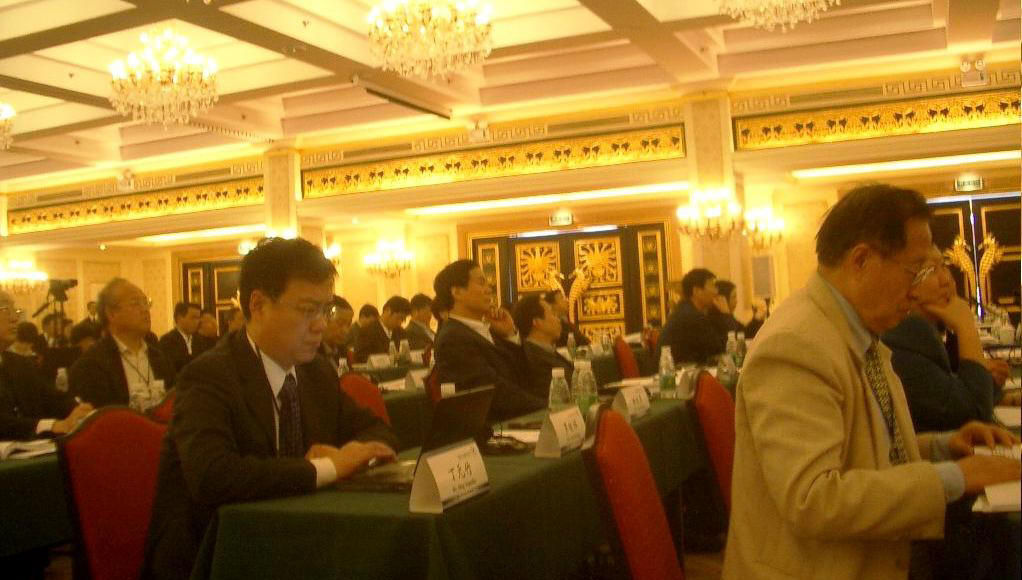
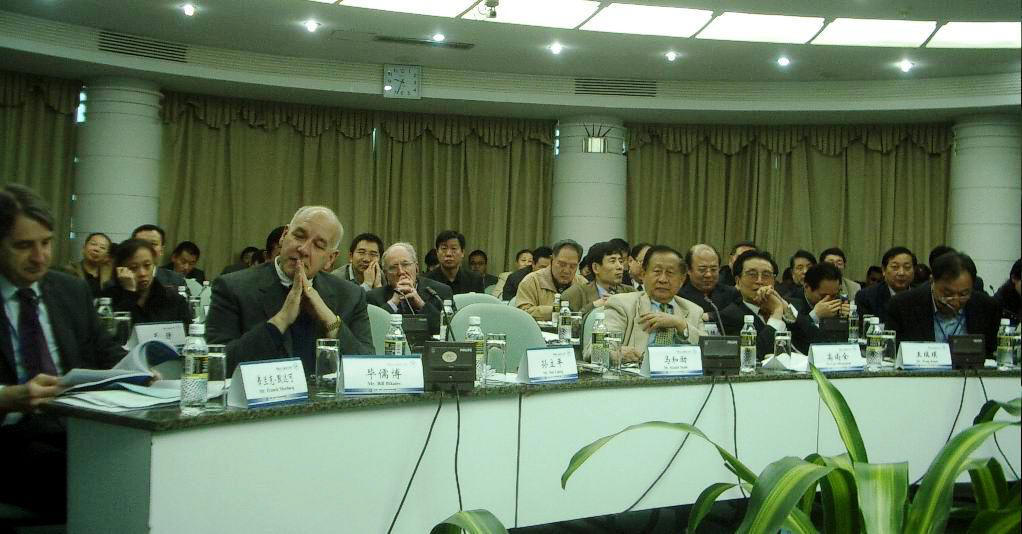
IN MINISTERIAL
TRADE POLICY RESEARCH, DEVELOPMENT AND MANAGEMENT
8-20 December
2007, Ministry of Industry and Trade (MOIT),
Prof Tran Van Hoa of the Centre for Strategic Economic Studies (CSES),
Faculty of Business & Law, Victoria University, led, during 8-20 December
2007, a number of Australian Research Council-funded workshops in major cities and provinces of
Vietnam to present his work with the Vietnam Institute for Trade (VIT),
Ministry of Industry and Trade (MOIT), on implementing improvements in economic
and trade policy in
the country. The workshops were organised by VIT (an Industry Partner in a
2004-2007 ARC Linkage Project) on Australia-Vietnam Trade, co-managed by VIT Director-General, Prof Dr Nguyen Van Lich), and endorsed by H.E. Nguyen Van Linh, Vietnam Vice-Minister of Trade.
The workshops were
attended by senior university and trade college executives and academics,
senior government officials, and select postgraduate students. The work
involves the implementation of a new modelling policy approach, the so-called generalised gravity theory (GGT) introduced
by Tran Van Hoa in 2002, that provides significant improvements in modelling
outcomes and policy credibility and reliability to existing and popular approaches that are
currently used in this field by national and international institutions (e.g.,
universities and research institutes) and organisations (e.g., the World Trade
Organisation, the International Monetary Fund, the World Bank, the Asian
Development Bank). A description
of the GGT is given in an award-winning article in 2004 in the Journal of the
Korean Economy, published by
At the
workshops, the participants were introduced to the work's preliminary research
and findings, and informed of MOIT decision to adopt the GGT methodology for
economic and trade analysis and implementation at the practical and operational
level by the Ministry.
The decision is highly significant for global government governance in the
sense of how relevant and quality government policy background support in
In the photo
below taken at the meeting at the MOIT Headquarter in Hanoi on 20 December 2007
are H.E. Nguyen Van Linh, Vice-Minister of Trade (on the left), and Prof Tran
Van Hoa.
A record photo
of the ARC-VIT workshop at the VIT Headquarter in
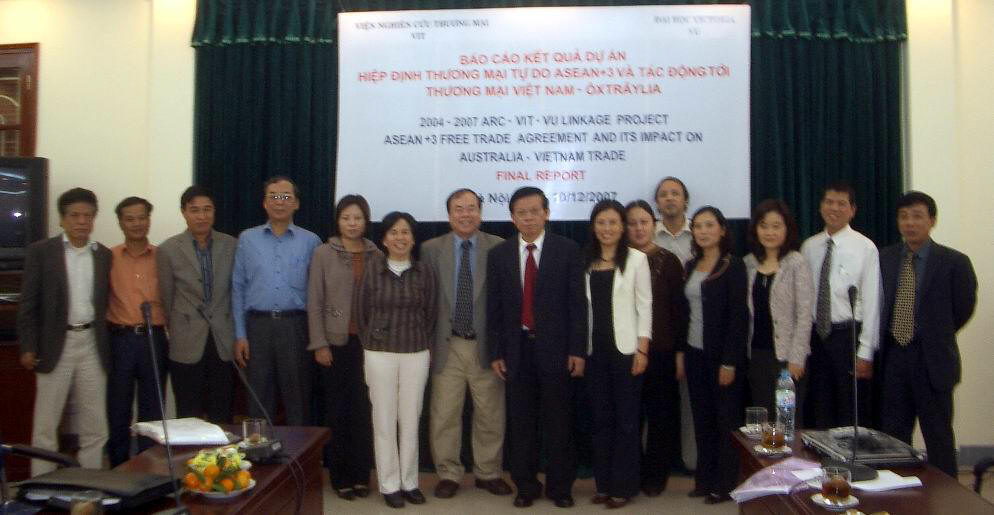
A record photo
of the ARC-VIT workshop at
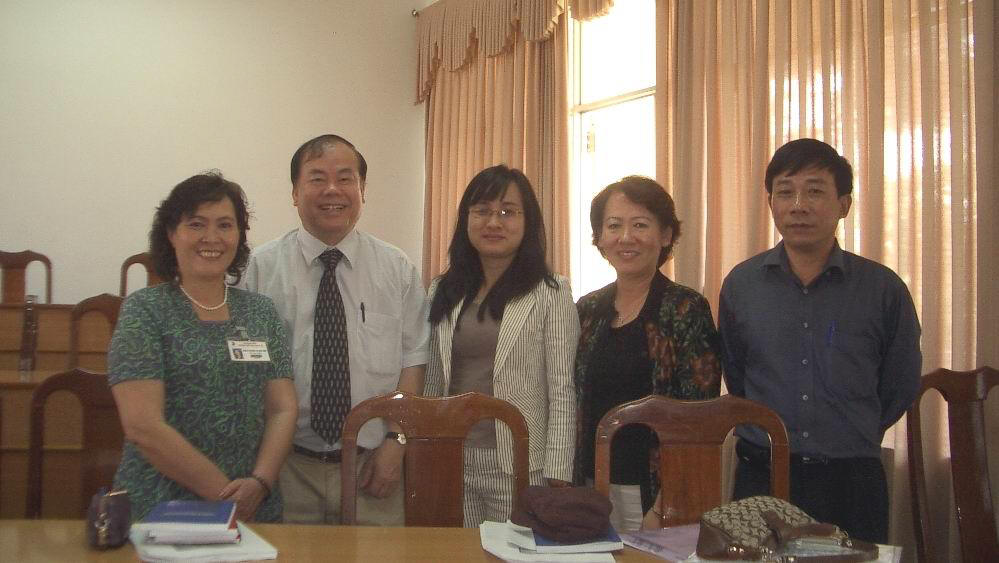
A record photo
of the ARC-VIT workshop at the College of Foreign Economic Relations, MOIT and Ministry
of Education and Training, Ho Chi Minh City, Southern Vietnam: Prof Tran Van
Hoa (left), and College Rector, Prof Dr Pham Chau Thanh (second from left), and
College academics and government participants.
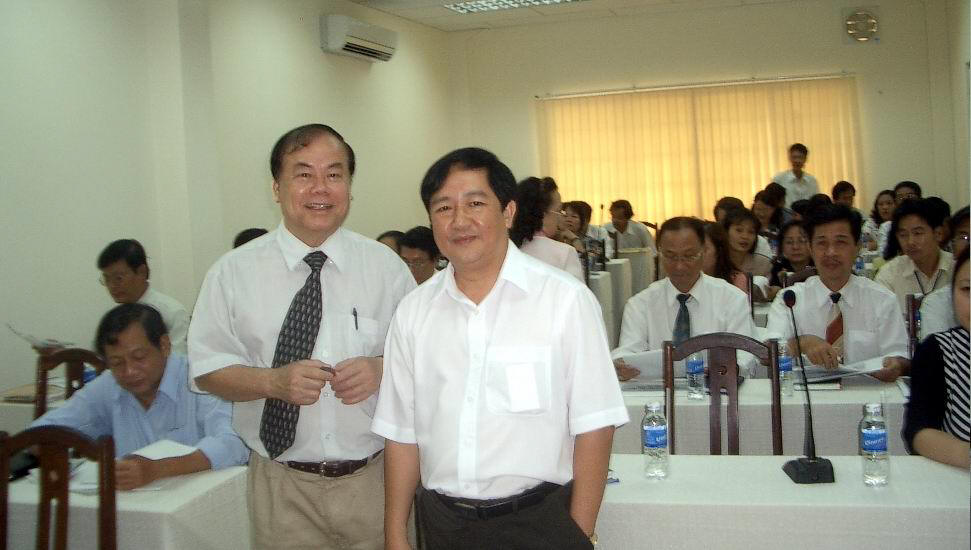
A record photo
of the ARC-VIT workshop at the Provincial Office of Trade and Tourism, MOIT, Da
Lat, Highland
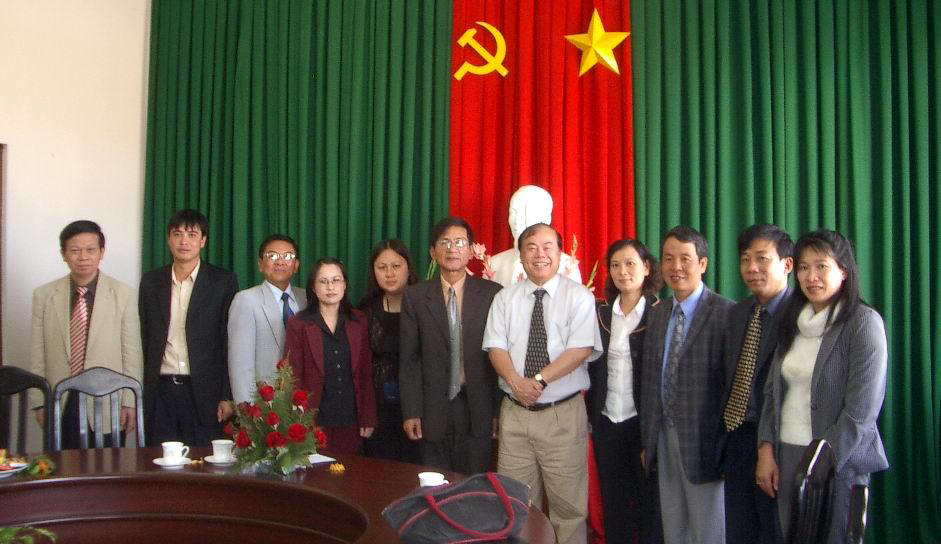
A record photo
of the ARC-VIT workshop at
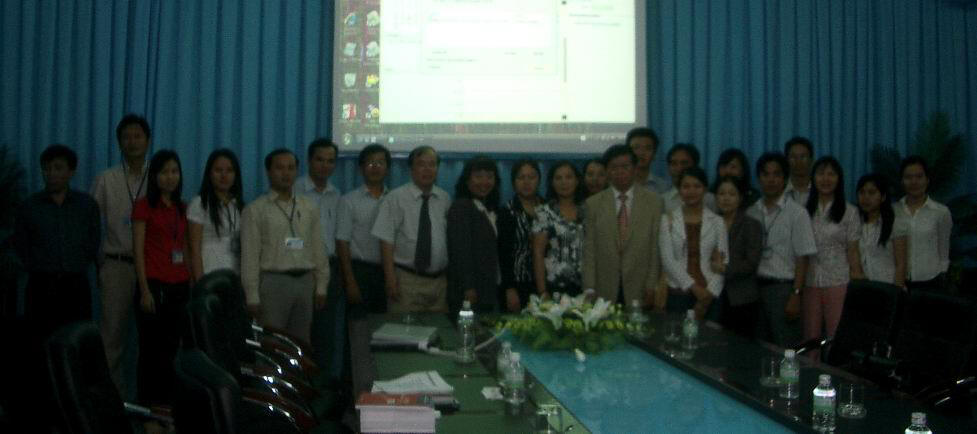
and
FOR TWO GIANTS
IN
25-27 October
2007,
Tran Van Hoa
attended the 90th Indian
Economic Association Conference at Kashmir University in India on 25-27 October
2007 to present his recent research findings
on China-India trade relations and their impact
on India's growth, 'Look East' policy, economic diplomacy and regional
cooperation. Since its
devastating balance of payments crisis in the early 1990s,
In the photo
below taken on campus in the Science Block at Kashmir University are, from left
to right, Prof G K Chadha (Member of the Economic Advisory Council to
the Prime Minister, and former Vice-Chancellor, Jawaharlal Nehru University,
Delhi), Prof Tran Van Hoa, and Prof B B Bhattacharya (Vice-Chancellor, Jawaharlal Nehru University, Delhi, and 2007
President, Indian Economic Association)
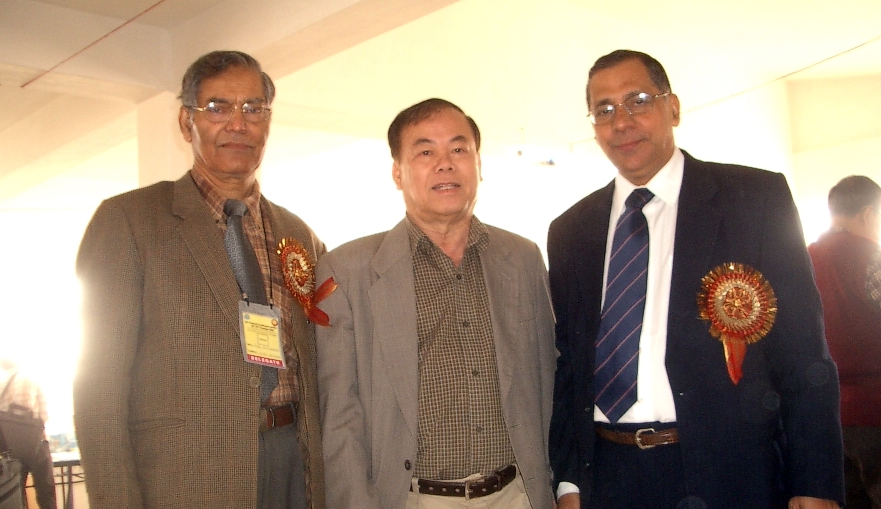
The photo below
taken at the Opening
Ceremony at the
Convocation Complex at Kashmir University are Prof A Wahid
(Vice-Chancellor,
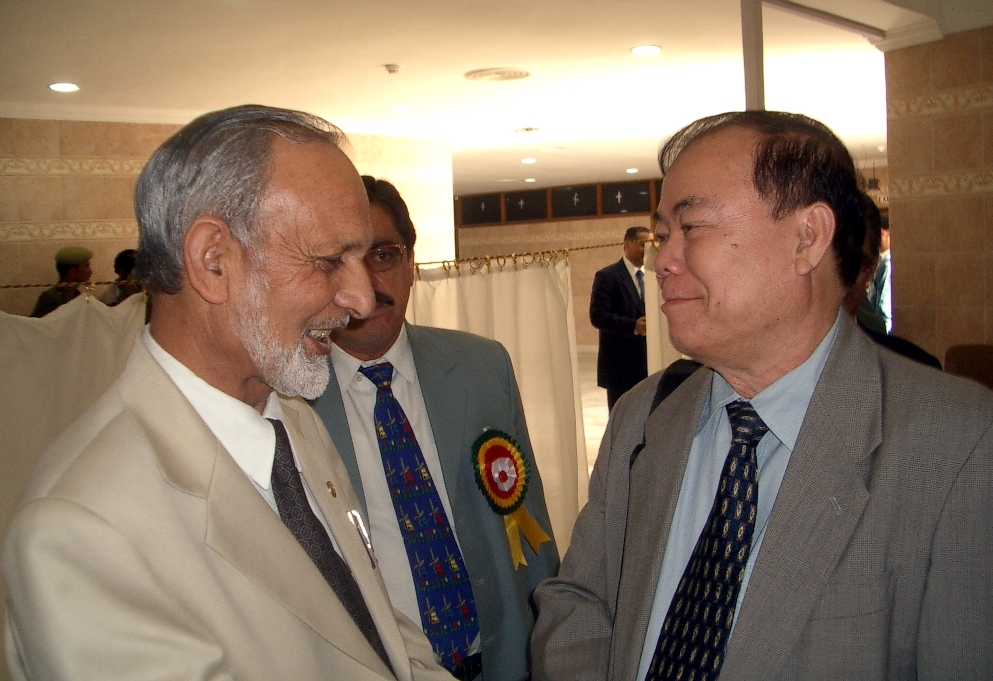
rEGIONAL ECONOMIC INTEGRATION IN
Issues in
31 July 2007,
While regional
economic integration has been strongly supported by the governments in the
ASEAN Plus region to promote trade, economic growth, poverty reduction and
co-operation, major
issues such as trade, investment and services in a bilateral framework between
China and Vietnam
for example in an AFTA Plus scheme have not been adequately studied in detail
or reported at both the academic and policy level. These issues were taken up
by VIT and other ministries and academic and research institutions in
In the photo
below taken at the workshop are, from left to right, Prof Dr Nguyen Van Lich (Director-General, VIT, and ARC Linkage
Industry Partner), Dr
Nguyen Manh Hung
(Prime Minister Office), Ho
Trung Thanh (standing, ARC
Linkage Project Manager, VIT), Prof Dr Nguyen Van Thanh (Vice Director-General, VIT), H E Le Van Dinh (Vice Minister, MOT), Prof Tran Van Hoa (ARC Linkage Chief Investigator and Director, Vietnam
and ASEAN Plus Research Program, Victoria University, Australia), Prof Dr Nguyen Mai (hidden, Ministry of Science and
Environment), and Prof
Dr Nguyen Van Huong (former
President, National Economics University, Hanoi).
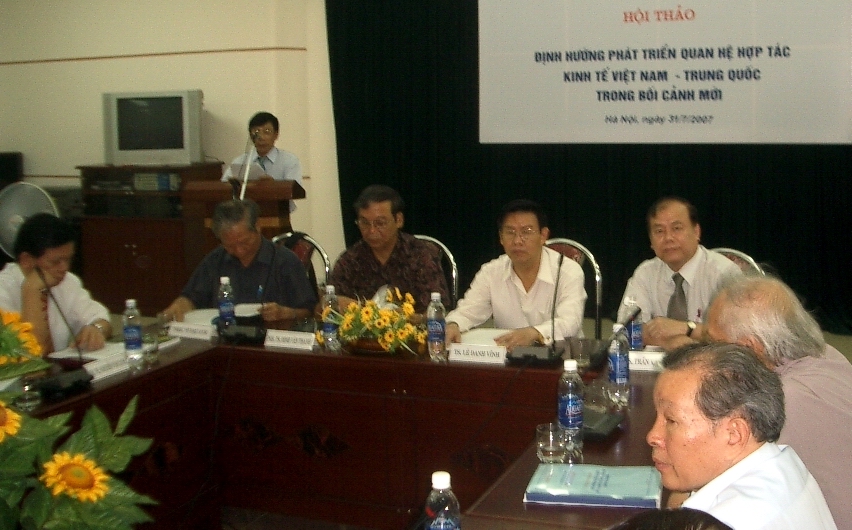
In the photo
below are some of the participants including the media representatives at the
workshop.
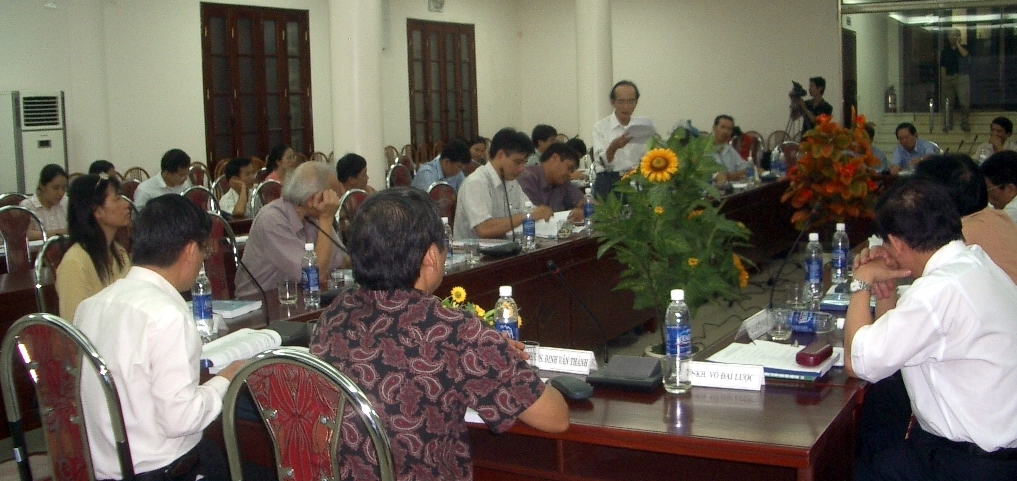
Issues in a
Korea-Australia FTA and Regional ODA
2-3 July 2007,
Tran Van Hoa attended the Korea and The World Economy International Conference
VI: Towards Asian Economic Community at the University of Wollongong, NSW, Australia, on 2-3 July 2007, to
present a paper on Official
Development Assistance (ODA) Effectiveness in Asia. Since the current debates on ODA effectiveness or
ineffectiveness have been based on aspects of political economy or
methodologies that have been regarded as simple or inadequate, the paper
provides a new and suitable modelling approach and substantive empirical
findings to improve the quality of the debates. The issue is important as in
2005, ODA reached $US107 billion and current and former senior World Bank
experts and consultants (eg, Sachs and Easterly) working on the area are not
sure about the ODA benefits and the effectiveness of ODA modus operandi. The Korea
and The World Conference series, organised principally by Korea's largest
economics association, the
Association of the Korean Economic Studies (AKES), started in Korea in 2001 by a group of international
academic economists, trade experts and government officials to research on
major issues in Korea and their implications and relations to the rest of the
world. About 50 people from 17 countries around the world participated in the
Conference which also attracted local and national media. Major issues in the
currently negotiated Korea-Australia FTA were also a major topic at the
Conference.
In the photo
below (Tran Van Hoa, second from right) taken at the foyer of the
Communications Centre at Wollongong University before the Conference are AKES
Council Members, key participants and local and AKES organisers.
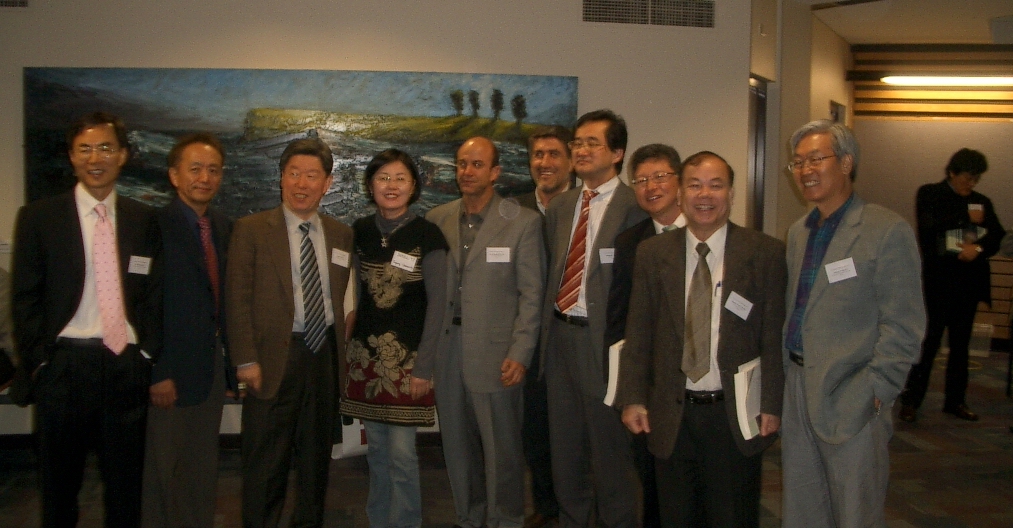
Eminent participants at the Korea and The
World Conference VI include H E Mr
Chang-Boem Cho, Korea Ambassador to Australia (right, photo at the Novotel below) and Prof Robert Castle, Deputy
Vice-Chancellor, Wollongong University, left), and Prof Tran Van Hoa.
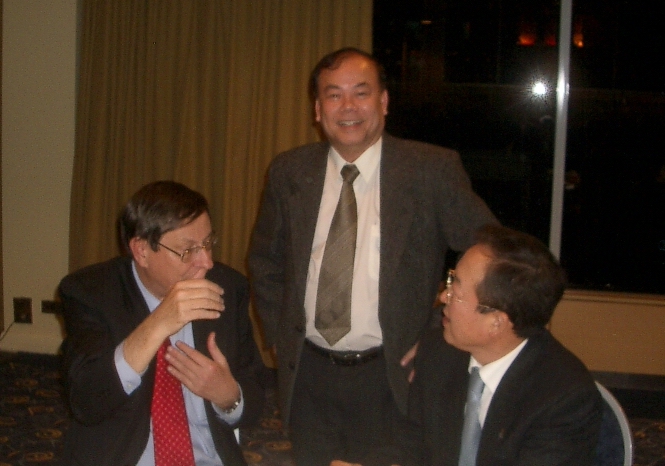
The photo below taken in front of the
MacKinnon (a former Vice-Chancellor at Wollongong University) Building after the
farewell lunch at the Food Re-Thought restaurant at Wollongong University shows
some of the participants.
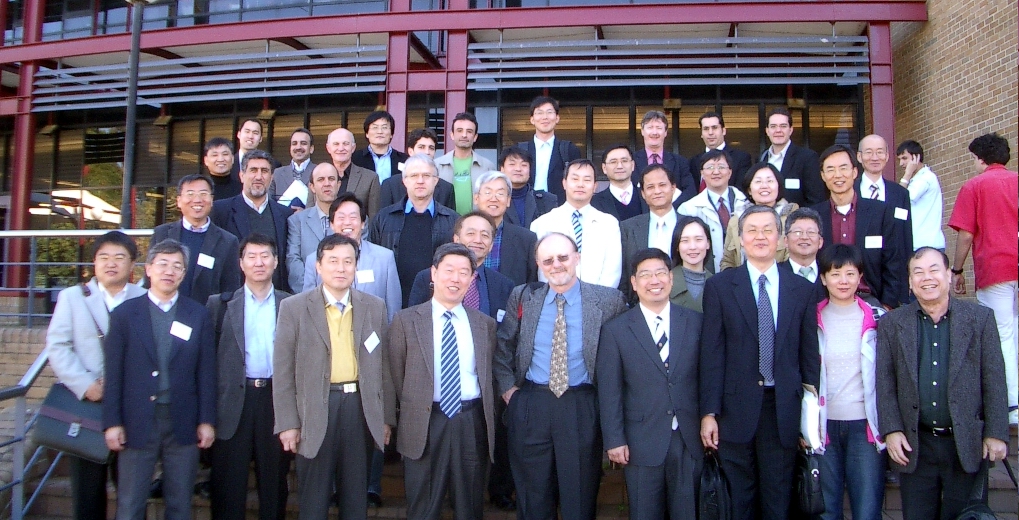
WHAT ARE NEW IN
THE ASIA-PACIFIC REGION?
30 June-1 July
2007,
While in Wollongong, Tran
Van Hoa also attended, as an Executive Member and speaker, the Asia-Pacific Economic Forum (APEF)
International Conference VI, with
the theme Asian
Regionalism: Issues, Opportunities, Challenges and Outcomes, where he presented a paper on International Economic Integration in Asia:
AFTA and WTO Memberships. The paper is
acutely relevant to the current development in the Asia-Pacific and Oceania
regions where, with the suspension of the WTO Doha Round negotiations in SARS
Hong Kong in 2006, free trade agreements among neighbouring countries have been
strongly promoted by major countries for mutual benefits. APEF is a new
economics association founded in Chuncheon, Korea, in 2001, and has a wide
international academic, government and industry membership and with an
Asia-Pacific (in contrast with the World Economic Forum) focus agenda.
Participants from 9 countries in East Asia, West Asia and
In the photo
below taken at
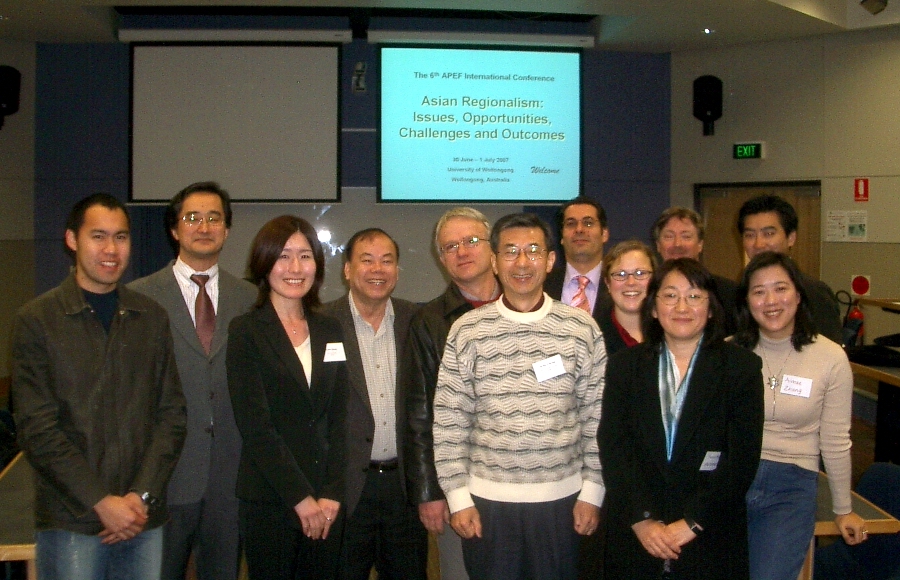
Business and
Investment in
21-23 May 2007,
Vietnam Institute for Trade, Ministry of Trade,
With its WTO membership on
11 January 2007 after over 12 years of tortuous negotiations, Vietnam is set to
integrate more boldly and more competitively into the world market to increase
its shares of exports and FDI, to enhance its sustainable growth, and to
strengthen its external economic relations. This 150th WTO membership also projects
ISSUES IN AUSTRALIA-KOREA
RELATIONS AND FTA
26 March 2007,
Myer Asia Institute,
Tran Van Hoa attended a meeting with H E Chang Beom Cho, Korea Ambassador to Australia, at a get-to-know event organised by the Asialink network of the Myer Asia Institute,
The photo below taken at the Myer Asia
Institute boardroom are Prof Tran Van Hoa and H
Australia-China Free Trade Agreement:
Issues in Regional Development and Substantive Policy Support
17-18 March 2007. Renmin
Prof Tran Van Hoa attended
the international conference on Australia-China
Free Trade Agreement: Regional Development Issues and Modelling Policy taking place in Beijing on 17-18 March 2007 to deliver a keynote address (Title: AFTA and WTO Memberships: Challenges, Opportunities and Choice) on the progress, outcomes and benefits of regional trade agreements in
Asia (such as the ACFTA) and the actual substantive gains (or a lack of them)
from WTO memberships. The conference was sponsored by AusAID-ISSS, the Australian Department of Foreign Affairs
and Trade (DFAT), and supported and locally organised by three Beijing
universities: the Renmin University of China (RUC), the Central University of
Finance and Economics (CUFE), and the Capital University of Economics and
Business (CUEB). The Centre for Strategic Economic Studies (CSES) at
More than 40 trade,
economic, population and agricultural academics and government officials from Australia, India, Vietnam, Beijing universities and a number of
north-west and north-east provincial universities in China participated in the conference. A wide range of research work and
findings by these experts on
In the photo
below taken at the ACFTA Conference are, from left to right and sitting, Dr Bui Anh Tuan (Institute of World Economy, Vietnam), Dr Pham Lan Huong (Deputy Head, Economic Integration
Department, Ministry of Planning and Investment, Vietnam), Prof Charles Harvie (Director, SME
Research Centre, University of Wollongong, Australia), Prof Tran Van Hoa (Director, Vietnam and ASEAN Plus Research
Program, Victoria University, Melbourne, Australia), Prof
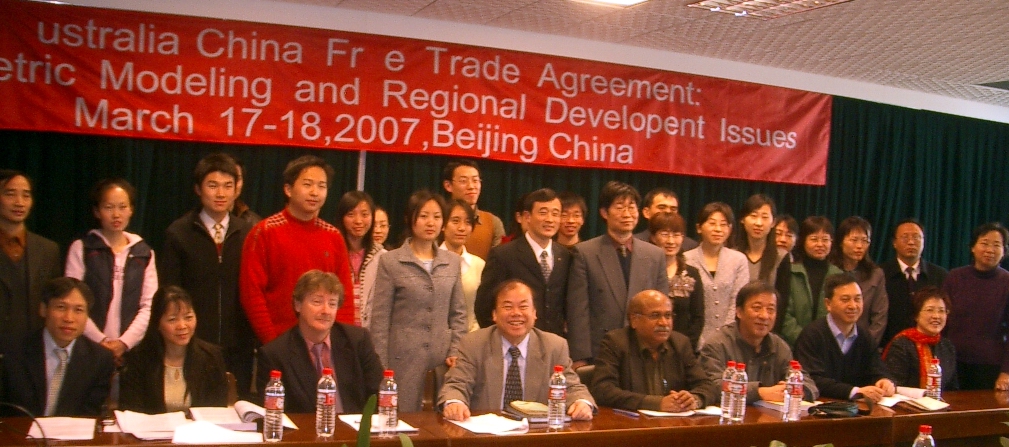
While in
WTO
and ASEAN FTA: Expectations and Outcomes
4-5 December 2006, NATI, Ministry of Trade,
The aspirations
of many countries in the world to be members of the WTO (an off-shoot of GATT, GATS, TRIMS, TRIPS and with recent added-on
income equality and poverty alleviation), to make sometimes painful and long-negotiated commitments and to
carry out 'hard' reforms are well-known especially for developing countries in
Prof Tran Van
Hoa recently attended the 2006 Asian Forum on
Business Education (AFBE,
based in Thailand) organised by the National Advanced
Training Institute (NATI), Vietnam Ministry of Trade, in Hanoi, to deliver a keynote speech in which he
presented some new international substantive evidence on these gains and
outcomes for Asian economies (Andrew Rose in
his 2004 American Economic Review paper
reported similar evidence for other countries). This evidence shows pure and simple that an AFTA membership (which is
not beset by
In the photo taken at the
opening of the 2006 AFBE conference at the NATI Conference Centre are, from
left to right, Assoc Prof Dr Pham Quang Thao (NATI Rector and Local Organiser);
HE Vice Minister of Trade, Mr Tran Duc Minh; Prof Dr Brian Sheehan (President,
AFBE); Dr. Wahdi Salasi April Yuhdi (Deputy Director, The Southeast Asian
Ministers of Education Organization (SAMEO)); and Prof Dr Tran Van Hoa
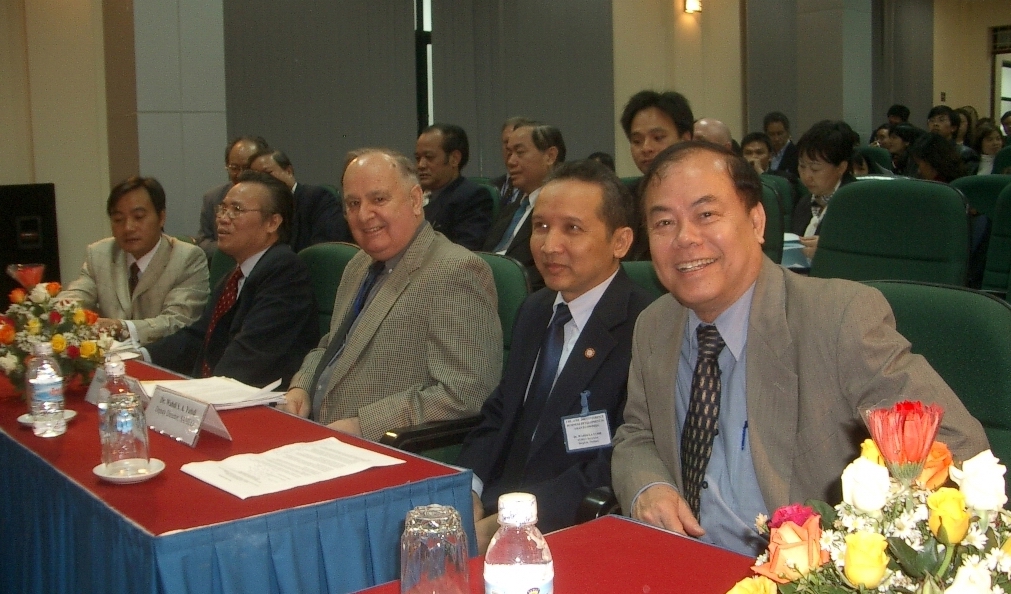
In the photo below taken
at the closing of the 2006 AFBE conference at NATI in
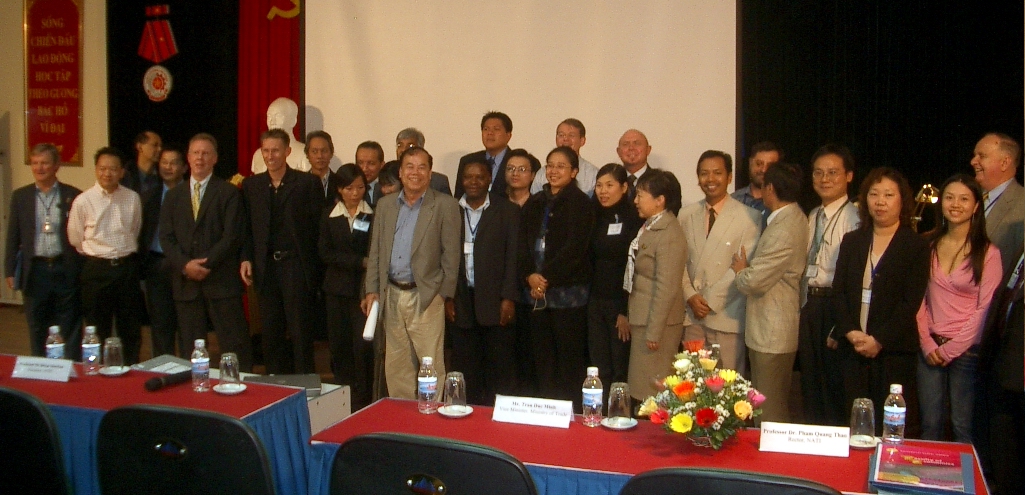
WTO,
30
November 2006, Institute of Economic Studies,
Prof Tran Van Hoa
participated, on 30 Nov 2006, in an ARC Linkage Project Workshop on the WTO, Regional Trade Agreements and Their Impact on
Tran Van Hoa pointed out
that while high expectations are legitimate for new WTO members, the positive
outcomes, from international evidence,
may be relatively small, and, from recent historical
events in the region, they are also strongly associated with risks (such as
domestic turmoil and inappropriate reform policies, regional and global
shocks). He called for caution and reservation by policy-makers about the
hyped-up outcomes by WTO-oriented advocates and consultants arising from a WTO
membership and focus instead on the fundamental issues of
competitiveness and comparative advantages in international trade and commerce
to support sustainable development and regional economic relations.
In the photo below
taken at the conclusion of the Workshop at the IES are, from left to right,
Assoc Prof Dr Nguyen Van Lich (Director General, VIT, and ARC Linkage Partner Investigator),
Prof Dr Tran Van Hoa (ARC Linkage Chief Investigator), Dr Tran Du Lich
(Director, IES), and Assoc Prof Dr Tran Dinh Thien (Institute of Economics, Hanoi)
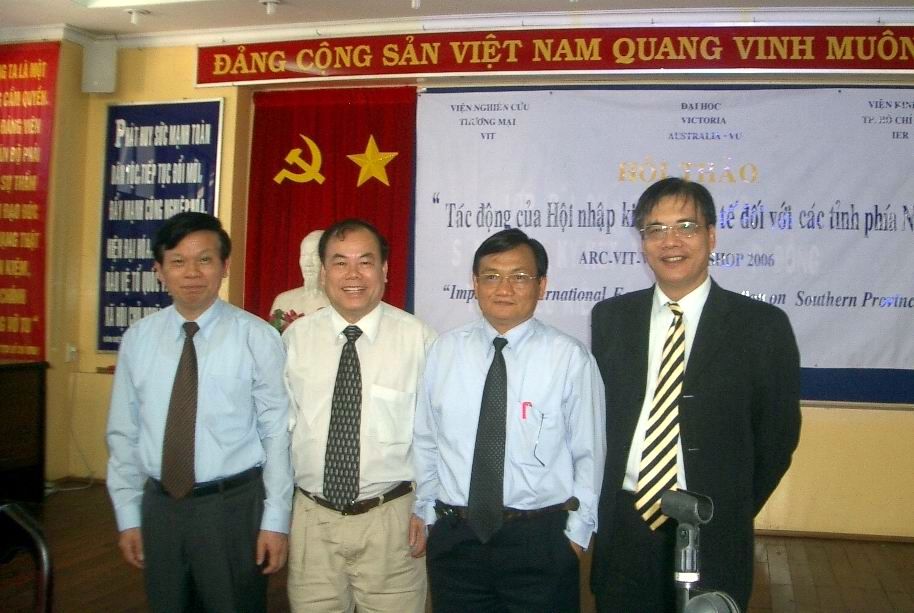
The photo below shows some
participants at the Workshop
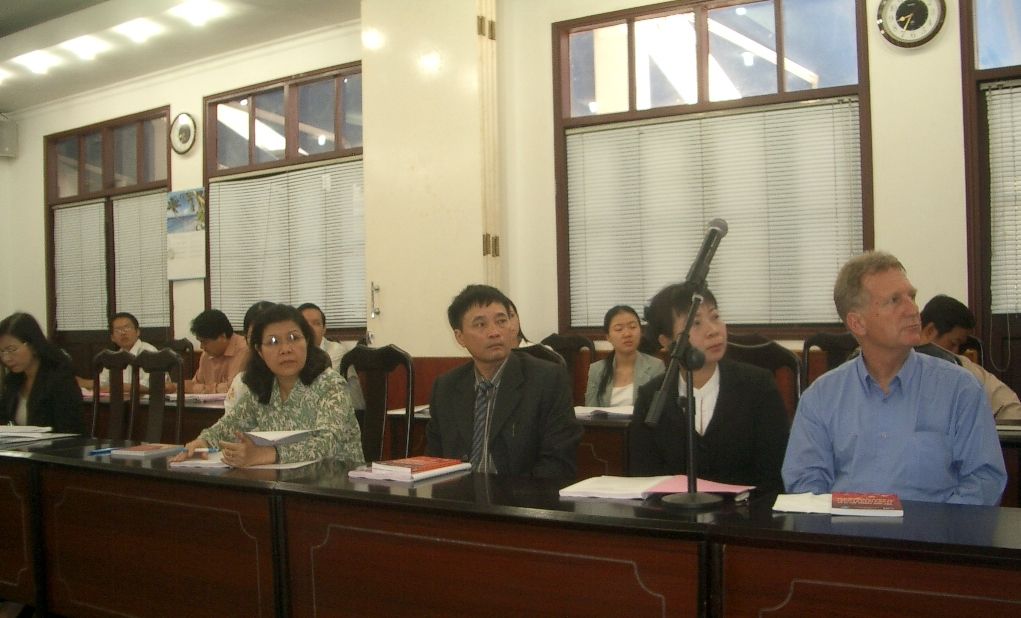
WTO and Asian Economic Integration: What Regional and Provincial
Economies Gain?
11 August 2006,
While the
negotiations for WTO and FTA memberships focus on national or aggregate benefits (and losses),
concerns are ripe about the realisation of these benefits (and losses) at the
grass-roots, provincial or regional level. It is accepted generally that WTO
and FTA memberships, often after long and hard negotiations lasting many years,
can bring about more trade, enhanced development and growth, welfare
improvement and poverty reduction, otherwise the aspiring countries will not
sign the agreements. It is also clear that not all regions and
sectors of a member country can uniformly gain from the memberships. In fact, some sectors and regions will lose This
painful truth is found both in developed (such as
To investigate
this imbalance of gains and losses from WTO or FTA memberships, Tran Van Hoa
organised a workshop on 11 August 2006 in the ancient imperial
city of
In the photo
below taken at the openning of the workshop at the Dien Bien Hotel in Hue, Central Vietnam, are, from left to right, Dr Nguyen Van Lich (Director-General, Vietnam
Institute for Trade, Ministry of Trade, ARC Project Industry Partner), Dr Nguyen Tan Thien (Vice-Chairman,
People's Committee of the Thua Thien-Hue Province), Prof Tran Van Hoa (Director, Vietnam and ASEAN+
Research Program, Victoria University, Melbourne, ARC Project Leader), and Prof
Tran Than Quoc (Institute of World Economics, Hanoi).
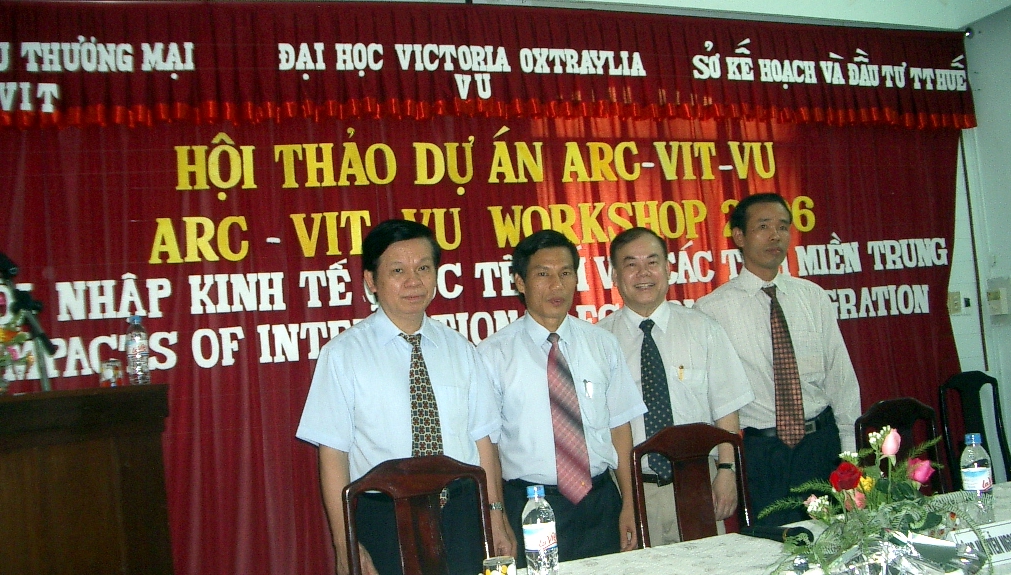
WTO and Asian FTA Commitments
7-10 August 2006, Ministry of Trade,
Prof Tran Van Hoa recently participated in a series of Policy Advising
Workshops and a Dissemination Seminar organized by ACIL-Cardno and Department
of Planning and Investment (DPI), Vietnam Ministry of Trade (MOT), in
The workshops, taking place in Hanoi
during 7-9 August 2006, were designed to assist a select group of Vietnam trade
officials and academics in carrying out relevant research (1) to prepare
available trade options (training) and (2) to propose effective implementable
trade policies (mentoring) of the country’s major negotiated commitments under
its general economic integration but especially under its forthcoming WTO
membership. The specific commitments under study in this
round cover (a) import control measures, (b) distribution services and (c)
subsidies and countervailing measures. These commitments and, more importantly, their economic, trade,
environment and social implications are currently of high priorities managed by
MOT as its ministerial functions.
The final research reports were presented
at the dissemination seminar (chaired by the Deputy Director-General of DPI, Dr
Hoang Thinh Lam) for discussion and media exposure on 10 August 2006 at the
Melia Hotel in
In the photo of some participants below
taken at the dissemination seminar at the Melia Hotel in Hanoi, on 10 August
2006, are (from left to right, front row) Dr Pham Quang Thao (Rector, National Advanced
Training Institute, MOT), Prof Tran Van Hoa (Research Professor and Director,
Vietnam and ASEAN+ Research Program, Victoria University, Melbourne,
Australia), Mr Nguyen Quang Anh (Program Officer, AusAID, Australian Embassy,
Hanoi) and Ms Susan McKeag (First Secretary, AusAID, Australian Embassy,
Hanoi).
7-8
July 2006,
Tran Van Hoa
participated in the Korea and the World Economy V: Korea and
the FTA Conference put on by the Association of the Korean
Economic Studies (AKES), Korea Development Institute, Korea
University-BK21-Economics, Korea Institute of Finance (KIF) and Washington
University (Seattle, USA) at Korea University in Seoul on 7-8 July 2006 to
deliver a paper on the impact of economic reforms and global shocks
on the Korea economy and trade and to discuss
papers presented. While at the
The photo
below taken at the Award Ceremony in the Conference Room of Korea University
shows Prof Tran Van Hoa receiving the 2004 Best Paper Award Plaque, looked on by the President of AKES, Prof Sung Tae Ro.
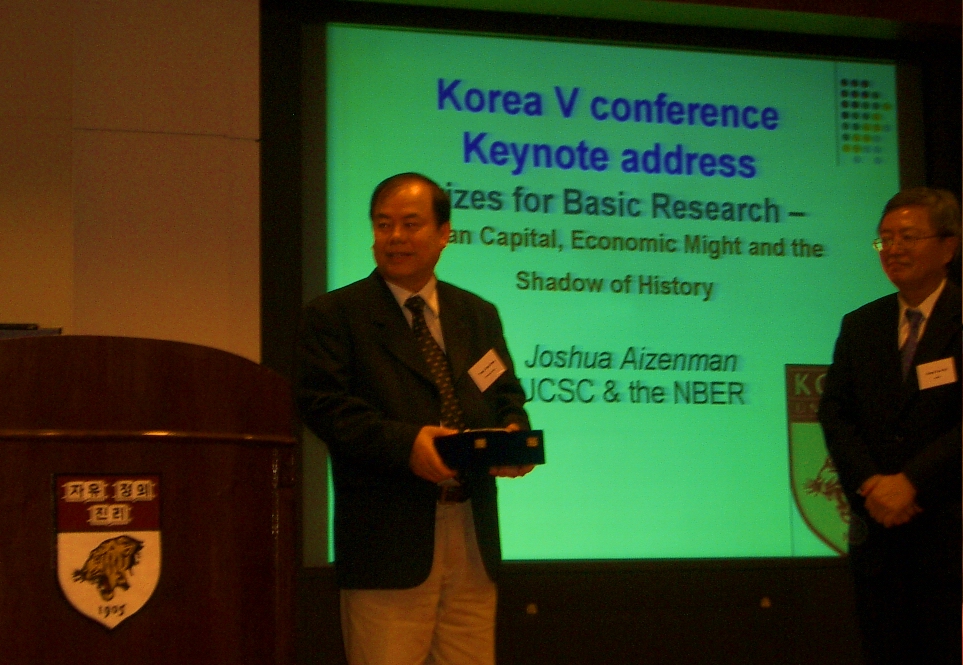
Asia-Pacific
Economic Forum (APEF) V Conference,
United
Nations Economic and Social Commission for the
5-6 July 2006,
Tran Van Hoa attended the APEF V Conference to deliver a paper on the gains and losses of an Australian-China free trade agreement
which is currently (2006) under negotiation between the governments of
While in Chuncheon, Prof Tran Van
Hoa also participated in the training course for
sustainable development for young leaders from the Asia Pacific organised by
Kangwon National University, Koica and UNESCAP in Bangkok. A
total of 20 government officials and media representatives from 14 Asia Pacific
countries attended the training course.
In the photo below
taken at the KNU training centre in Chuncheon are the UNESCAP-KNU Asia-Pacific
trainees and Prof Tran Van Hoa (5th from right, second row).
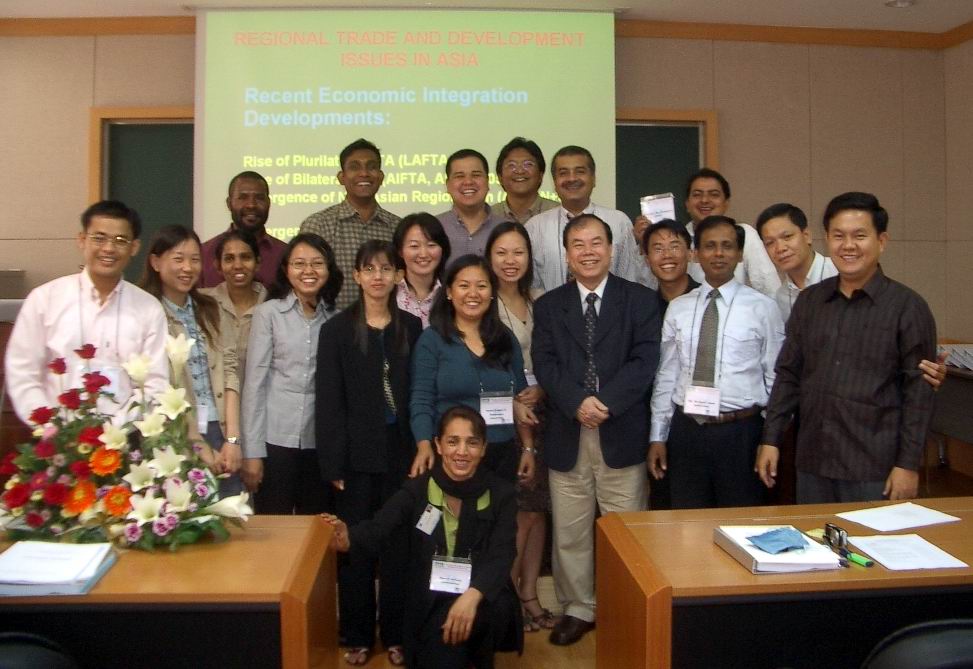
WTO,
24-26 June 2006
Tran Van Hoa was an invited speaker
at the WTO,
In the photo below
taken at a welcoming dinner at the Ting Li Guan Restaurant in the Royal Summer Palace in Beijing are Prof Guijun Lin, Vice-President of
UIBE, and Prof Tran Van Hoa.
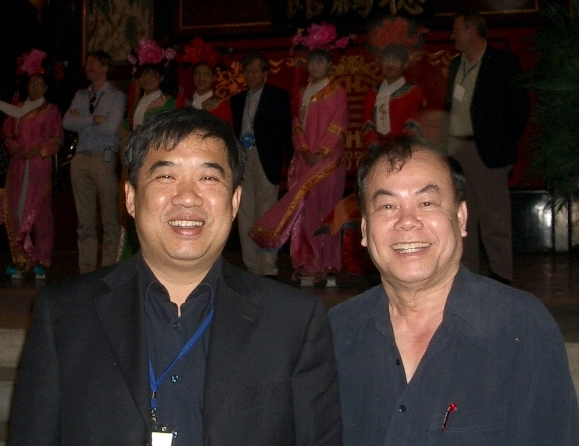
AUSTRALIA-MALAYSIA: A
DIFFICULT RELATIONSHIP?
2 June 2006, Windsor Hotel,
In spite
of their similar political structures, geographical nearness, historical links,
and the economic, social and regional cooperation successes of Malaysia in the
past few decades, the relationship
between Australia and Malaysia has not been easy in recent years at both the
commercial and highest political levels. Attention in both countries is needed to improve this relationship for
mutual benefits especially with the introduction of the 9th
At the
Forum, Prof Tran Van Hoa raised the question on the recent (Kuala Lumpur, 14 December 2005) proposed enlargement of the ASEAN to include
Australia and New Zealand (among other major trading blocs) after Australia
decided to sign, after a long delay, the ASEAN Treaty of Amity and Cooperation, and the view, if any, of Malaysia about the
potential costs, benefits or problems of this regional membership and its
impact on the relationship between Australia and Malaysia. This is in the
context of a difficult relationship between the two countries in the past.
In the photo below taken at the Windsor Hotel are, from left to right,
Prof Tran Van Hoa, Malaysia Foreign Minster, the Hon. Dato Seri Syed Hamid
Albar, and Ms Elisabeth Hames-Brooks (Honorary Fellow, Monash Asia Institute).
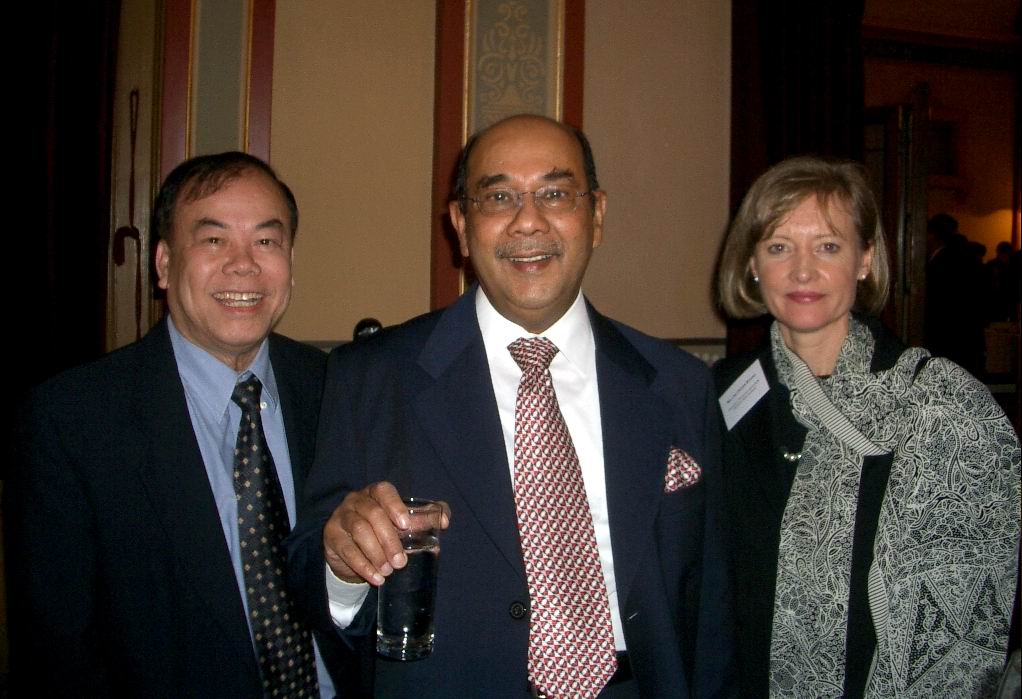
A DIPLOMATIC CONCLUSION
26 May 2006,
Sidney Myer Asia Centre,
Vietnam’s new
(since November 2005) ambassador
to Australia, HE Nguyen Thanh Tan, accompanied by his First Secretary, Mr
Nguyen Van Nhat,
visited Melbourne on 26 May 2006 to deliver his first public lecture in
Victoria on Vietnam’s recent economic achievements, reforms, growing trade with
Australia (worth $A3,896 million in 2005), and prospects after the country’s 10th
Party Congress taking place in Hanoi last April. The visit was organised by the Asia Link in collaboration with the
Department of Political Science at the
Prof Tran Van Hoa attended
the lecture and participated
in the discussion on
In the photo below taken at the Yasuko Hiraoka Myer Room at the
Sidney Myer Asia Centre, University of Melbourne, are, from left to right, Ms
Kieu Thanh (Ph D Research Scholar, Faculty of Business and Law, Victoria
University), HE Nguyen Thanh Tan (Vietnam Ambassador to Australia), Prof Tran
Van Hoa, and Ms Elisabeth Hames-Brooks (Honorary Fellow, Monash Asia Institute,
Monash University).
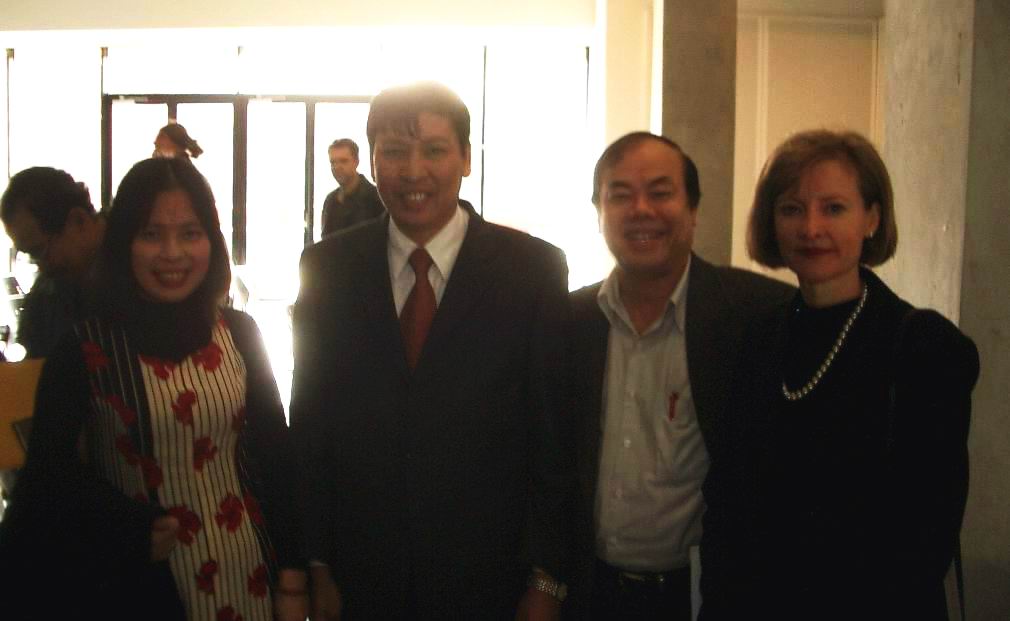
WTO MEMBERSHIP AND ASEAN FTA:
IMPACT ON
Prof Tran Van
Hoa recently participated in the 2006 Regional Progress Workshop, organised by the consulting firm ACIL (Australia) as part of the Trade Analysis and Reform Project (TARP) funded by the Australian
Government's AusAID over the period 2005-08, to assist in capacity-building of government officials in Cambodia,
Laos, Thailand and Vietnam, to prepare and manage their countries' WTO accession negotiations and implementation. A total of 11 research projects of high-priority
national interest and specifically dealing with trade and reforms in the
context of the WTO and ASEAN free trade agreements were selected by these
countries senior government officials for analysis. At the workshop, about 30
government officials were present to report their research progress and to
receive feedback from TARP consultants (trainers, mentors and project managers)
which included business consultants, well-known academics and senior government
officials from Australia, New Zealand, Canada, the US, the UK and Hong
Kong.
In the photo
below taken at the closing of the Workshop in the Crystal Ballroom of Holiday
Inn in Silom Road, Bangkok, are (first row, from left to right) Prof Tran Van
Hoa (Vietnam Mentor, 4th place), Bill Bowen (Laos Mentor, 6th), Ms Raviprapa
Srisartsanarat (TARP Project Manager, AusAID, Australian Embassy, Bangkok,
8th), Alan Oxley (Vietnam Trainer, ITS, 9th), and Sam Chittick (TARP Project
Manager, ACIL, 14th).
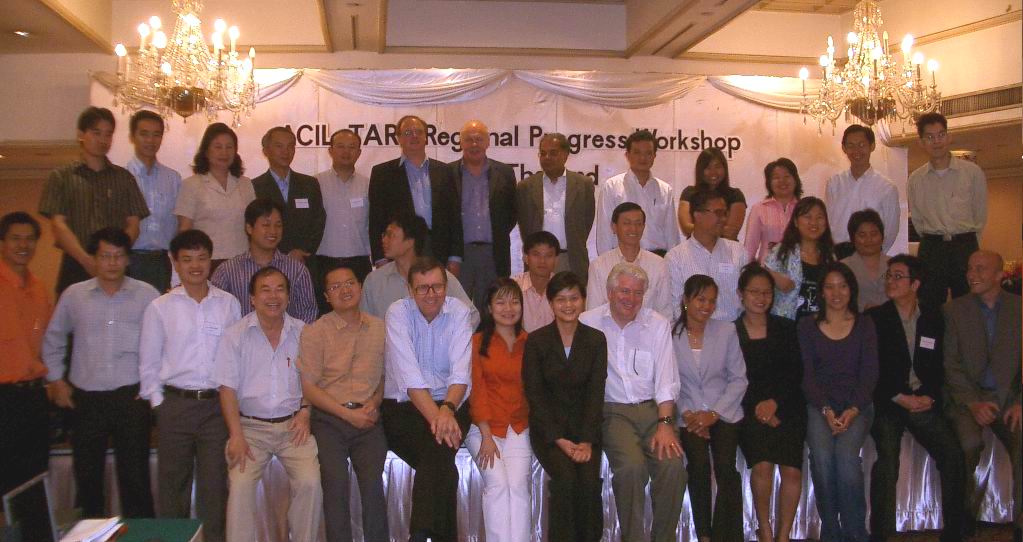
AUSTRALIA-CHINA FREE
TRADE AGREEMENT:
WHO GAINS AND WHO LOSES?
Capital
Regional free trade agreements (FTAs) have proliferated
in
In response to this lack of substantive research
and information for informed debates, Tran
Van Hoa, with the funding support from Australia Department of Foreign Affairs,
AusAID-ISSS Division, and China high-level academic institutions, led
a group of ASEAN and Australia experts on regional FTAs to participate in a 2-day 2-university conference and experts symposium
in Beijing to report on important new research work by
ASEAN, Australian and Chinese experts on sectoral, regional and national gains
and losses of an ACFTA to improve informed trade analysis and trade policy by
the two countries. Over 25 and 70 ASEAN, Australian and Chinese academics and
experts attended the CUBE experts symposium and the RUC conference
respectively.
The photo below taken at
the Opening Address given by the Local Organiser, Prof Yanyun Zhao, at the
ACFTA Conference in the School of Statistics Building on RUC campus on 18 April
2006 shows some of the participants.
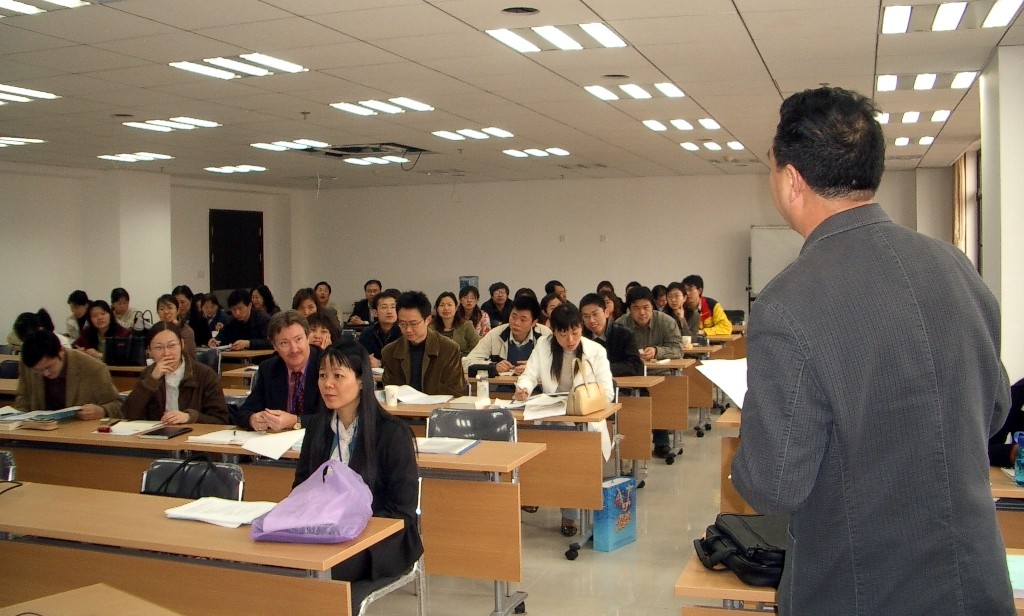
In the photo below are,
from left to right, (2nd to 7th) Prof
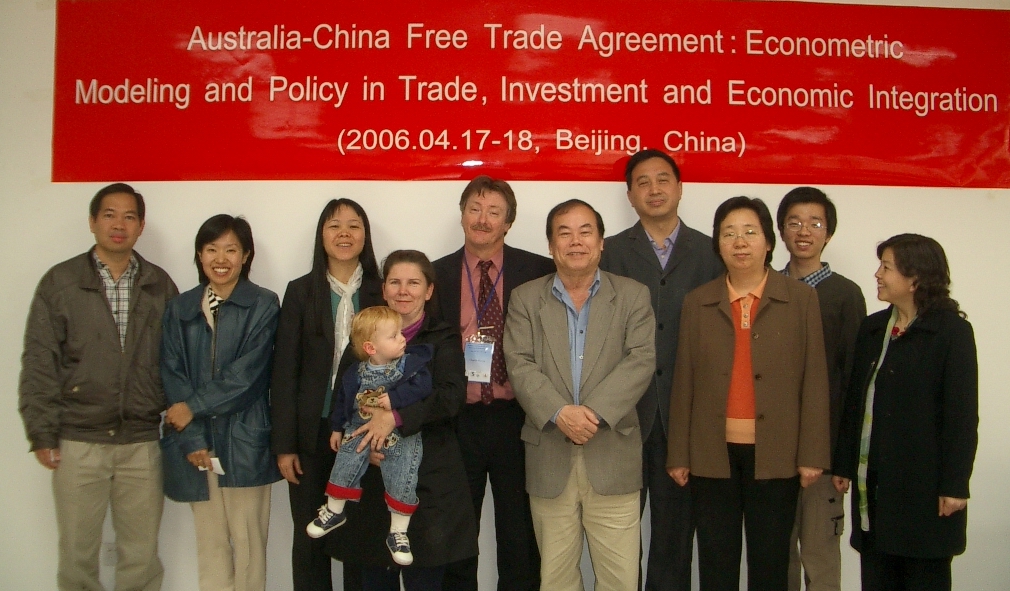
TRADE ANALYSIS AND
REFORM PROJECT (TARP) FOR
Tran Van Hoa recently joined an
international team of trainers and mentors to provide high-level training and
research capacity-building on the WTO/FTA and its practical policy
implementation for government officials in
In the photo below are some members of the
TARP trainer and mentor team after the Briefing Session at the Sofitel Hotel
Central Plaza in Bangkok, Thailand: (from left to right) Bill Dymond (Director,
Centre for Trade Policy and Law, Carlton University, Canada), Alan Oxley
(Managing Director, Monash University APEC Study Centre), Bill Bowen (Principal
Consultant, ITS Global, Melbourne), Prof Tran Van Hoa (CSES and Director,
Vietnam and ASEAN+ Research Program, Victoria University, Melbourne,
Australia), and Dr Razeen Sally (ISEAS, Singapore).
The TARP briefings in
A New Approach
to Better Study the Impact of the WTO Membership and Free Trade Agreements: International
Recognition
30 January 2006,
The WTO membership and its subsets, regional free
trade agreements (FTAs), are considered world-wide the main frameworks to
promote trade, development, growth and welfare improvement for member countries.
However, the benefits (and costs) of these frameworks are usually perceived in
official negotiations and expert debates leading to a WTO/FTA membership more
as an article of faith (in free-market economics) than as hard or reliable
substantive empirical evidence. The importance of more reliable empirical
evidence on this impact of the WTO and FTAs is recognised in the form of the 2004 Best Paper Prize
awarded recently by the Association of the Korean Economic Studies
(AKES) to a journal article written by Prof Tran Van Hoa, Korea’s Trade, Growth of Trade and the World Economy in Post-crisis
ASEAN+3 Free Trade Agreement: An Econometric and Policy Analysis, Journal of the Korean Economy, 2004, Vol. 5, No. 2, pp. 73-108. Online
access:www.akes.or.kr/jke/index.htm. The paper introduces the Generalised
Gravity Theory and a new modelling and impact study approach (with superior
properties to existing quantitative methodologies adopted by some academics and
international organisations such as the IMF, the World Bank, and the Asian
Development Bank) to investigate and causally explain Korea's spectacular
ups-and-downs economic performance in the past 30 years.
ASEAN,
Monash Asia
Institute,
Regional economic integration (EI) and free trade
agreements (FTAs) have proliferated in Asia and Oceania in recent years,
resulting in, for example, the current AFTA, ASEAN+3, Australia-Thailand,
Australia-Singapore, Japan+Singapore, and the proposed ASEAN+Australia,
ASEAN+India and ASEAN+Russia. The ASEAN+ FTAs in particular are important for
South East Asian countries in their regional strategic alignment to promote
growth, investment, services, economic relations and co-operation, and
political dialogue. These issues and the implications of the economic
performance and sustainability of China and India or China vis-à-vis India were
discussed by Prof B.B. Bhattacharya, the new Vice-Chancellor of India’s
prestigious postgraduate university, Jewaharlal Nehru University (JNU), at a
recent seminar on India as an Emerging Economic Power:
Constraints and Imperatives at Monash Asia Insitute
on 19 January 2006. (It is important to note that one of the JNU’s
long-established traditions is that JNU’s Vice-Chancellors are appointed by the
President of
In the photo taken before the seminar
at the
Methodologies to Measure the Impact of Free Trade Agreements and the WTO
6 December 2005,
Hanoi, Vietnam Institute for Trade (VIT), Ministry of
While there are many
ways, from simple to sophisticated, to measure the effects of economic policy
and change, and global co-operation, existing methods such as the CGE/GTAP or gravity theory,
while popular and useful, may not be appropriate for robust and realistic
outcomes because of their structural restrictions and data limitations. A
survey of these methods and other new and more reliable approaches (such as the
Generalised Gravity Theory proposed in 2002
by Tran Van Hoa and applied extensively) was provided by
Tran Van Hoa recently when he attended the Australian Research Council-VIT
workshop, organised by the 2004-07 ARC Linkage Industry Partner, VIT, in Hanoi,
to deliver a lead lecture on recent methodologies to evaluate the benefits and
costs of free trade agreements (FTAs) and the WTO membership. The workshop was
also used as a venue for capacity-building for government officials in
In the photo below
taken at the Conference Centre at the VIT Headquarter, 46 Ngo Quyen, Hanoi,
are, from left to right, Doctoral Scholar Ho Trung Thanh, (Head, Research
Department, VIT), Dr Pham Lan Huong (Head, Economic Integration Department,
Central Institute for Economic Management (CIEM), Ministry of Planning and
Investment), Prof Tran Van Hoa (ARC Linkage Project Leader), and Prof Dr Nguyen
Van Lich (Director-General, VIT, and ARC Linkage Industry Partner).
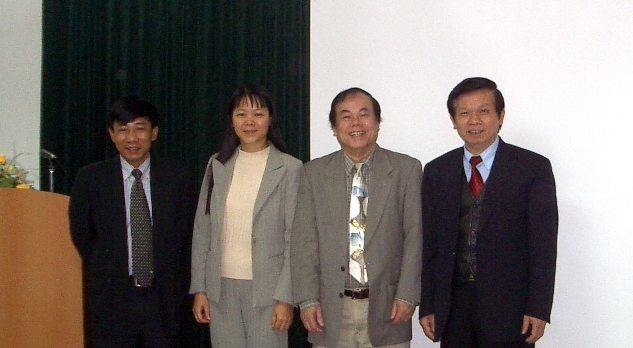
Asian Forum on Business Education
30 Nov-2 Dec 2005,
The ways business
has been conducted in major Asian countries in recent years were discussed at
the 10th Asian Forum on Business Education
(AFBE) conference organised by the Faculty of Management Sciences at Ubonrajathani
University in north-east Thailand during 30 Nov-2 Dec 2005. More than 50 experts, academics, corporate executives, and MBA and DBA
students from major countries in Asia, Australasia, Europe and
In the photo taken at
the conference venue, the Tor Sang Hotel, are, from left to right, Prof Dr
Apichai Puntasen (Dean, Faculty of Management Sciences, Ubonrajathani
University), Prof Tran Van Hoa, Prof Prakob Wirojanagud (President,
Ubonrajatani University), and Prof Brian Sheehan (President and Secretary,
AFBE)
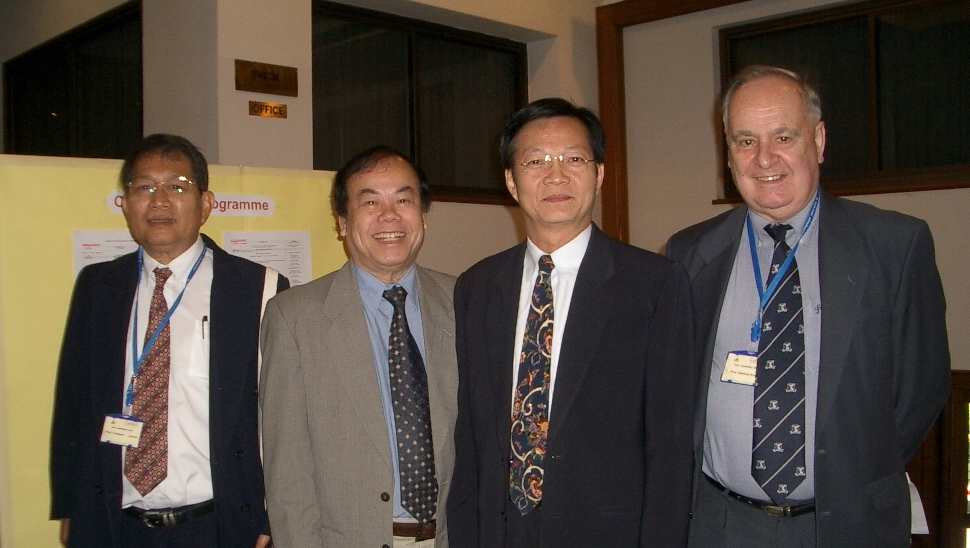
The photo below shows
some of the participants at the Opening Ceremony of the 10th AFBE conference.
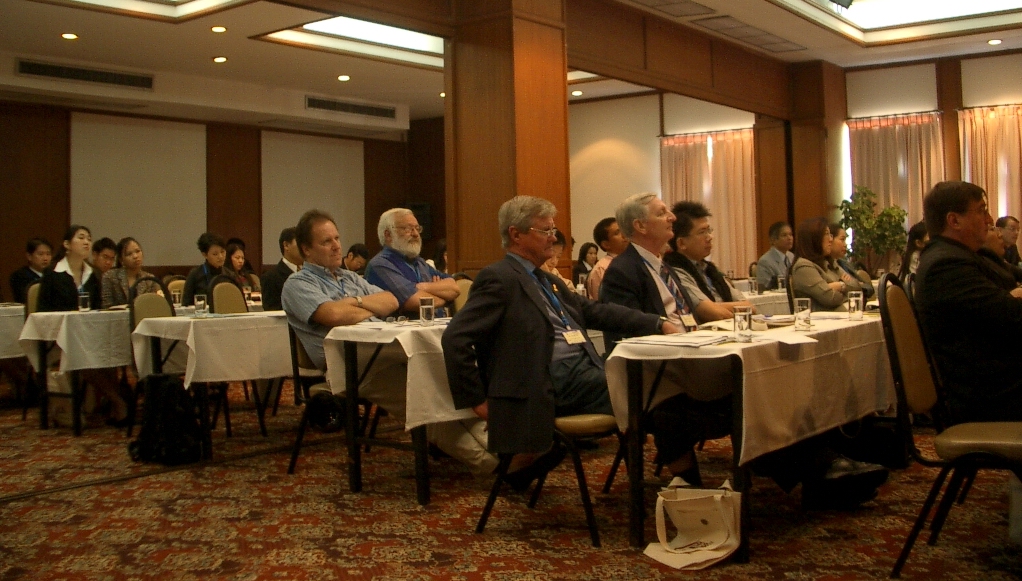
Issues of Trade, Development, Investment, Cooperation, and Integration in an Enlarged ASEAN
Centre
for Strategic Economic Studies (CSES),
24-25
November 2005, Victorian Arts Centre,
Tran Van Hoa convened and organised an
important high-level international conference on 24-25 November 2005 at the
Centre for Strategic Economic Studies (CSES),
Funded by the Australian Government’s AusAID
and the Faculty of Business and Law, the conference attracted eminent
economists and speakers from major countries in an enlarged ASEAN region. These
include
Interest was also shown by such organisations in
The special focus of the conference was to discuss major issues in trade in
merchandise goods, services (including education and finance), investment,
across- and inside-border economic integration, corporate culture in international
business, poverty reduction through trade, the effectiveness of ODA-related
micro-finance programmes, the role of SMEs and agriculture (a major obstacle in
on-going WTO negotiations), issues of intellectual properties (eg,
pharmaceuticals), issues of large trade surplus for Asian economies, and
regional economic relations and cooperation between enlarged ASEAN members.
Some of these are timely and major issues for presentation and discussion in
the forthcoming agenda of the First East Asia Summit by enlarged ASEAN Heads of
State and hosted by the Government of Malaysia taking place on 13-14 December
2005 in
In the photo below taken at the Conference Opening Ceremony at the
Amcor-Commonwealth Bank Suites at the Victorian Arts Centre are, from left to
right, Prof
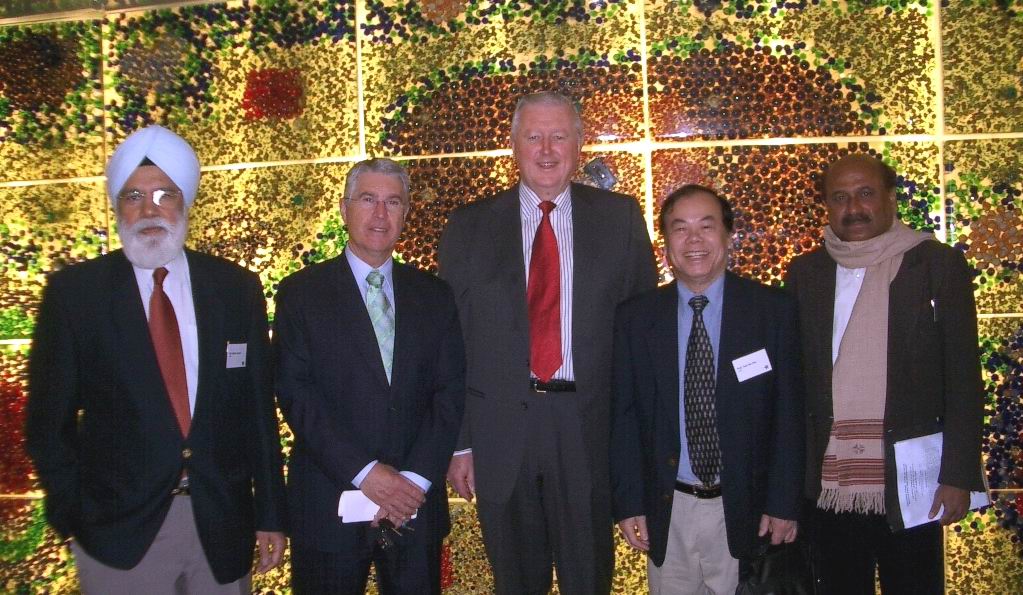
In the photo below are some of the participants attending the
conference.
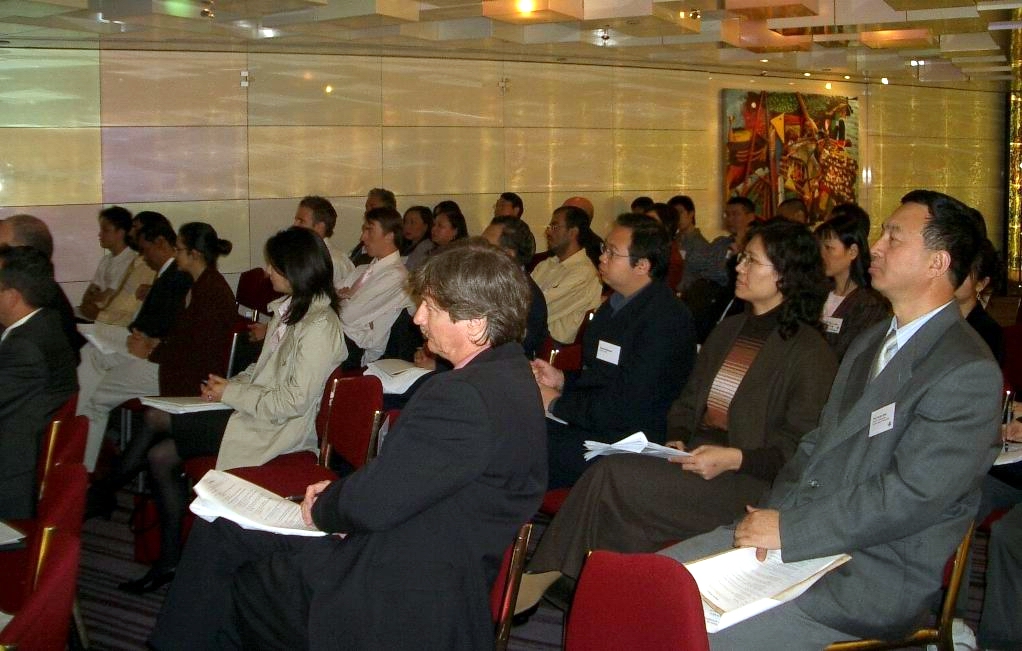
The photo
below, taken at the Vice-Chancellor Conference Suite at Victoria University
Melbourne City Campus, shows some of the participants at the roundtable
discussion of the First East Asia Summit
and other trade, investment, services, and economic co-operation issues.
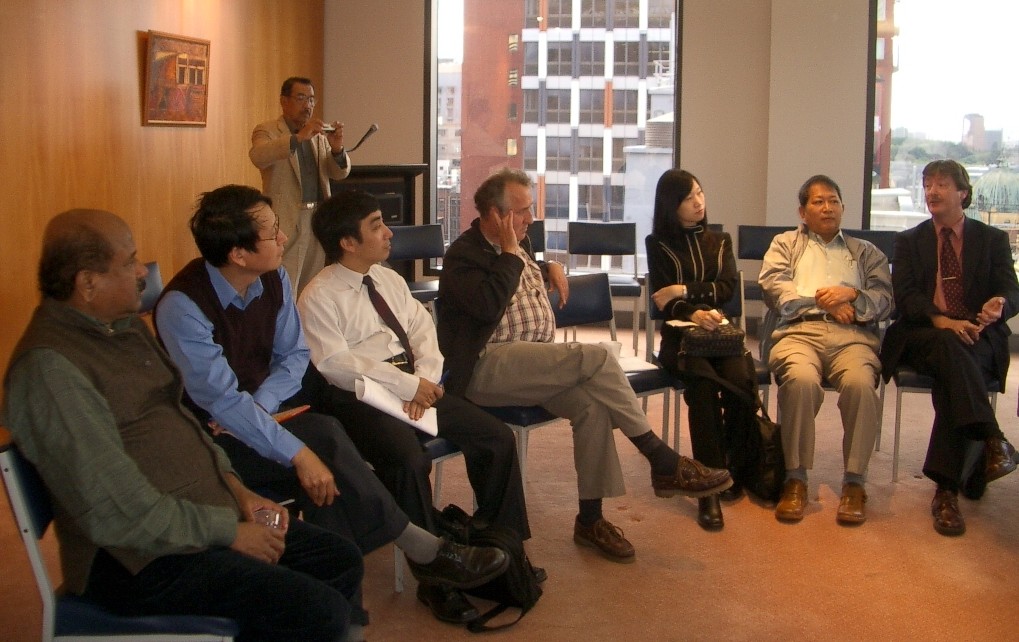
Impact of Asian Free Trade Agreements and the WTO on
10-13 November 2005
Dong Bei (North-East) University
of Finance and Economics (DUFE),
Four
in a network of a total of 30 Universities of Business, Economics and Finance
in China recently held an international conference Statistical Modelling and Regional Economic Development in West China at the Capital (Beijing) University of Business and
Economics (CUBE), Beijing, to discuss economic development issues in North-East, North-West, Central West and
South-West China, and the impact of Asian free trade agreements and the WTO on
this regional development. Tran Van Hoa was a keynote speaker at this conference which was funded
by businesses and the local and central governments. The conference attracted
more than 60 participants from all regions in
In the photo below are, from left
to right, Prof Hong Ji (Head of the Statistics Department, CUBE, and Local Organiser),
Prof Tran Van Hoa, Prof Wenju Wang (Vice President, CUBE), and Prof Yanyun Zhao
(Director. Center for Competitiveness Studies, and
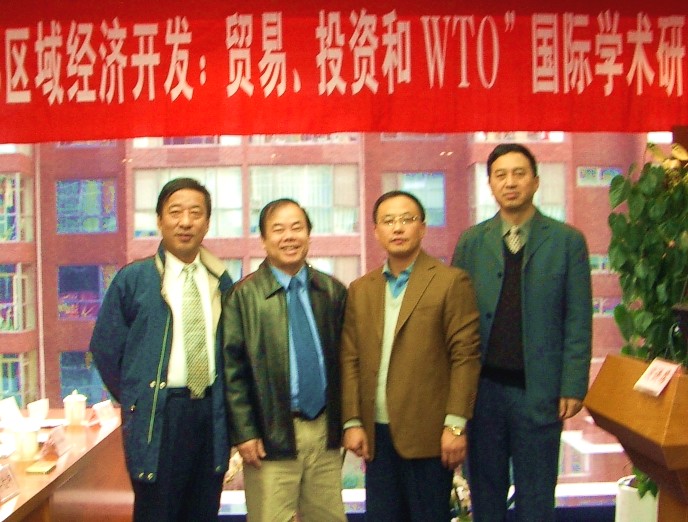
In the photo below are
Prof Tran Van Hoa (5th from left, first row, standing) and Prof Charles Harvie
(6th, Director, SME Research Centre, University of Wollongong) with some
participants in front of the Conference Centre at the Winterless Hotel in
Beijing.
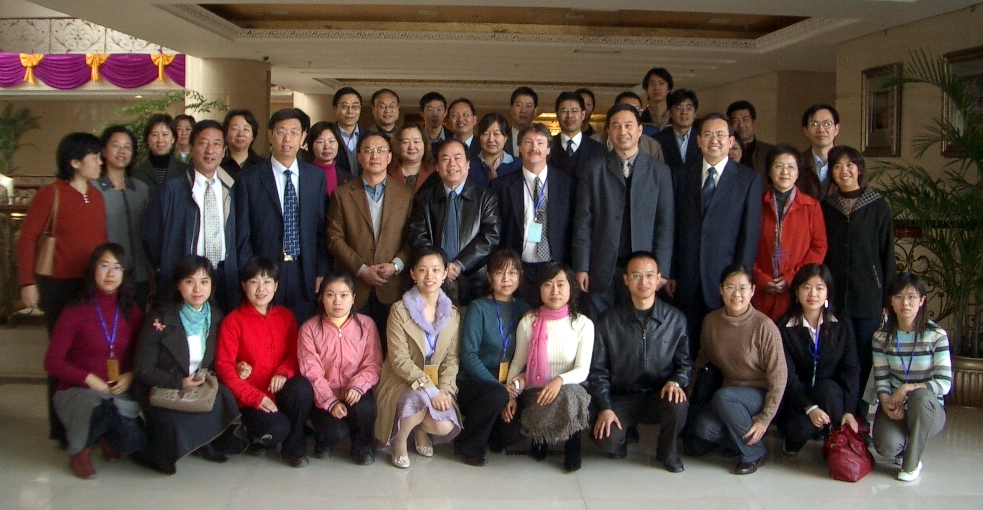
The photo below shows
some of the audience at the Special Sunday Lecture given by Prof Tran Van Hoa at Dong Bei (literally East North)
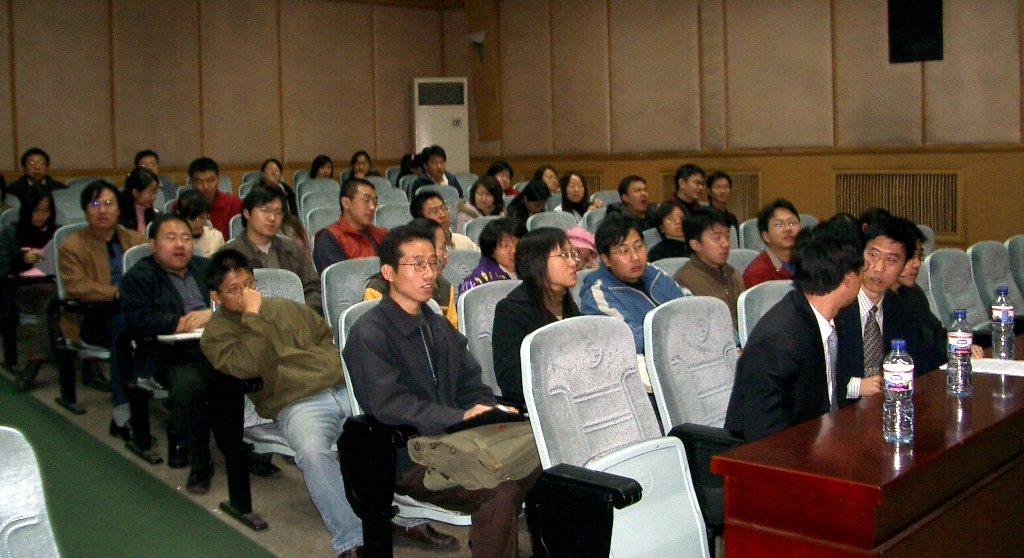
How to Measure More Reliably the Rural Impact of Asia-Australia Free
Trade Agreements
19 October 2005, Charles Sturt University, Wagga Wagga, NSW, Australia
Tran Van Hoa was invited to visit the Faculty
of Commerce at
In
the photo taken at the seminar are, from left to right, Associate Prof Kishor
Sharma (Sub Dean, International Research), Prof Tran Van Hoa,
Prof Eddie Oczkowski, and Chris Deely
(Seminar Convenor)
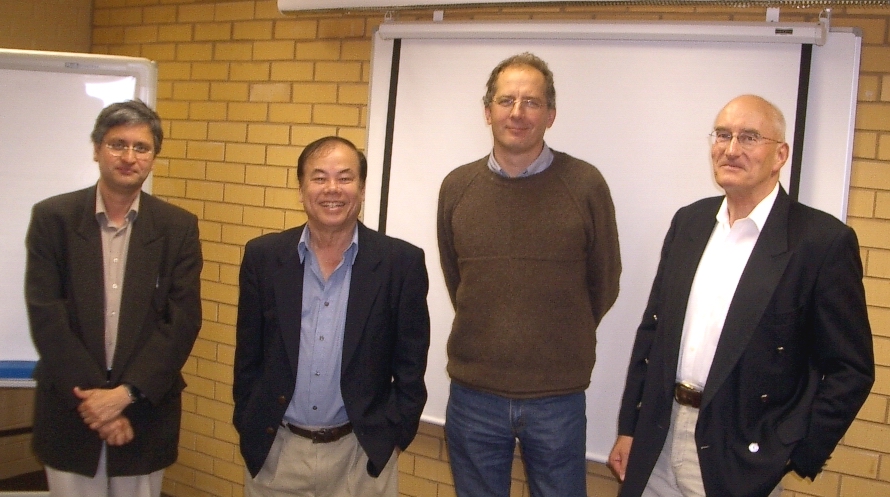
Measuring
Women's Worth in Society and the Economy
28
September 2005,
Women's
contribution to society and the economy world-wide had been, for more than 100
years, neglected or grossly underestimated by mainstream economics and
sociology and, occasionally, even by university and college presidents. This is
unfortunate despite the seminal studies on women's market and non-market work
and pay or worth by Charlotte Perkins Gilman in 1898 (Women and Economics), Margaret Reid in
1934 (Economics of Household Production) or Gary Becker (USA)
and Duncan Ironmonger (Australia) in
more recent years. This perception and deficit have however been rectified to a
large extent by significant studies by international experts in the area and
published in August 2005 in Tran Van Hoa (editor) Advances in Household Economics, Consumer
Behaviour and Economic Policy (Ashgate, Aldershot, UK).
The timely and
important book contains recent studies, in honour of Duncan Ironmonger's
life-time work, on the state-of-the-art in the measurement and application of
household economics and household production, and on new developments of
consumer behaviour (essential for effective marketing). More importantly, the book discusses the implications of these
advances for more appropriate and effective analysis and formulation of
contemporary economic and social and welfare policy in both developed and and
developing countries and at the micro and macroeconomic level. The studies
contained in the book also point out that women's worth is immense for society
and, in an economic sense, far excceds the GDP (as measured routinely so far by
market activities only) of a nation.
The book was formally launched by
Prof Emeritus Joe Isaac at the invitation of Prof Emeritus Jim Perkins, on 28
September 2005 at the
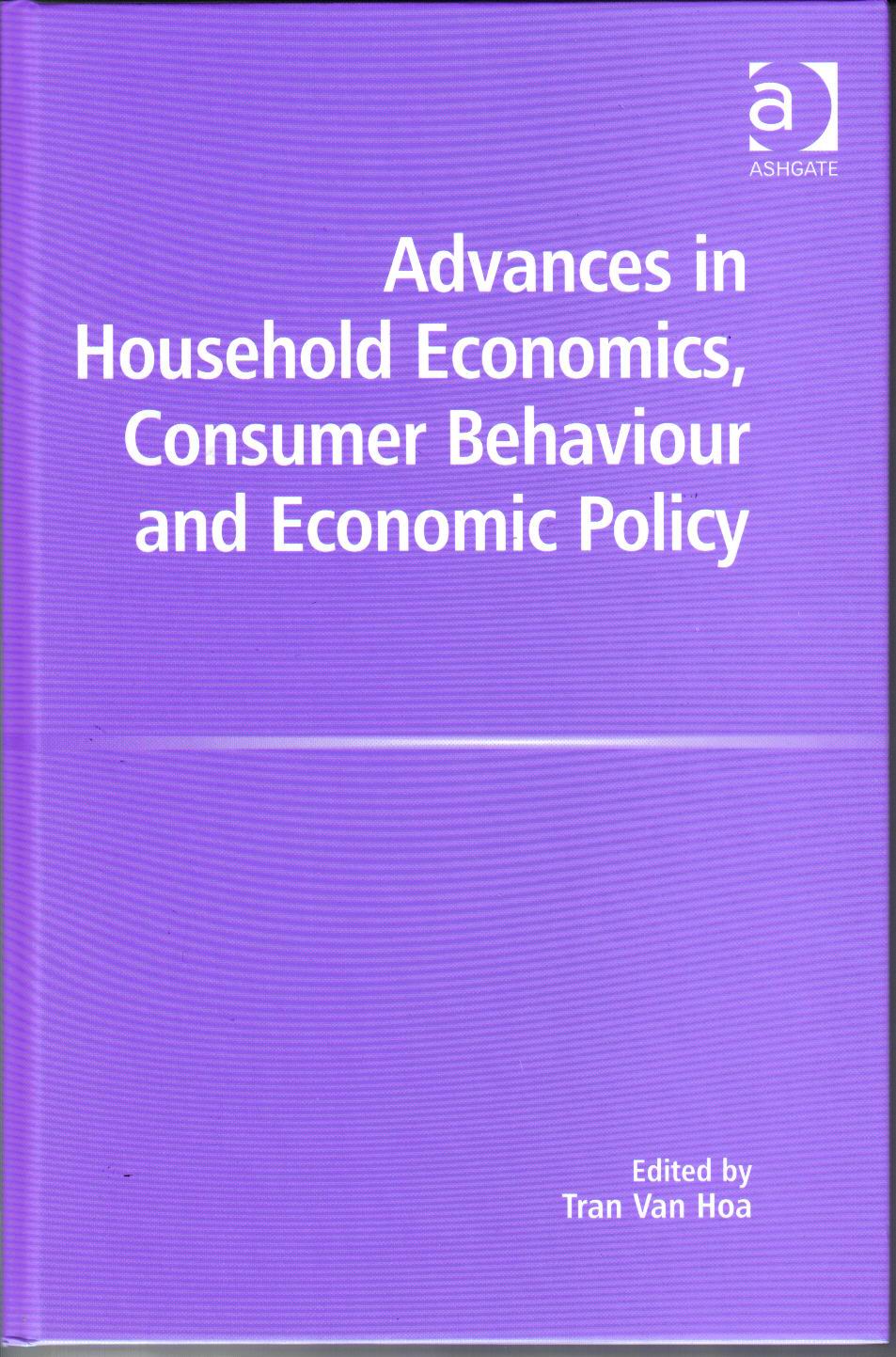
In the photo below taken
at University House, University of Melbourne, at the book's launch are, from
left to right, Dr Duncan Ironmonger (Director, Households Research Unit,
Department of Economics, University of Melbourne), Dr Barry Jones (President,
Australian Labor Party), Prof Tran Van Hoa, and Prof
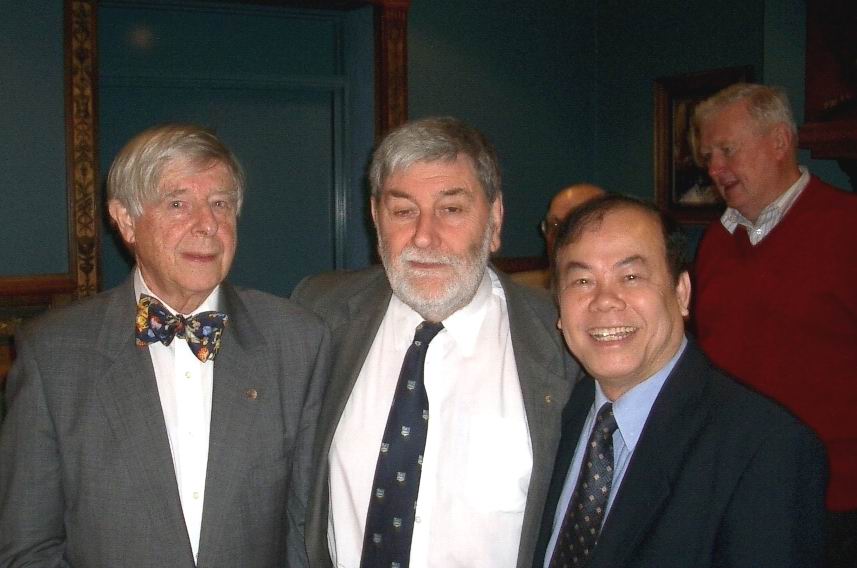
Asia
and Regional Development in
23
September 2005
Tran Van Hoa attended and delivered a keynote speech
at the 2005 Asia Update Forum in
Speakers at the 2005 Forum included the Director
General of the NSW Regional and State Development Department, First Assistant
Secretary of the Department of Foreign Affairs and Trade, ABARE senior
economist, Austrade commissioner, Chairman of the Central West Regional
Development Board, Prof Tran Van Hoa, Prof Stephanie Fahey (University of
Sydney), an MLA, and the regional manager of DEVRO.
In the photo taken at the Forum function below are,
from left to right (standing), 1st, Mr Sandy Morrison (Chair, Central West
Regional Development Board); 2nd, Jammie Penn (ABARE); 3rd partly obscured, Mr
Loftus Harris (Director General, NSWRSDD); 4th, Prof Stephanie Fahey (Pro Vice
Chancellor and Director, Research Institute for Asia and the Pacific, Sydney
University); 9th, Prof Kevin Parton (Forum Organiser); 11th, Prof Tran Van Hoa;
and 14th, Dan Williams, Trade Commissioner at the Australian Embassy in the
Philippines.
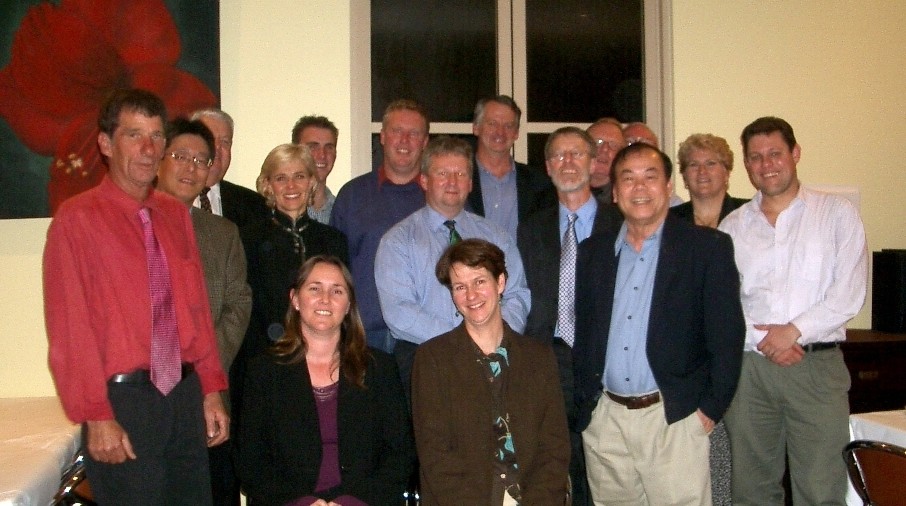
ASEAN+3 FREE TRADE AGREEMENT AND AUSTRALIA-VIETNAM TRADE
6 September 2005, Ministry of Trade,
Tran Van Hoa recently participated in an ARC workshop on ASEAN+3 Free Trade Agreement and Recent Trends in Trade and Development
in ASEAN at the Vietnam Institute for Trade (VIT), Ministry of
Trade (MOT), in Hanoi. The workshop was organised by the ARC Industry Partner,
VIT, and was a venue to report the progress research work of the first stage of
activities of the ARC Linkage Project ASEAN+3
Free Trade Agreement and Its Impact on Australia-Vietnam Trade.
At the workshop, aspects and issues of FTAs, recent trends in trade,
investment, development, growth, and regional economic relations were presented
and discussed by Prof Tran Van Hoa (the ARC Chief Investigator) and VIT
researchers. More than 30 MOT government officials attended the workshop.
A fieldtrip for the ARC Chief Investigator to a southern province in
In the photo below taken at the workshop
are, from left to right, Ho Trung Thanh (ARC VIT Project Manager), Prof Tran
Van Hoa, Dr Nguyen Van Thanh (Deputy Director General, VIT), and Nguyen Van
Duong (Director, International Office, VIT).
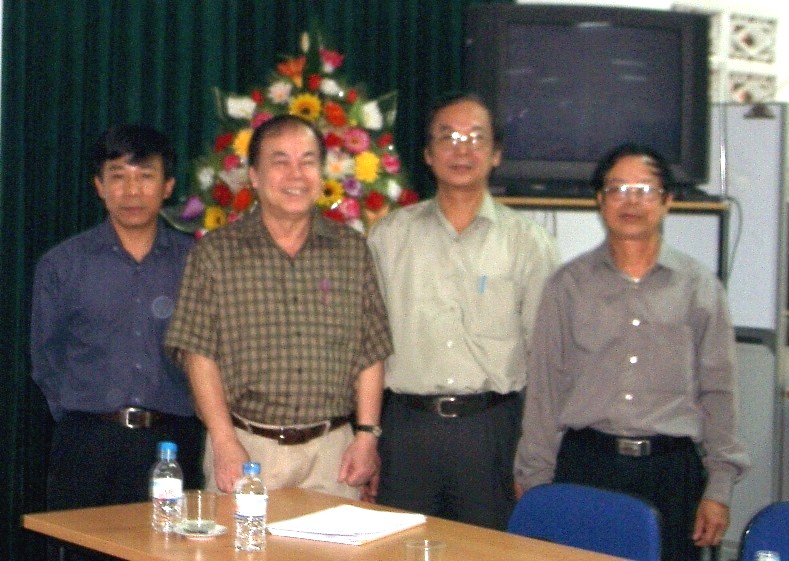
In the photo below is a view of participants
at the workshop at VIT headquarters in
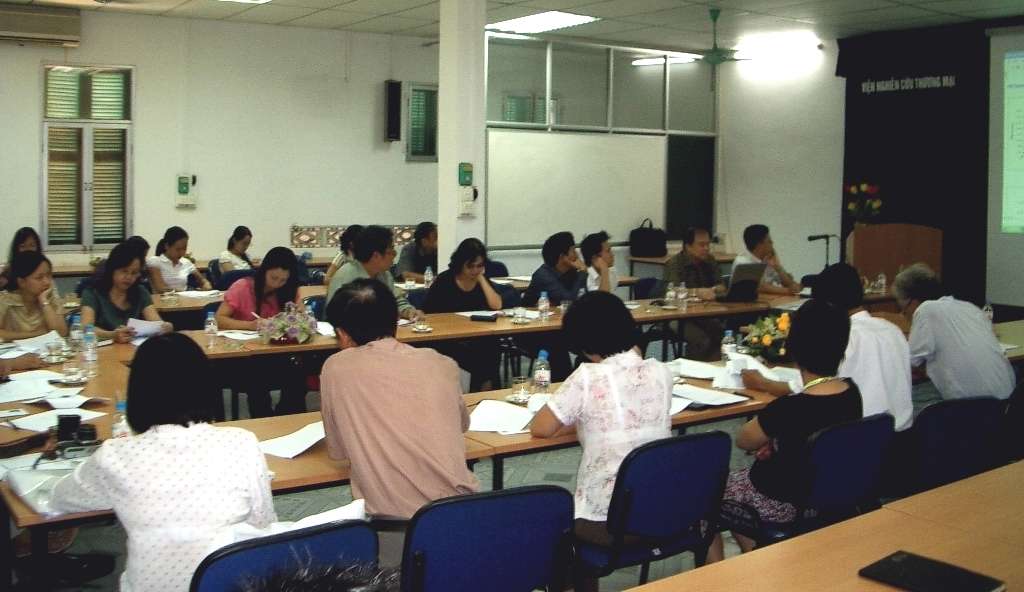
15th
During
28-29 June 2005, Tran Van Hoa also attended, as an IOA delegate invited by the
Local Organiser, the 15th
Interntional Conference of the Input Output Association that took place at Run Run Shaw Conference Center at
the Renmin University of China in Beijing. The Conference was highly
significant in that it was the first ever IIOA conference taking place in
In
the photo below taken in front of the School of Staitsics Building at Renmin
University of China are, from left to right, Prof Qiyun Liu (IIOA Vice
President, China) , Prof Yanyun Zhao (IIOA Vice President, China, and
Conference Local Organiser), Prof Karen Rosel Polemke (former IIOA President,
and Prof, Department of Urban Studies, MIT, USA), and Prof Tran Van Hoa,
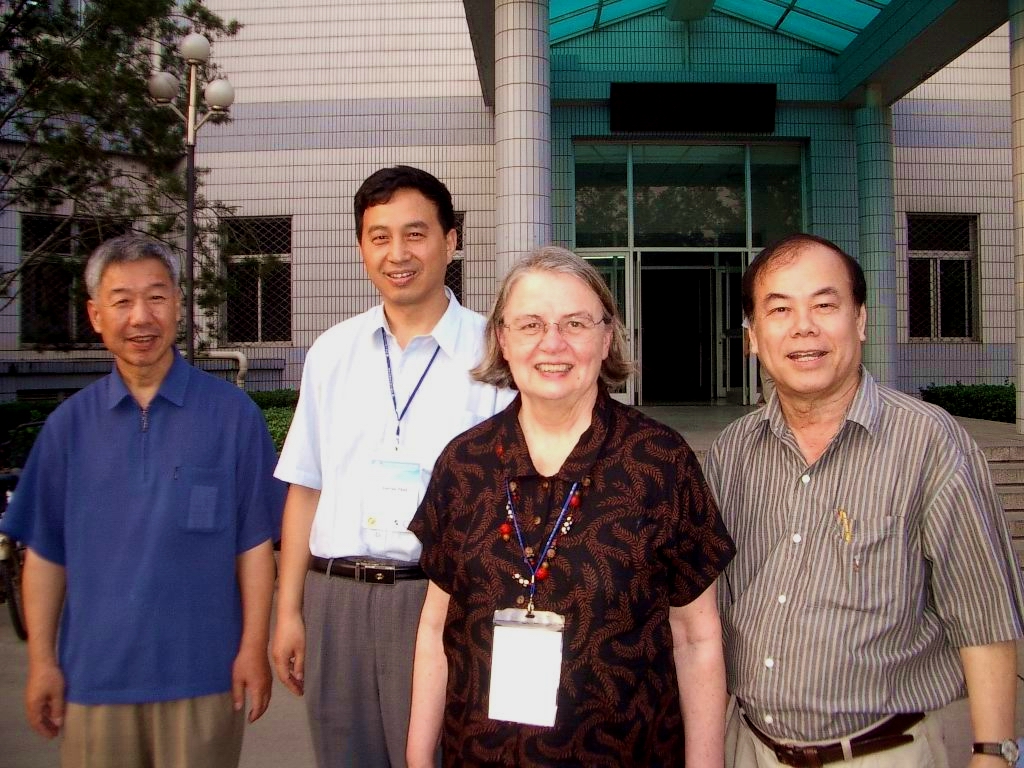
WTO,
X'ian
Tran
Van Hoa recently attended the International
Conference on the WTO,
In
the photo below taken at the Conference Opening Ceremony at the X'ian Jiaotong
University Conference Center are, from left to right, Prof Tran Van Hoa, Ms Aq
Ying Gao (Shan'xi TV Representative) and Prof Zongxian Feng (Head of Department
of Economics and Finance, XJTU), the Local Conference Organiser.
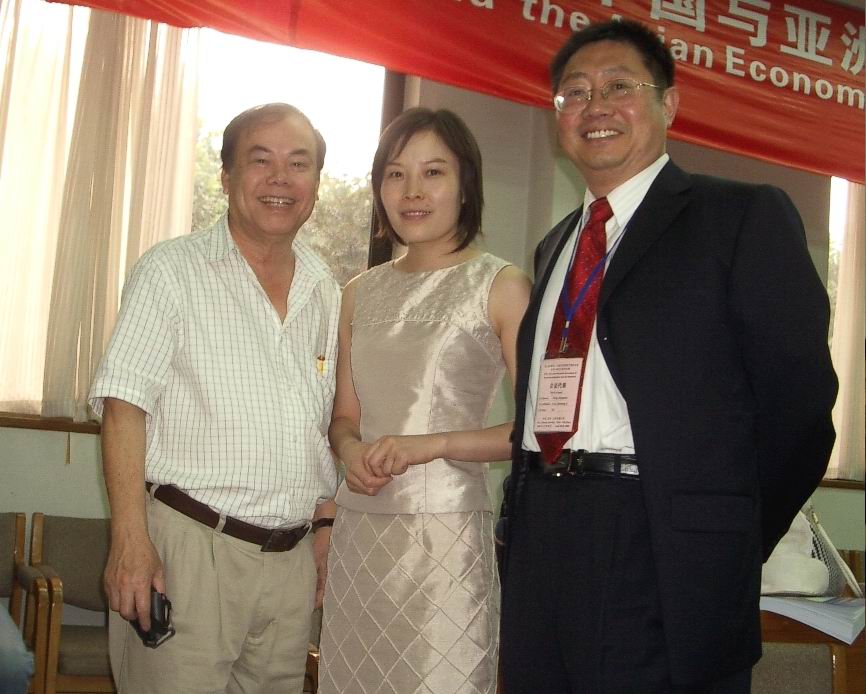
Development
and Co-operation in
the
An
AusAID-funded International Workshop
Hanoi 29-30 March 2005, NATI, Vietnam
Ministry of Trade
An important international
workshop with the theme Impact of the WTO and Regional Economic
Integration on Development and Trade in the Mekong River Subregion Economies recently took place at the National Advanced Training Insitute (NATI),
Vietnam Ministry of Trade, in
Facilitated by Prof
Tran Van Hoa (Department of Economics, and Director, ASEAN+3 and Vietnam Focus
Research Program, University of Wollongong, Australia), funded by AusAID, Australia Department of Foreign Affairs and Trade, locally organised by the NATI (Rector, Dr Pham Quang Thao), and
co-sponsored by Prof
Major issues for presentation and
discussion were focused on the turbulent history of the economies in the GMS,
their current economic and trade development nationally and within the
framework of the WTO and regional economic integration, and the need for their
co-operation to enhance their mutually important economic, commerce and
political benefits in the medium and long term.
The workshop papers and discussion were widely
reported in the English (eg, Viet
Nam News and Vietnam Investment Review, 30 March 2005)
and Vietnamese mass media.
In the photo below,
taken in the NATI auditorium at the opening ceremony of the workshop, are, from
left to right, Prof Yanyun Zhao (P.R. China), Prof Charles Harvie (Britain),
Prof
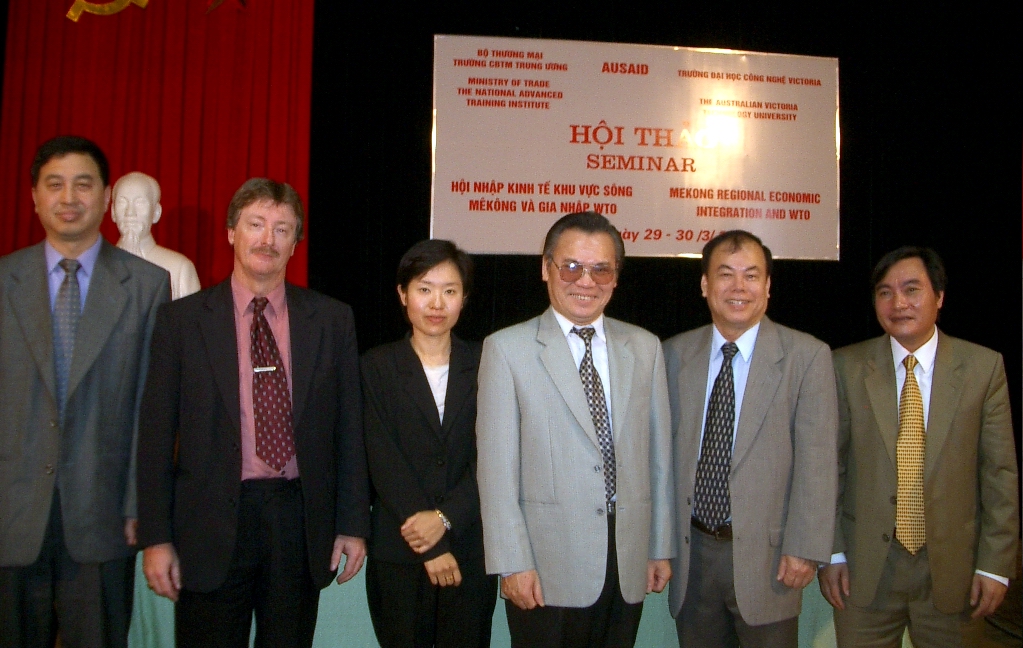
In the photo below
taken at the workshop during discussion are Prof Tran Van Hoa (left) and Mr Phanh Vilaysom, Economic and Commercial Counsellor at the Embassy of the Lao People Democratic Republic (PDR).
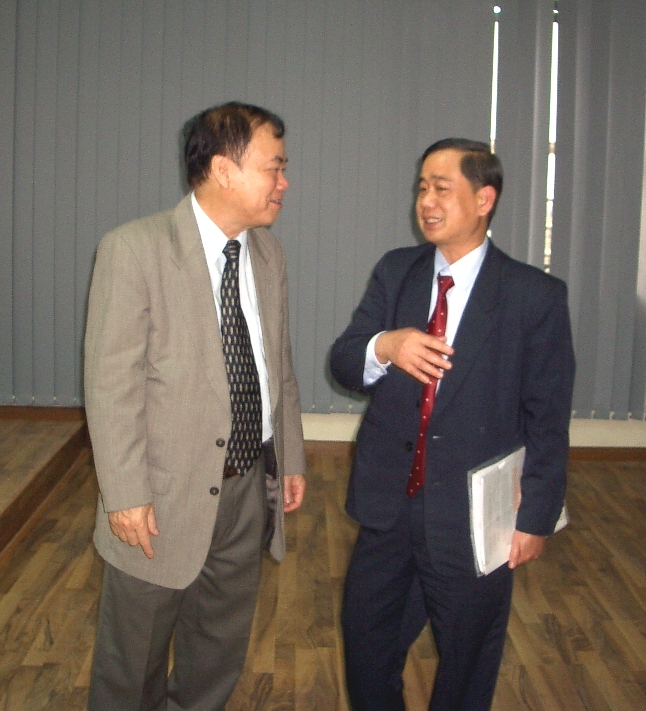
Below
is a photo of some of the participants, coming from the major ministries,
national and international agencies, and national and transnational companies
in
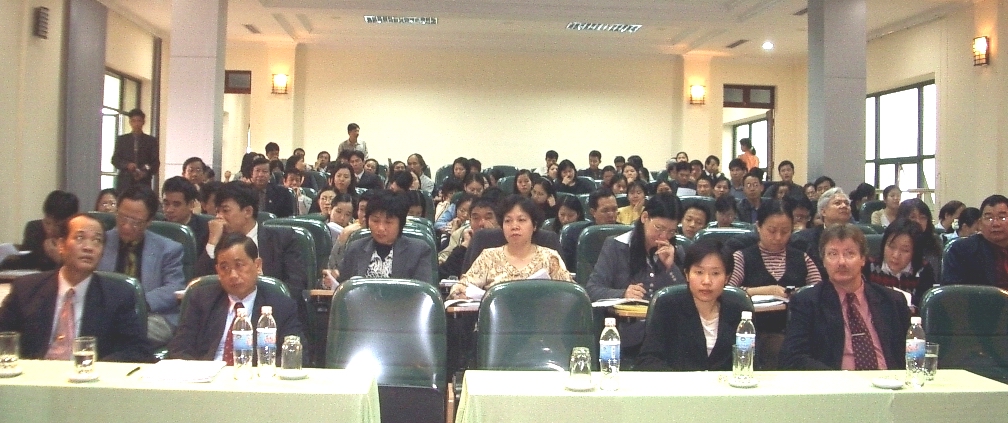
ASEAN+3
Free Trade Agreement:
Impact on Australia-Vietnam Trade and
Investment
10 November 2004, Vietnam Institute for
Trade,
With the slow progress and still extensive
disagreements on the
A new methodology
with substantial and realistic improvements on economic structure, scope in
trade, time-series data consistency and superior estimation and impact features
has been proposed in a major international linkage research project to study an
important regional economic and trade issue in Asia: the Impact of ASEAN+3 FTA on Australia-Vietnam Trade. Funded by the Australian Government Research
Council (ARC) for the period 2004-07,
the project is managed by Prof Tran Van Hoa (the Chief
Investigator) and with the collaboration of the Director-General (the Industry
Partner Investigator), Prof Nguyen Van Lich, of Vietnam Institute for Trade (VIT), a division of Vietnam Ministry of Trade. VIT-funds matching ARC grant were provided by Vietnam Ministry of Trade
under the sponsorship of HE Le Danh Vinh, Vice Minister of Trade. Substantive empirical outcomes from the project are expected to provide
timely, robust and reliable policy recommendations to both the governments and
trade agencies in Australia and Vietnam to enhance their trade and economic
well-being and regional cooperation and, as a result, stability and security in
the region. Applications of the methodology to other FTAs such as the recent
Australia-US and Australia-Thailand and the proposed ASEAN+
In the photo below
taken at the Signing Ceremony of the ARC Linkage Project at the Vietnam Institute
for Trade's conference centre at its headquarter, 46 Ngo Quyen, Hanoi,
are from left to right, Ms Nguyen Thi Nga (VIT Interpreter), Prof Dr Nguyen Van
Lich (VIT Director-General), H.E. Le Danh Vinh (Vietnam Vice-Minister for
Trade), H.E. Joe Thwaites (Australian Ambassador to Vietnam), and Prof Tran Van
Hoa. The Signing Ceremony was nationally televised and reported in the radio
and print media.
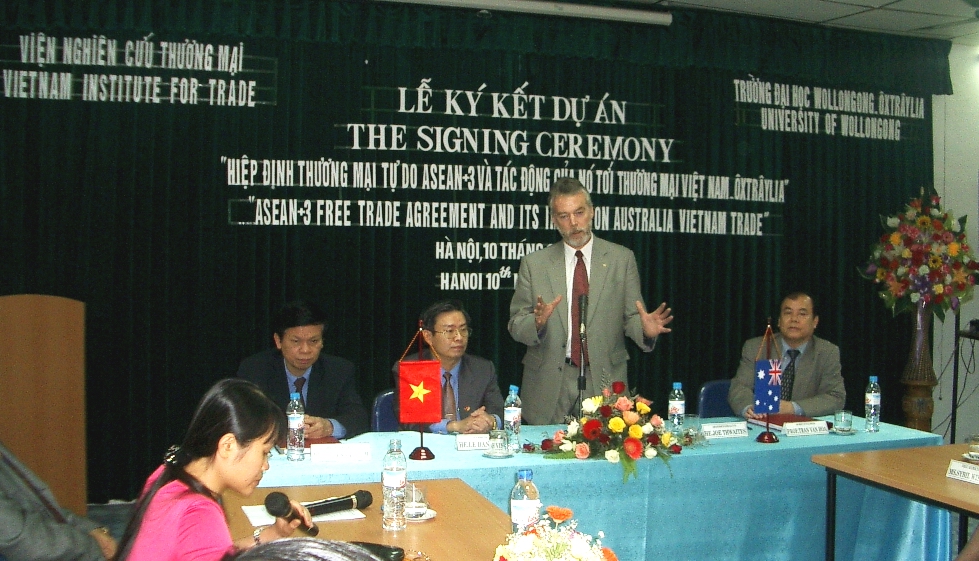
What's New in Sex Discrimination and
Economic Policy
4 November 2004
Department of Economics,
In the photo below taken at a post-lecture
dinner at the University Food Re-thought Restaurant are
the
Hon Sharon Bird, new Federal MP for Cunningham and Prof Tran Van Hoa.
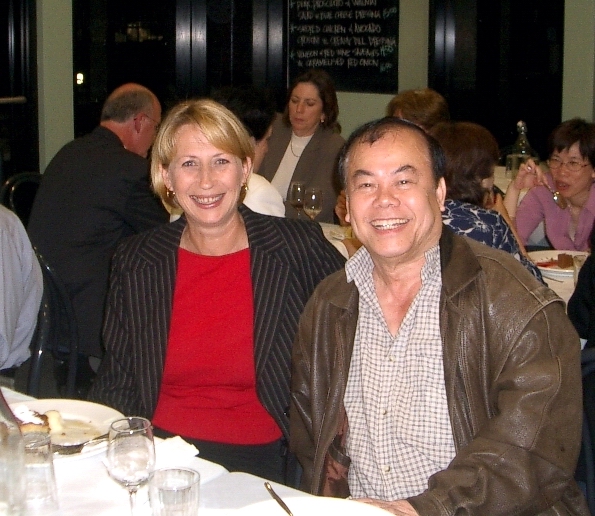
Second Italy-China International
Conference on
Economic and Social Statistics
25 October 2004
University of
As part of their on-going collaborative work in economic and
statistical research within the Asia-Europe linkage framework, the University of Florence (UNIFI)
in Italy and the Renmin University of China (RUC) in Beijing, China,
jointly held their 2nd interntional conference at the Department of Statistics
(G. Parenti) Centre on the UNIFI campus on 25 October 2004 (the first Italy-China
international conference was held in Guangdong in December 2002). Co-ordinated by Profs
Guido Ferrari of UNIFI and Yanyun Zhao of RUC and with the collaboration of
Prof Tran Van Hoa (University of Wollongong, Australia), the conference had the
participation of more than 20 academics and experts from major cities in
Italy, four major provinces in China and high-ranking universities in
Australia. The topics of discussion are wide-ranging (16 papers were presented)
and cover both theoretical and empirical aspects of: ASEAN+3 free trade
agreement and its impact on Asia-EU trade, growth and economic relations;
computable regional equilibrium modelling; R&D, technology innovation,
competitiveness, technology efficieny and optimal expenditure size on national,
regional and sectoral growth in China; administrative data organization,
teaching supply analysis and university education evaluation in Italy; use of
equivalence scales in separated (divorced) family child support; and firm
size distribution in a socialist market economy (such as China and Vietnam).
The conference was also a major event from a bilateral (Italy-China)
perspective that was organised to help, through the efforts of EU and Asia
economic and statistical academics and experts, to strengthen the broader
Asia-EU link and collaboration scheme vigorously supported by the European Commission
and the Government of China and institutions in Asia and
In the photo below taken at the opening of the
conference are, from left to right, Prof Sandro Viviani (UNIFI), Dr
Lorella Palla (Head, UNIFI International Relations Office), Mr Li Runfu (Consul
General of China in Florence), Prof Guido Ferrari (UNIFI), Prof Tran Van Hoa
(UOW) and Prof Yanyun Zhao (RUC).
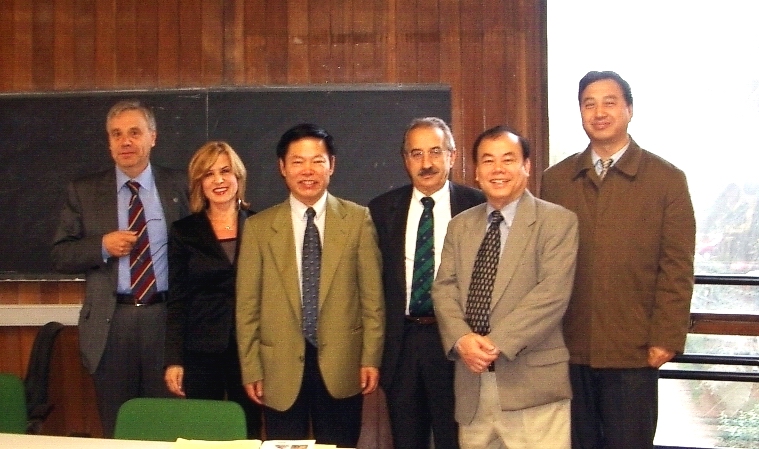
In the photo below taken on the terrace at the Pitti Palace Hotel for the Conference Farewell Dinner,
hosted by Mr Paolo del Bianco, President of the Fondazione
Romualdo del Bianco of Florence (a non-profit agency with international social
mission
objectives),
are, from left to right, Prof Guido Ferrari, Mr Paolo del Bianco, Prof Tran Van
Hoa and Prof Yanyun Zhao.
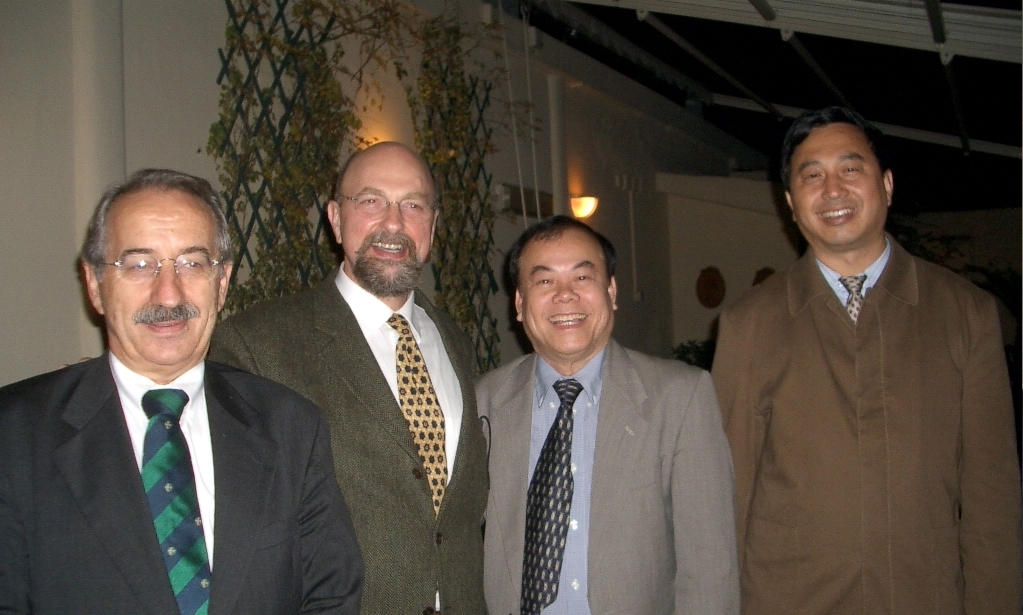
4th Asia-Pacific Economic Forum
International Conference
Asian and Global Economies:
Issues of Competitiveness and Growth
5-7
September 2004
Renmin
The Asia-Pacific Economic Forum (APEF) held, with the financial support
of China Department of Education, its 4th International Conference at the
Renmin (People)
Founded in 2001 at the Kangwon National University, Chunchon, Korea, the
APEF which is a new economics society has a wide-ranging high-level membership
from a global academic and government expert community consisting of major
countries in Asia (eg, China, Hong Kong, Indonesia, Japan, Korea, Philippines,
Taiwan, Thailand, Vietnam), the European Union (France, Italy), the Middle East
(Iran), North America (the US and Canada) and Oceania (Australia and New
Zealand). The focus of interest, research and dissemination of substantive
findings of the APEF is economic development and growth, trade and investment,
competitiveness, free trade agreements, international economic integration and
relations, and new Asian regionalism.
Participants at the APEF 4 Conference include academics,
government and Asian Development Bank economists and other experts from
the powerful East Asia 3 group,
In the group photo below taken in the Run Run Shaw Room at the Yi Fu
Conference Centre at Renmin University of China are, from left and from 7th to
13th places, Prof
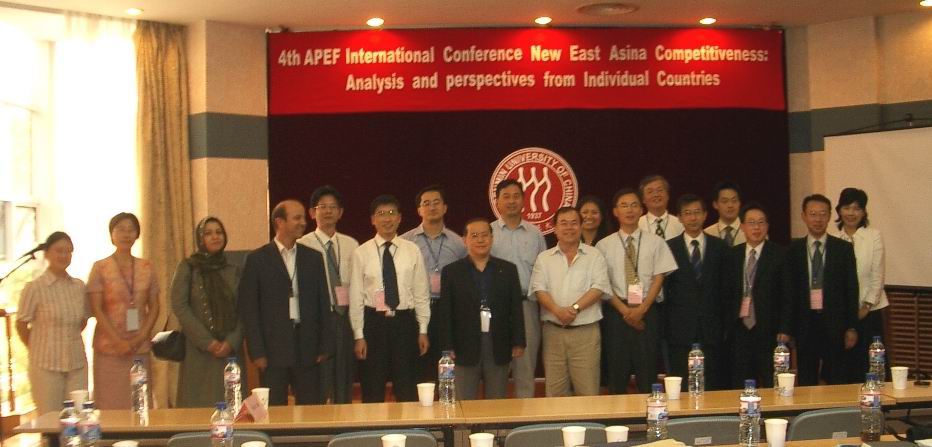
Globalisation Gains and Losses:
Lord Meghnad Desai
Prof Meghnad Desai of the London School of Economics and a life peer of St Clement
Danes (in
In the photo below taken in the Faculty of
Arts at the University of Wollongong during his visit are, from left to right,
Prof Leone Lyons, Deputy Diretor of CAPSTRANS, Prof Lord Meghnad Desai and Prof
Tran Van Hoa.
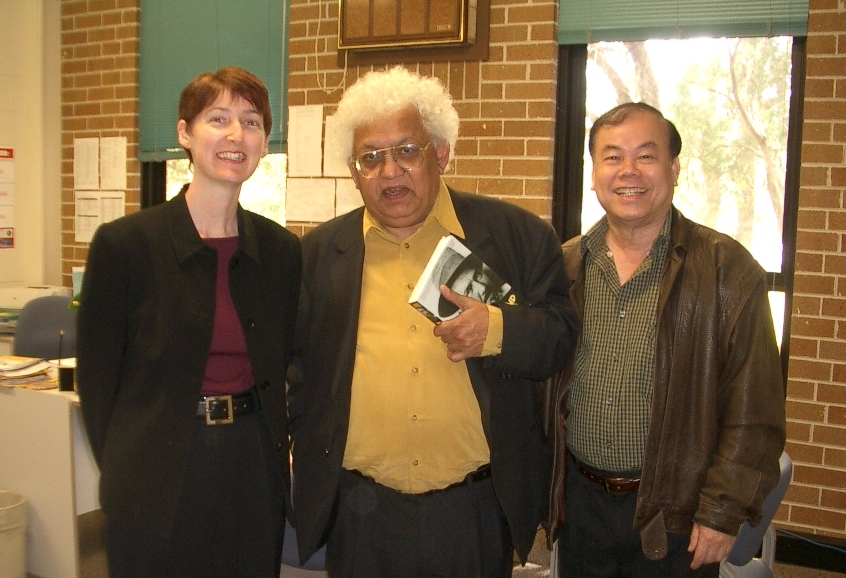
3-4 July 2004,
Early in July 2004, Tran Van Hoa
attended the third conference in the conference series Korea
and the World Economy,taking place on 3-4 July 2004 at
Sungkyunkwan University, Seoul, Korea,to deliver a
paper on Korea's Trade,Growth of Trade
and the World Economies in Post-crisis ASEAN+3 Free Trade Agreement. He
also acted as a discussant in a Plenary Session Economic
Cooperation in
In the photo below taken in the 600 Anniversary
Memorial Hall at Sungkyunkwan University at the end of the Conference are, from
left to right, Prof H H Lee (Kangwon National University, Korea), Prof
Charles Harvie (Director, Hunter Valley Research Foundation, Australia), Prof
Chung Mo Koo (Kangwon National University), Prof Jong Won Lee (President,
AKES), Prof Tran Van Hoa (Australia), and Prof Karyiu Wong (RCIE, USA).
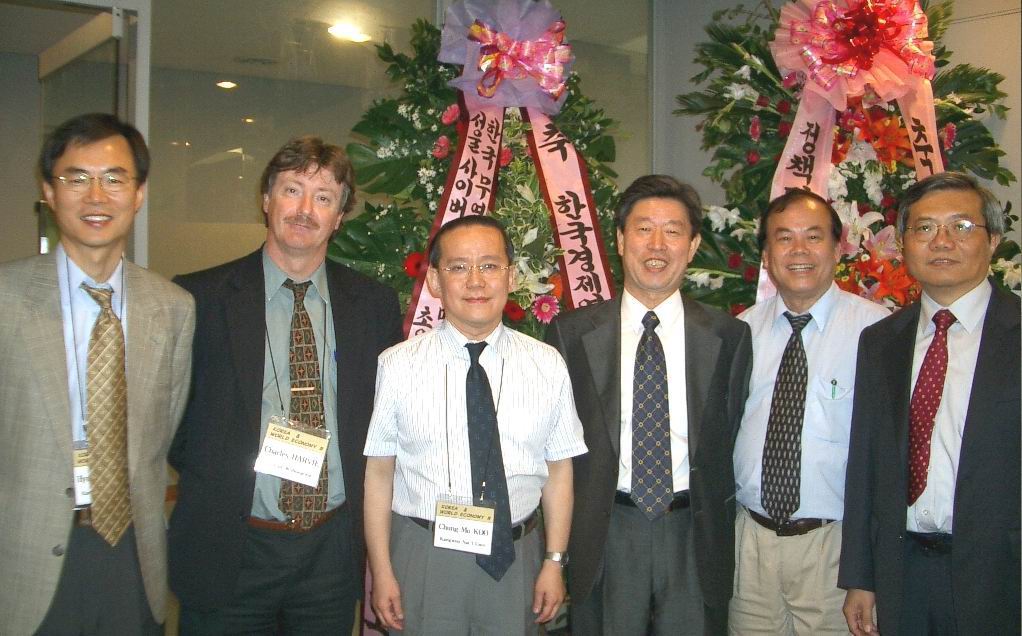
Contemporary Modelling Economic and
Financial Policy:
A European Union Perspective
30 June-2 July 2004, Universite de Paris I, Pantheon-Sorbonne
Tran Van Hoa participated in the EcoMod 2004
International Conference on Policy Modelling that took place on 30 June-2
July 2004 at France's prestigious university, Pantheon-Sorbonne, Universite de
Paris I, to present his current modelling policy research work on the Impact of the ASEAN+3
Free Trade Agreement on Asia-Europe Trade and Economic Relations: A New
Modelling Approach. The Conference was organised by the EcoMod Network
and sponsored by
The keynote addresses and papers delivered at
the Conference represent some of the state-of-the-art research and
commissioned activities by economic and financial experts on major
issues, aspects and policy modelling methodologial advances in trade, growth,
monetary policy, labour, competition and economic relations in the EU and
in other countries that have relations with the EU. Attending the Conference
were over 200 academics, businesspeople, government officials and advisers, and
delegates from the European Commission, the European Central Bank, the US International
Trade Commission, and coming from the countries in the EU, the
Middle East, Africa, Asia and Oceania, and the UK, the US, and Russia.
In the photo below taken in the Sorbonne Foyer on the opening day at the
Conference are, from left to right, Lionel Fontaigne (Director, CEPII,
Professor, Universite de Paris I, and EcoMod 2004 Program Committee Member),
Beatrice Poster ( Executive Administrative, CEPII), and Tran Van Hoa.
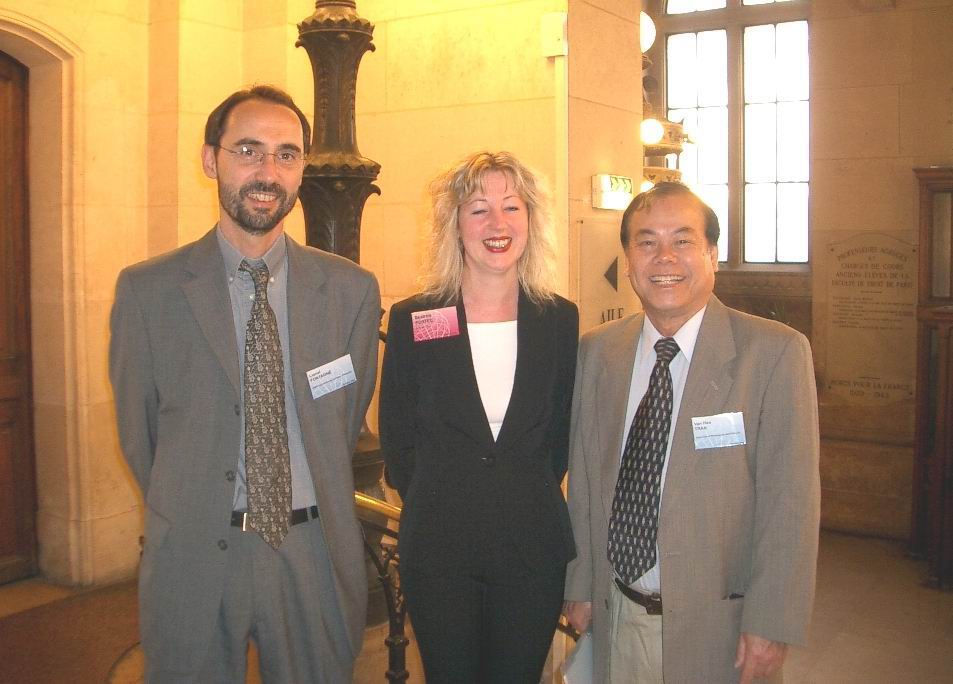
WTO,
Major Regional Issues
An Interntional Conference was recently jointly
organised by the Research Center for International Economics (Director: Prof
Karyiu Wong) at Washington University (Seattle, USA), East-West Center (Hawaii,
USA), and the Business School, Renmin University of China, with a focus on the
theme The WTO, China and the Asian Economies II. The Conference
took place at the Yi Fu Conference Center on RUC campus during 18-19 June
2004 with the participation of over 60 experts from
Since its WTO membership in 2001,
In the photo below, taken at the
RUC Yi Fu Conference Center, are, from left to right, Prof Feng Zongxian (Xian
Giaotong University and Organiser for 2005 WTO and China III Conference), Prof
Karyiu Wong (Director, RCIE, University of Washington, USA) and Prof Tran Van
Hoa (Director, Vietnam Focus and ASEAN+3 Research Program, Wollongong
University, Australia).
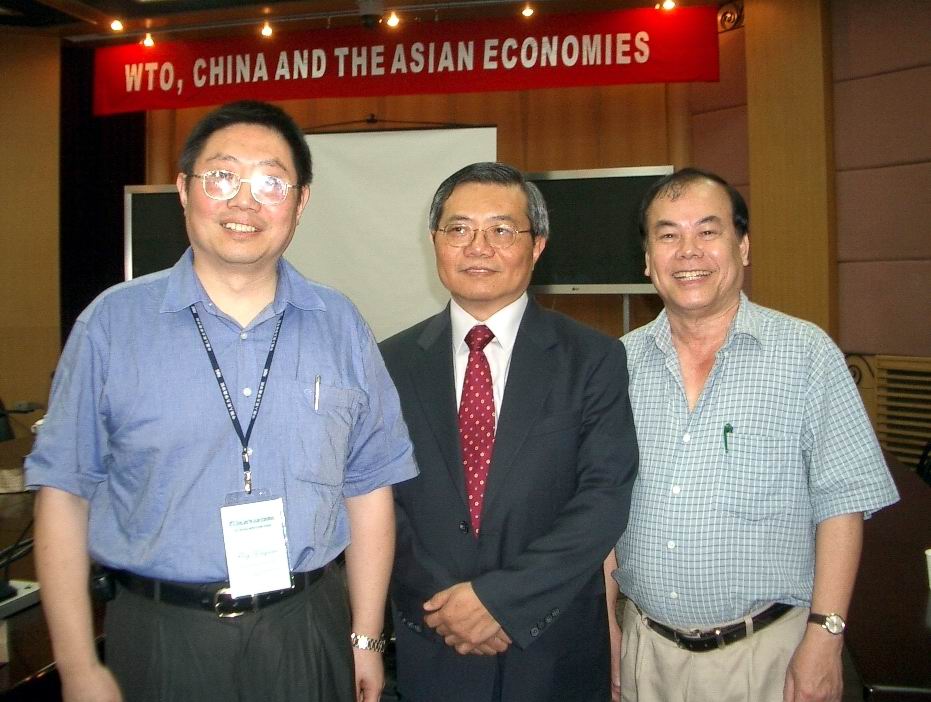
In the group photo taken in front of the RUC Yi
Fu Conference Center at the end of the Conference on WTO,
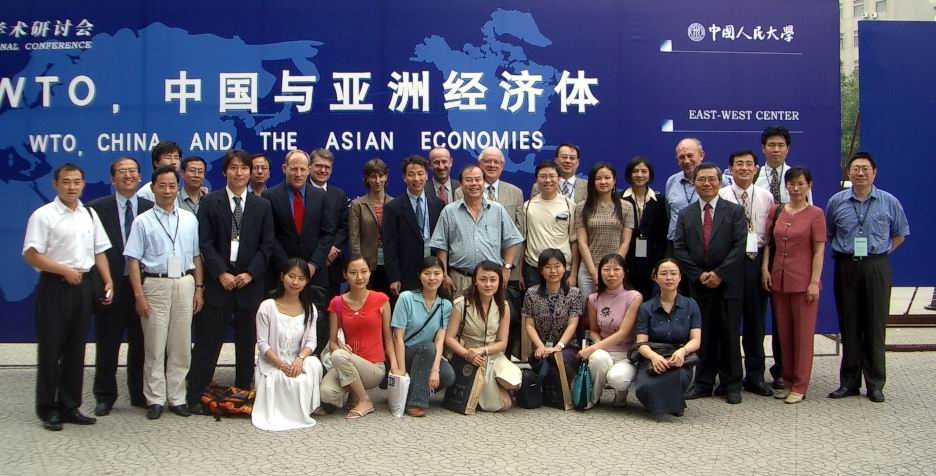
ASEAN+3 Free Trade Agreement
and Its Impact on Australia-China Trade:
Who Gains and Who Loses?
With the slow progress of the WTO negotiations
(due chiefly to several yet unresolvable issues on trade protection and
subsidies by WTO members) and the still non-WTO membership of many LDCs, the
proliferation of regional free trade agreeements (FTAs) and closer economic
relations (CER) especially in Asia in order to liberalise trade and promote
growth is being vigorously supported by governments and the development is
amply justified. One of these important recent FTAs is the ASEAN+3 (10 ASEAN
countries plus
The first workshop to report on
the project's research findings by UOW and RUC economic and trade experts was
organised by Prof Zhao at the China Centre for
Applied Statistics Research on the RUC campus on 17 June
2004 where Tran Van Hoa and other Chinese experts presented and discussed their
progress work. Participants in the workshop also included postgraduate
students, postdoctoral fellows and academics from the RUC and other Chinese
universities.
In the photo below, taken at the end of the
workshop in the School of Statistics, RUC, are some participants including,
from left to right, Prof Guirong Li (School of FInance, RUC, 6th place), Prof
Yanyun Zhao (RUC, 8th place), and Prof Tran Van Hoa (9th place).
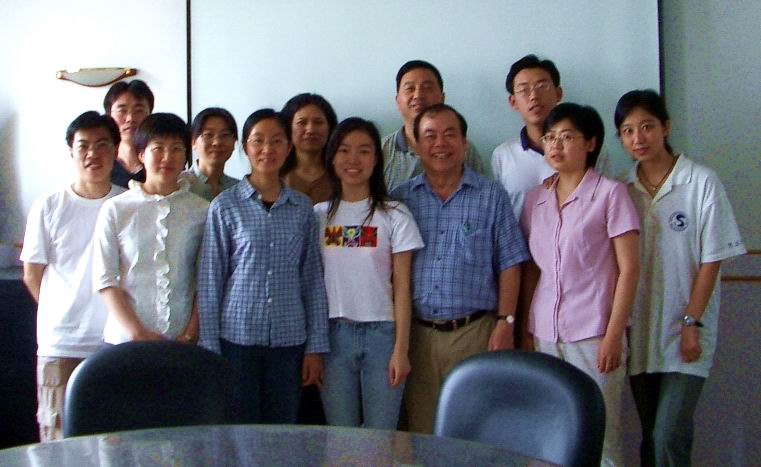
GLOBALISATION: DEFINITION AND
FUNDAMENTAL ISSUES
May 2004
Globalisation is perhaps one of the most
frequently quoted words or reverently cited concepts in all areas of
contemporary hard, soft or metaphysical sciences (eg, engineering, economics,
humanities, politics, business, management, governance, religion, sociology,
philosophy, to name a few), but it remains the most misunderstood or
mis-interpreted at all levels, layman or expert, of enquiry. Every one of the
2822 acdemic papers and 589 books published in 1998 alone for example has its
own definition (see www.globalisationguide.org/01.html). A quick browse
of current writings or debates on globalisation will however reveal that most
publications and discussions focus essentially on what globalisation does or
generates rather than on what it truly is.
Globalisation occurs (or is) when human
activities (physical and non-physical), originated from one state, move to
other dependent (satellite) or independent (sovereign) states. These activities
may be in one of the areas mentioned above. A cause of this movement is the
superiority (or comparative advantages, competitiveness, or novelty) of the
tools (goods), the ideas (services), finance (capital availability) or the
armed forces of a state. The outcome of this globalisation can be either
better (unification of warring states, improved trade and
living standards, broadened enlightenment or closer economic relations), or
for worse [destruction of a state (forced and invited
occupation), its infrastructure, activities, resources (deforestation,
environment degradation, or terrorist attacks) or its culture (religion,
family, custom or ages-old traditions)].
With this definition, globalisation could be regarded
as being existent with the first human cross-continetal migration of the world,
followed or manisfested further by the occupation or expansion or the
international trade of the desert kingdoms in the Middle East (the cradle of
civilisation), the rise and fall of the Greek and Roman empires, the global
spread of Christianity, Buddism or Islam or more recent diverse religions, the
establishment of the Silk Road, the conquests of the Gengis Khan families, the
adventures of Marco Polo, the colonial empires of major European countries in
America, Africa, Asia and the Pacific, the continental or world wars of the
past, the feared hegemonism of communism after the Second World War and
socialism, the setting-up of the League of Nations, the United Nations, the
GATT and GATS, the WTO, and the increasing reach and influence of capitalism
and its coporates. The current promotion of globalisation by
its advocates is usually based on the utilisation of international
competitiveness or an advancement of closer economic relations. The
anti-globalisation supporters, while grudgingly admitting the process of
globalisation, emphasise on the other hand the lack of equity or fairness (who
gains most and who loses most) or the social concerns of globalisation. Like
all other things in life, an equilibrium (or balance) of gains (output growth,
improved living standard, welfare and security) and losses (rights and wrongs,
suitability and unsuitablity, transgenerational negatives and pluses) of
globalisation (or all other human activities or decisions) must be considered
and achieved for optimal outcomes and less wasteful confrontations for all
stakeholders. Curiously, efficiency and equity are the
two main concerns of mainstream economics and the real base for research,
policy advice and public debates by respectable economists. See
also Tran Van Hoa and C Harvie (eds) New Asian Regionalism: Responses to
Globalisation and Crises,
ACADEMIC WRITERS AND INTERNATIONAL
PUBLISHERS:
IMPORTANT LINK
2 March 2004
A strong linkage between the 'research and
write' academics and reputable international publishers is crucial for an
efficient public-benefits dissemination worldwide of new knowledge and findings
of both a basic and applied/policy kind in all scientific endeavours. To
maintain this linkage, Edward and Sandy Elgar of Edward
Elgar Publishers in the
In the photo below taken in the Department of
Economics during Catherine's hectic visit and meetings with academics at the
University of Wollognong are (from left) Prof Ann Hodgkinson (Head
of the School of Economics and Information Systems), Catherine Elgar (Edward
Elgar, UK) and Prof Tran Van Hoa (who, in addition to other books published
with Macmillan, UK, has published five books with EE in the past
four years).
AUSTRALIA-VIETNAM DIPLOMATIC,
ECONOMIC AND TRADE RELATIONS: 30 YEARS OF BRIDGING DIVIDES
14 February 2004, Stamford Plaza Hotel,
On the Valentine Day 2004, the Director of the
ASEAN and Vietnam Focus Research Program at the University of Wollongong (Prof
Tran Van Hoa) attended an official function at the Stamford Plaza Hotel, Double
Bay, organised by the Vietnam Consul General in New South Wales (Mr Nguyen Van
Tho) to honour the visit by Vietnam's new Foreign Minister, H E Nguyen Di Nien,
to Sydney. The visit by Mr Nien (and his wife, Mrs Dung) was significant since
he was one of
At the function, it was also expressed that,
with these expanding relations and its abundance of natural, physical and human
resources, its dedication at all society levels to improve the economic and
social conditions, and its recent economic achievements even during the
devastating Asia crisis of 1997-2002 and the 2003 SARS and 2004 avian flu
outbreaks, Vietnam will surely stand proud of its future economic development
and social progress and its high standing in the regional and
international community.
In the
photo below taken at the Stamford Plaza Hotel function welcoming Vietnam
Foreign Minister, are (from left), the Hon. Nguyen Van Tho (Vietnam Consul
General in Sydney), Prof Tran Van Hoa, Mrs Dung, H E Nguyen Di Nien (Vietnam
Foreign Minister), Mrs Tran Thi Lai (Vina World Travel) and H E Le Xuan Lieu,
Vietnam Ambassador to Australia.
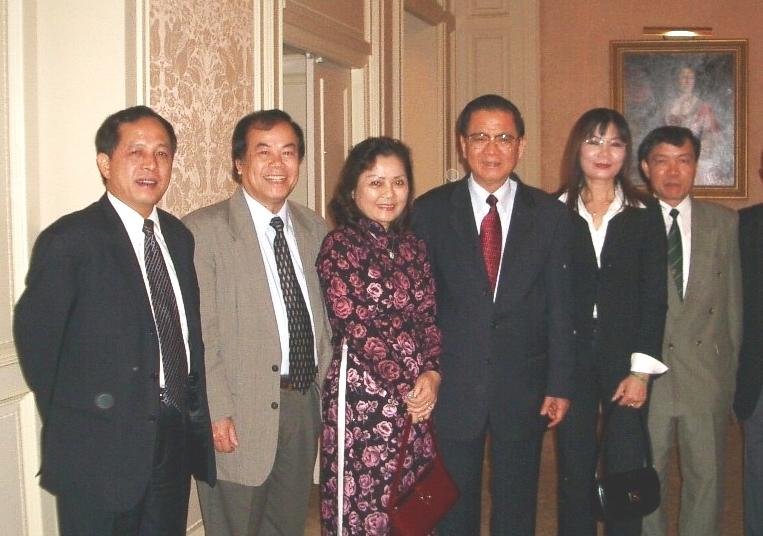
WHAT DO ASIAN ECONOMIES HAVE TO DO
WHEN FACING
REGIONAL CRISES AND RELENTLESS GLOBALISATION?
9 February 2004
Crises seem to beset most of us at all levels:
personal, community, national, global and transgenerational. The once 'high
growth miracle' economies of the East and
A new and timely book New Asian
Regionalism: Responses to Globalisation and Crises [edited by Tran Van
Hoa and Charles Harvie, Palgrave-Macmillan, 2003 (see below)], is a collection
of important studies by a select group of Asian and Oceanian economists
exploring and analysing the strong emergence of Asian regionalisms and economic
integration in the region in recent times to deal with the aftermath of the
recent crises, the relentless marching of globalisation, and the increasing
emphasis on and penetration of international competitiveness in all economies,
developed and developing. A product of an international conference organised by
the executives of the newly formed APEF (Asia Pacific Economic Forum) at the
University of Wollongong (Australia) in 2002, the book provides a wealth of
information and ideas on the development of this new Asian regionalism and how
it can be used by economic policy makers and shakers to steer Asian crisis
economies towards quick recovery, strong growth and more social and political
stability, and increasing living standards for all peoples in the region in the
near future.
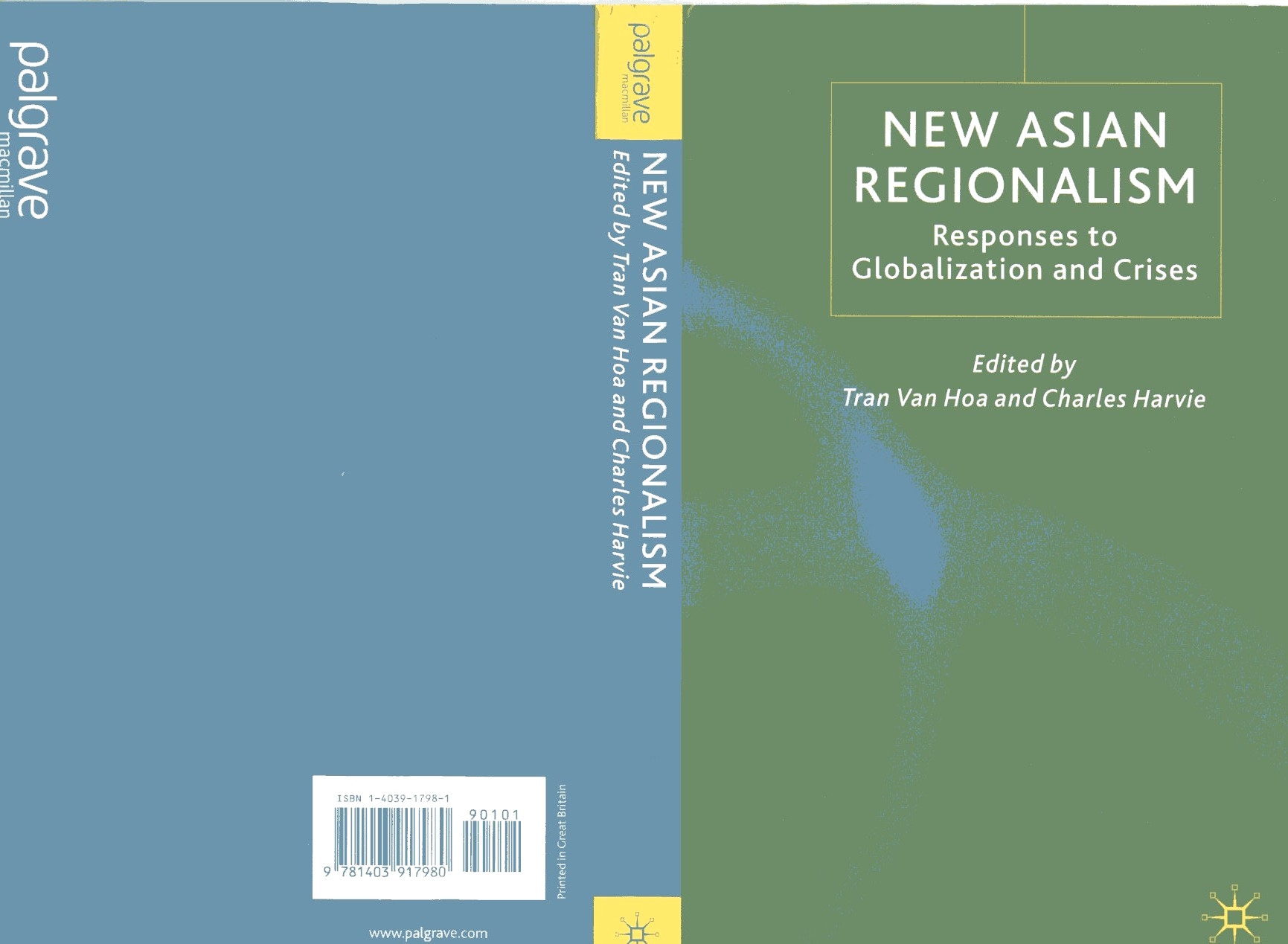
FOR
8-10
December 2003
Impact and long-term implications as well as emerging challenges and
opportunities of Asia's past and current crises and recoveries were the
themes of the Asia Crisis V International Conference taking place on campus at the
Kangwon National University (KNU) in
In the photo below taken on campus (Faculty of Arts Building) at the
Kangwon National University on the opening day of the Conference were (from
left) Prof Chung Mo Koo (Local Conference Organiser), Ms Kopea (KNU
Postgraduate Student, background), Prof Kar Yiu Wong (Conference Organiser,
University of Washington), Prof Dr Yong Soo Park (President of KNU)
and Prof Tran Van Hoa.
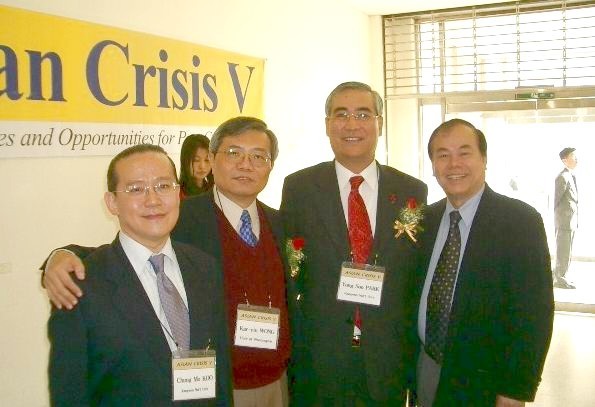
AUSTRALIA AND VIETNAM'S
ECONOMIC AND TRADE DEVELOPMENT
Hanoi, 4-8 December 2003
During the first week of the
22nd SEA (South East Asia) Games taking place in Hanoi (30 November-14 December
2003), Tran Van Hoa held discussions with senior officials of Vietnam's
Ministry of Trade (MOT) on current and planned work between MOT and the
Vietnam Focus Research Program (Director: Tran Van Hoa) at the University of
Wollogong. Work for the triennial 2004-2006 includes a number of training
workshops for Vietnam government officials on Research and Investment Evaluation at
NATI (MOT National Advanced Training Institute) and a research project
proposal ASEAN+3 Free Trade Agreement and its
impact on Australia-Vietnam trade at
Vietnam Institute for Trade (VIT). Dicussions were also carried out on
potential collaborative work between NATI and VIT and VFOC on targeted areas of
interest in the $10 million ODA (Official Development Assistance) program
on
In the photo below taken at the VIT
headquarter,
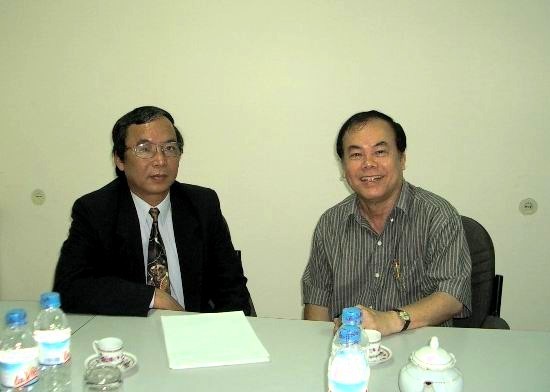
AUSTRALIA-THAILAND FREE TRADE AGREEMENT: INTERNATIONAL COLLABORATIVE
WORK
Prof Tran Van Hoa recently
visited Thailand's prestigious university, Chulalongkorn University in Bangkok,
to develop international collaborative link and work between it and the
University of Wollongong (Australia) on aspects and issues including obstacles
and opportunities of the Australia-Thailand
free trade agreement (ATFTA) and closer economic relations signed by the Prime Ministers of Australia and Thailand during the APEC
Leaders Meeting in Bangkok in November 2003. Representing
Informally attending the
ATFTA discussion and working lunch between Profs Tran Van Hoa (UOW) and
Suthipand Chirathivat (Chula) was their colleague, H. E. Dr Kitti Limskul, Thailand's Vice Minister of
Finance, who was a professor (on leave) at Chulalobngkorn
University and one of the 23 founding members of the ruling party, Thai Ruk Thai, in
Thailand. Prof Tran Van Hoa later visited Dr Kitti's office at the Ministry of
Finance to discuss further issues related to major economies in the Asian
region in general and to the ATFTA in particular. He also visited his
networked colleagues at Thammasat
University to explore joint research and training opportunities
between the Vietnam Focus Research Program at the University of Wollongong and
the Faculty of Economics at Thammasat University for several modules
of the Greater Mekong Project (GMP) being
funded by the Thai Government to Vietnam to assist Vietnam's current economic
development programs.
In the photo below taken
on campus at
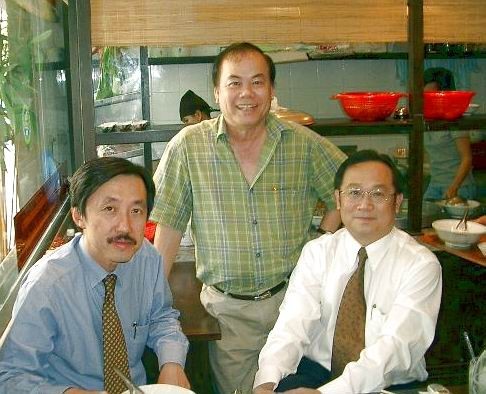
Also in the photo
below taken on campus at
Prof Tran Van Hoa (left) and Prof Pranee Nitakorn, Dean, Faculty of Economics,
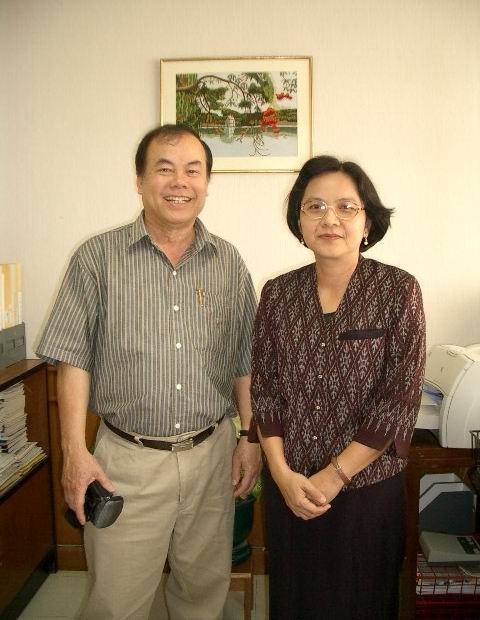
New
Asian Regionalism in
18-19 September 2003,
Major
important issues and problems of one of Asia's hottest developments at the
highest level of government, namely new Asian regionalism and its upshoots, free trade
agreements, economic integration and closer relations, were discussed at the 3rd Asia-Pacific Economic Forum (APEF) International
Conference (The Conference
Theme: New East Asian Regionalism: Perspectives
from Individual Countries) at
Japan's prestigious private university in Tokyo last week. The APEF was
inaugurated at
At
the conference, eminent participants and paper authors from eight major
countries in East Asia (China,
Japan, Korea), South-East Asia (Thailand) and West Asia (Iran), Oceania
(Australia and New Zealand) and the US presented and discussed their new applied and
analytical research findings of immense importance to not only their own
countries but also to regional and global economies including the major trading
blocs in the world. The topics
include new Asian regionalism and its regional and global impact and
costs-benefits, economic development and growth, trade, investment, East Asia
energy cooperation, regional production and distribution network, monetary
cooperation, development of a North-East Asian Development Bank, and economic
integration policy. At
the Conference, Prof Yanyun Zhao of the Renmin University of China in
In the photo taken at the APEF 3
Reception hosted by Keio University on Art Hills in Central Tokyo are (from
left to right) Lika Tanaka and Satoko Fukaya (Keio Postgraduate Students), Prof
Eiji Ogawa (Hitotsubashi University), Prof Chan-Hyun Sohn (Korea Institute for
International Economic Policy), Yuya Takahashi (Keio Postgraduate Student),
Prof Hiro Lee (ICSEAD, Japan), Prof Yanyun Zhao (Renmin University of China,
Beijing), Profs Huyn-Hoon Lee and Chung-Mo Koo (Kangwon National University,
Korea), Mitsuyo Ando (Research Associate, Keio University), Dr Komail Tayyebi
(University of Isfahan, Iran), Prof
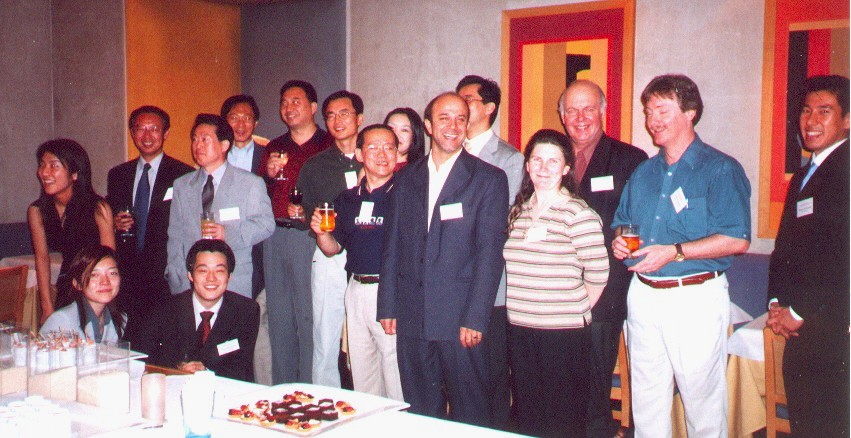
In
the photo below taken at the main building at Keio University, Mita Campus, are
(from left to right) Prof Suthipand Chirathivat (Dean, Faculty of Economics,
Chulalongkorn University, Thailand), Prof Zongming Tang (Shanghai Jiaotong
University, China), Lika Tanaka, Prof Chung-Mo Koo, and Prof Robert Scollay
(PECC Member).
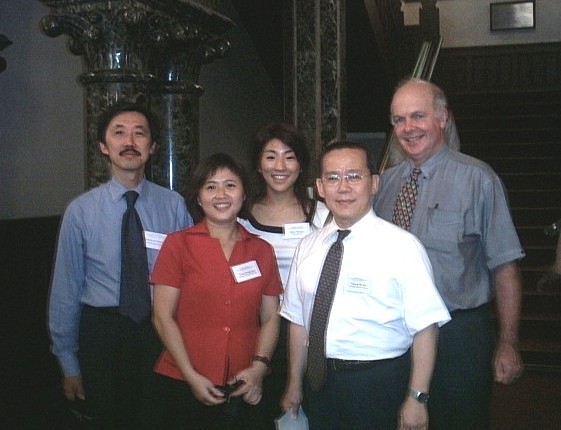
In
the photo below also taken at
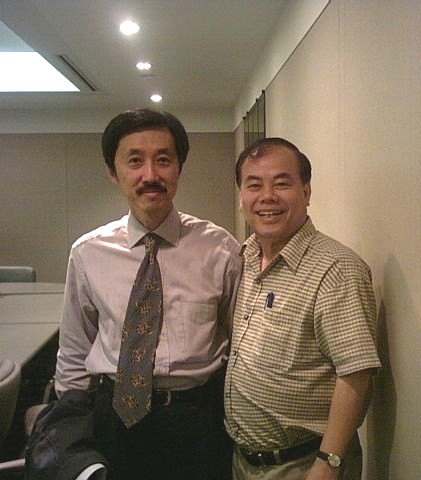
In
the photo below taken at the Faculty Club at Keio University Mita Campus are
(from left to right) Prof Yanyun Zhao (Dean, Faculty of Statistics, Renmin
University of China,
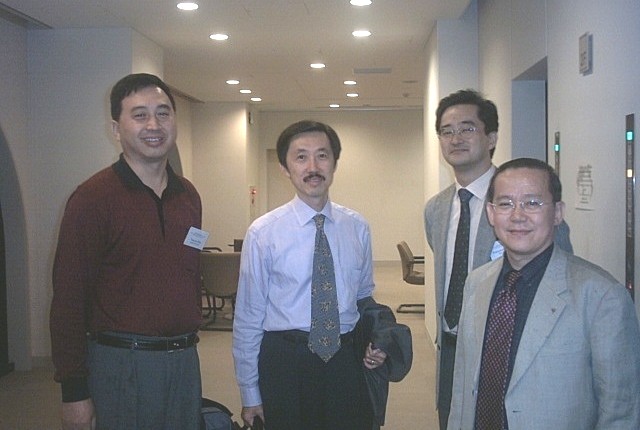
THE
BBC, THE WTO, THE 2003 CANCUN AGENDA
AND ECONOMIC AND TRADE PROSPECTS
FOR
(Summary
of a BBC Interview with Tran Van Hoa
on 11 September 2003)
The
146-member WTO Ministerial Meeting this week in Cancun, Mexico, has to deal not
only with anti-globalisation protesters but also a number of difficult
post-Doha problems faced by current WTO members and affecting aspiring WTO
members especially those in the agriculturally-based Asian region. To some
analysts, the only
All
this seems to mean that the LDC members (especially those in the mainly
agricultural-exports regions) in the WTO may not gain substantial and quick
trade and economic benefits from their WTO memberships. A logical consequence
is that
COMPETITION
POLICY AND LAW AND THEIR FUTURE
IN
10 September 2003
Prof Allan
Fels, former Chairman of the Australian Competition and Consumer Commission
(ACCC) and current
In
the photo below at a Commerce Faculty reception for Prof Allan Fels are (from
left to right) Profs Allan Fels, Tran Van Hoa (Allan's colleague and friend
over 35 years from their days at the University of Western Australia and Monash
University) and John Glynn (Dean, Faculty of Commerce, University of
Wollongong).
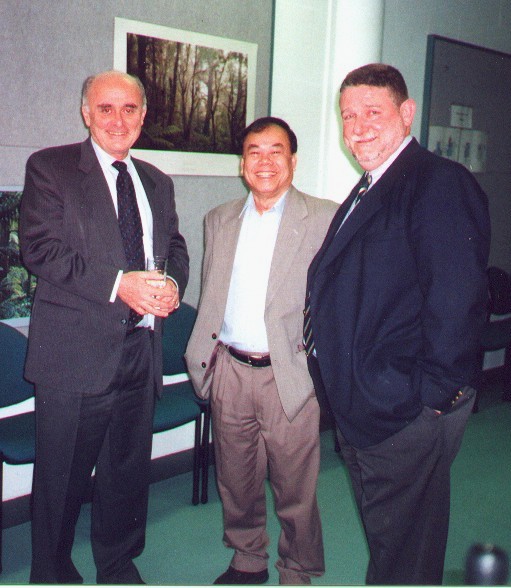
Highly
relevant to the First Economics Public Lecture's theme above but with a focus
and emphasis on Asia's economic development and competitiveness is the
publication by Edward
Elgar in the UK and US, of a
new book by Tran Van Hoa with the title Competition Policy and Global Competitiveness in Major Asian Economies (see photo and review below). The book is the product of an APEC training project funded by the Australian
Government AusAID Agency and Wollongong International Business Research
Institute (IBRI). Its contents are at the level of the UNCTAD, WTO,
APEC and ASEAN and deal with the foundation of competition theory and new
developments and implementation of competition policy and law in major economies
in East Asia, South East Asia and
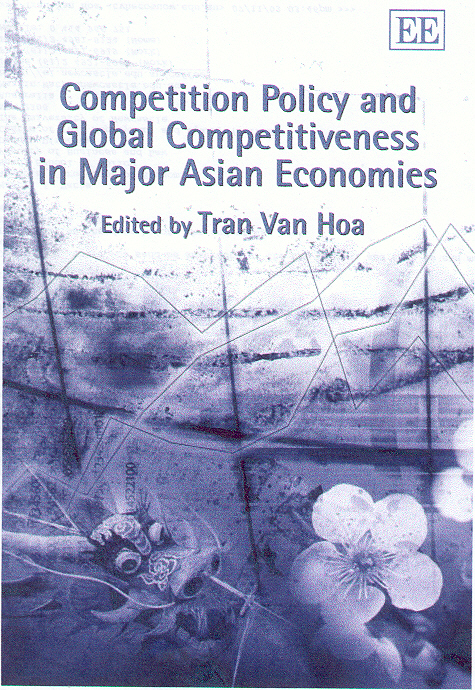
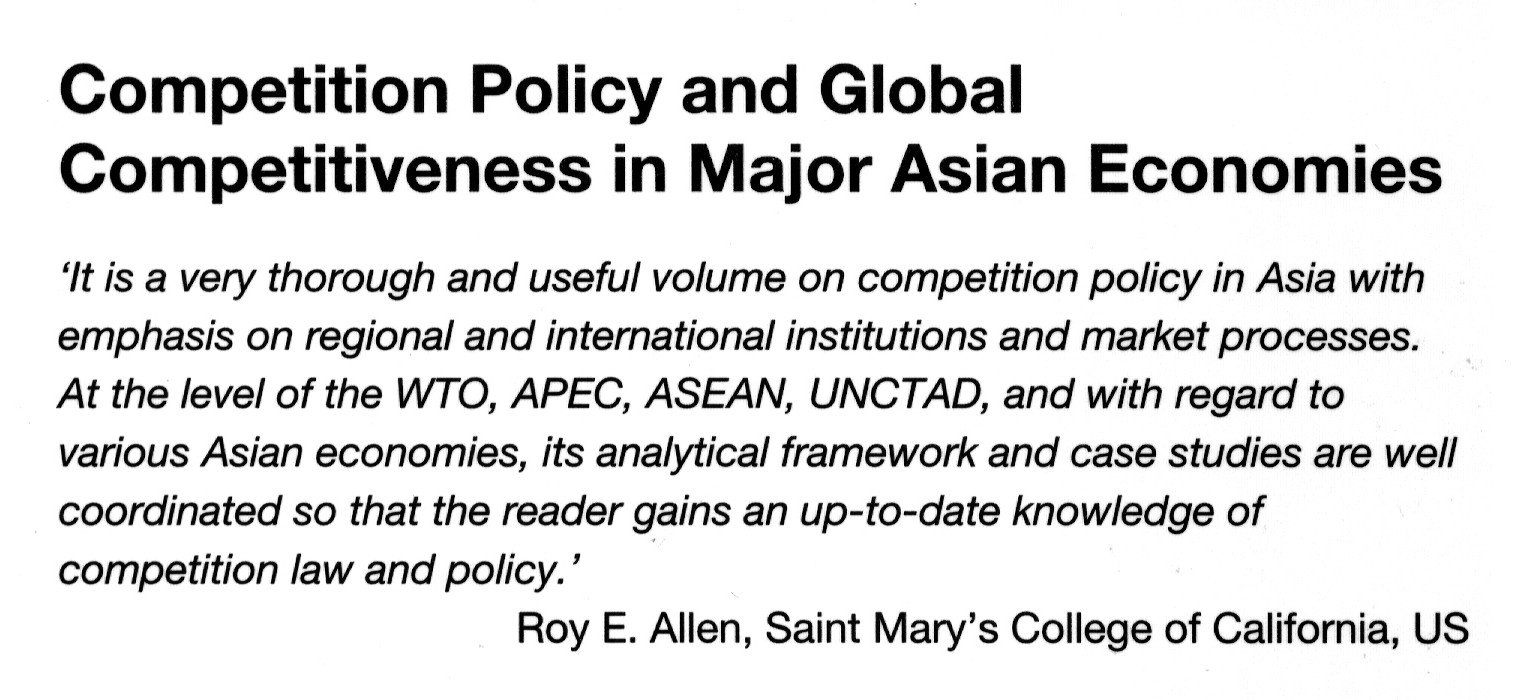
ENHANCING
ASIA-EUROPEAN
AND RESEARCH COLLABORATION
June
2003
Serious work
on enhancing ASEM network and research collaboration has been recently
initiated by Prof Tran Van Hoa during his visits to several prestigious
research institutes and universities in the European Union during June 2003.
The purpose of the visits was to communicate his recent research findings on
ASEAN free trade agreement and new Asian regionalism and to start cooperation
or to strengthen the existing network and association with EU academics and
researchers who have been working, either individually or on commission from
the European Commission, on important aspects and major issues in Asia-EU
trade, investment and international economic relations.
The visited
institutes include the Center for Operations Research and Econometrics (CORE)
and the
In
the photo below are Prof Guido Ferrari (left), Department of Statistics,
Vietnam-Australia
Friendship Association Meeting
at the
22
May 2003
The
Chairman of the Vietnam Australian Friendship Association (a society of
government officials, business people and Vietnamese alumni from Australia), Dr
Luong Van Ly, recently visited the Melbourhne Institute for Asian Languages and
Societies (MIALS) at the Sidney Myer Asia Centre at the University of Melbourne
to meet with experts on Vietnam to discuss high-education collaboration and
joint-venture opportunities in Southern Vietnam for Australian universities.
The visit is part of the program organised by the
Present
for discussion at the meeting at MIALS were Prof Tran Van Hoa (representing the
In
the photo taken at MIALS Meeting Room No. 1 below are, from left to right, Ms
Ngan Collins (Ph D student in Management), Dr Di Bretherton
(Psychology-Trauma), Dr Jane Fisher (Post Natal Depression), Prof Tran Van Hoa,
Dr Luong Van Ly, Dr Adam Fforde (Principal Fellow, MIALS), Dr Pip Nicholson
(Asian Law Centre), Dr Maureen Welch (Asian Education Foundation), Dr Jennifer
Holmgren (DFAT Executive Desk Officer), and Angela Kerry (Melbourne
University).
A
THEORY AND PRACTICE TO DO BETTER FORECASTS
ANYTHING, ANYTIME AND ANYWHERE
by
Tran Van Hoa
For millennia,
it has been the ambition of mankind, for selfish or pecuniary or altruist or
noble reasons, to see clearly or predict accurately things in the future, near
or far. Sometimes, it can do so with a divining rod, by looking at the sky or
mountains, by resorting to past occurrences, by using insider information, or
by a forecasting tool known by statistical experts as a forecasting model. A
forecasting model is simply a logical causal structure that stipulates that
things happening now depend on things happening to them in the past, and things
that will happen in the future depend on things happening to them before that.
This forecasting model consists of the required but unknown forecast itself and
its determinant factors (variables) and contributing strengths (parameters).
The form of this forecasting model is usually not known by anyone but
determined or chosen by the expert doing the forecasting. Given a forecasting
model, its variables and parameters, a forecast into the future can then be
made. The theory of forecasting used universally nowadays involves either that
all variables and parameters are known (the neo-classical or CGE or AGE or WTO
school) or that all variables are known but their parameters have to be
estimated from real-life data for realism (the realist or Keynesian school) or
a mixture of both. The estimation method used here is usually the ordinary
least-squares (OLS) or maximimum-likelihood (ML) that provides best linear
unbiased parameters when the model generating them is correctly formulated and
contains no omitted variable or no measurement error-in-variables. The
conditions are hardly met in all real-life situations and what we have been
given in all forecasting studies of this kind are simply biased and highly
inaccurate parameters and forecasts.
A new forecasting
approach proposed by Tran Van Hoa provides better forecasts on the issues
arising above. The approach states that, given any function in any form linking
causally in anyway a forecast (of anything) to its determining variables, a
linear forecasting (function-free) model can always be derived (Tran Van Hoa,
1992) and its parameters can always be obtained by a new estimation theory (the
so-called two-stage hierarchical information (2SHI), also known as the improved
Stein or empirical Bayes) that produce always more accurate or better
in-average-squared-errors properties than all other existing estimation methods
currently in use (see for example, Tran Van Hoa, 1985, Tran Van Hoa and
Chaturvedi, 1997). Better forecasts can then be obtained from these better
estimated parameters. Applications of the new approach have been carried out
over the past 10 years or so in numerous scholarly and commissioned applied
studies involving economics, business, energy demand, trade, investment and
finance. Improved accuracy in forecasting in these studies range from 10 to 150
per cent, an enormous achievement that can make or break individual fortunes,
expand or destroy giant businesses, discredit national and international
organisations, and change governments. Some studies dealing with this new
forecasting approach and applications are given in the publications below.
A.V.
Jennings Industries in
10
March 2003
A.V. Jennings
Industries P/L, one of
In the photo below
taken at a luncheon reception at Phu Dong Restaurant in Central Hanoi in honour
of Vic and Margaret Jennings are (from left to right, standing) Margaret
and Vic Jennings, (sitting) Mr Nguyen Chi (Senior Expert, Ministry of Trade),
Dr Pham Quang Thao (Rector, NATI), Dr
Bui Huu Dao (Director General, Science Department, Ministry of Trade) and
Prof Tran Van Hoa.
Festschrift
in Honour of Prof Peter Lloyd
(of the Grubel-Lloyd Index fame)
Prof
Tran Van Hoa recently joined close colleagues and international friends of
Peter Lloyd to participate in a festschrift conference in the Faculty of
Economics and Commerce at the University of Melbourne (on 23-24 January 2003)
to celebrate Peter's long-standing and significant contribution to the theory
of international trade, notably his collaborative work with Herbert Grubel (a
Canadian economist then visiting the Australian National University) in
formalising the so-called Grubel-Lloyd
Index of Intra-industry Trade.
Used extensively in the profession as the main indicator of regional trade
flows, the index has been able to track more accurately the intensity of South
East Asian countries' trade in recent years and to provide an explanation for
this region's spectacular growth before the 1997
In
the photo below taken at the festschrift dinner hosted by the Department of
Economics at the
In
the second photo taken at a festschrift farewell cocktail function at Prof
Lloyd's residence are
(from left to right) Tran Van Hoa,
Emeritus Prof Max Corden and Prof Herbert Grubel.
The
Melbourne Institute's 40th Anniversary (1962-2002)
12 December 2002 and 7 February 2003
Tran
Van Hoa recently attended two 40th Anniversary Functions (12 December 2002 at
the University House, and 7 February 2003 at Ormond College, College Crescent,
Parkville) of the Melbourne Institute (also known as the Melbourne Institute of
Applied Economic and Social Research) at the University of Melbourne. Founded
in January 1963 by Prof Ronald Henderson shortly after his arrival from
Scotland and supported first by Prof Richard Downing (former Chairman of the
Australian Broadcasting Commission) and Dr Duncan Ironmonger, Deputy Director
(1972-1986) and Acting Director (1979-1984), and subsequently a succession of
Directors and Acting Directors in the past 18 years, the Institute has become
an icon and think-tank of the economics profession in Australia with particular
focus on national economic and social issues. Notable achievements by the
Institute in its early years include the founding of the Australian Economic Reviewby Duncan Ironmonger in 1968 and the pioneering work
by Ronald Henderson on poverty (resulting in the famousHenderson Poverty Line) in
Attending
the anniversary functions were
In the photo below taken at the 40th
Anniversary Function at the University House on campus are (from left to
right) Prof Tran Van Hoa, Ms Diana Warren (a Research Fellow at the
Institute and former student of Tran Van Hoa and Dr David Johnson,
Deputy/Acting Director of the Melbourne Institute.
WTO,
Opportunitites, Challenges and Prospects
An international conference organised
by
the Asian Development Bank, the University of Hong Kong and the
University of Washington
Hong Kong 9-10 November 2002
Since its accession to the WTO in 2001,
In
the photo below taken in front of the Fountains Garden in the Meng Wah Complex
at the University of Hong Kong are some of the Conference Session Chairs and
Speakers: (from left to right) Prof Tran Van Hoa (Director, ASEAN+3 Research
Program, Wollongong University), Dr Jean-Pierre A. Verbiest (Chief Economist,
Asian Development Bank), Dr Chira Hongladarom (Director, Foundation for
International Human Resource Development, Thailand), Prof Karyiu Wong
(Conference Co-organiser, RCIE, University of Washington), and Prof Tianshu Chu
(East West Center, Hawaii).
The difficult problems and
challenging issues of the Asia recovery from the 1997 crisis and subsequent
policies for reforms were discussed recently at an international conference on
The conference was attended by
over 280 national and international economists, bankers, corporate executives,
ministerial and other high-ranking government officials from major countries in
the Asian region and the International Monetarty Fund and the World Bank. Tran
Van Hoa participated in the conference as a session chair, a session discussant
and also presented a paper on disturbing issues crying for serious focus in Economic Crisis Management in Asia.
At the panel discussions, he also raised a number of questions on the still
ineffectiveness, five years on, of international organisations' rescue and
reform policies for crisis economies in
In the photo below
taken at the Conference Reception Dinner hosted by the Thammasat University
Economic Association and with Special Guest Speaker, the Governor of the Bank
of Thailand, at the Imperial Queens Park Hotel in Bangkok are (from left to
right) Ms Daranee (Secretary General of the
Thammasat University Economic Association), Dr Naris Chaiyasoot (Rector,
Thammasat University), Dr Sukanya Nitungkorn (Dean, Faculty of Economics,
Thammasat University), Dr Wichai (Bank of Thailand), Prof Tran Van Hoa, Dr
Prapasorn (Vice Rector, Thammasat University), and Prof Watchareeya (Faculty of
Economics, Thammasat University).
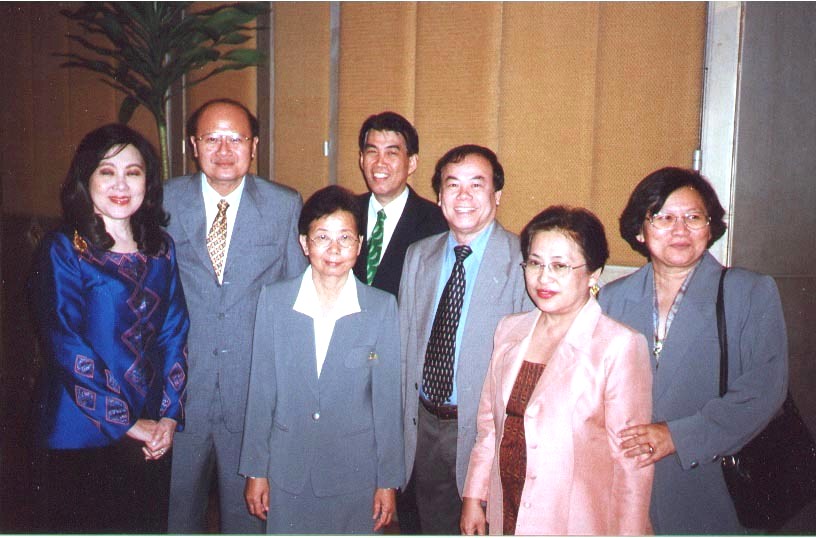
In the photo below
at the same reception are (from left to right) Professor
Tran Van Hoa and his former student (Dr
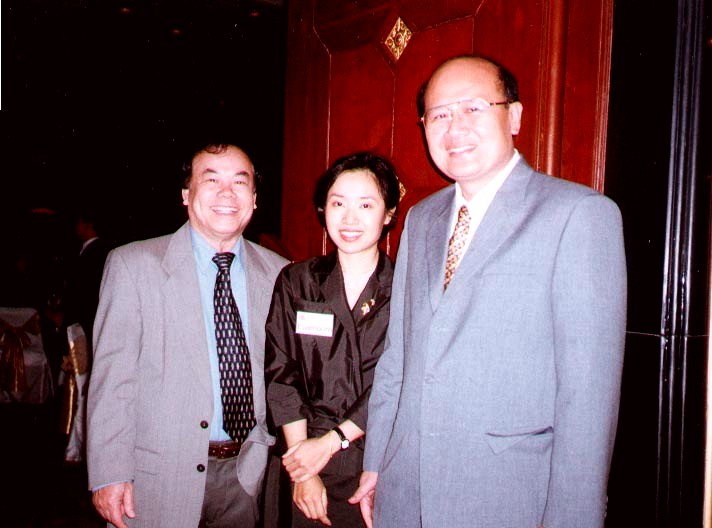
November 2002
The role played by Australia and
other Western countries in assisting major developing economies in the Asian
region to enhance their capacity for economic development, trade and investment
liberalisation, and structural reform in the face of increasing globalisation,
WTO membership requirement, international competitiveness and crises can be
assessed via these countries' numerous aid programs over the years. Vietnam is
one of these few developing economies that has also developed its own funded
programs for joint vocational and degree education in commerce, business and IT
in collaboration especially with Australian post-sedondary and tertiary
institutions. The Vietnam Focus and ASEAN+3 Research Program at Wollongong
University has, through its Director, Prof Tran Van Hoa, been actively involved
in some of these off-shore activities to enhance the capacity and skills
standards of Vietnam's government officials, corporrate executives and
postgraduate students in this education.
In the photo below
taken at the ceremony at the University of Wollongong to sign a Memorandum of
Intent for an off-shore one-year Master of Commerce degree course to be jointly
delivered in Vietnam by Wollongong and Vietnam Ministry of Trade staff are
(from left to right) Prof Tran Van Hoa, Dr Nguyen Thi Thu Nguyet (Rector, Ho
Chi Minh City College of Foreign Economic Relations, Vietnam Ministry of
Trade). Prof Rob Castle (Pro Vice-Chancellor (Academic), University of
Wollongong) and the Hon. Commercial Consul of Vietnam in Sydney, Dr Dinh Thi My
Loan.
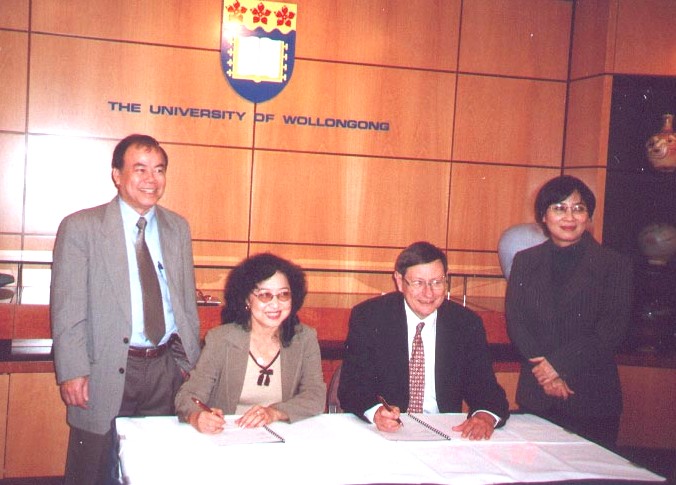
Asia Pacific Economic Forum
(APEF) International Conference:
Impact of Asia and Terrorist Attack Crises
on New Asian Regionalism, Growth and Trade, Globalisation and the WTO
in Asia and
The Asia Pacific Economic Forum (APEF) had its first international
conference (conference organisers: Profs Tran Van Hoa and Charles Harvie) at
the
Paper contributors and speakers at the conference consist of
international high-level academics and government officials (including a former
Dean of Commerce and the Ritchie Professor of Economics from the University of
Melbourne, a former Minister of the Economy from the Philippines and a Deputy
Minister of Small and Medium-Size Enterprises (SME) from Indonesia) from 7
major Asian countries (China, Indonesia, Korea, Japan, the Philippines,
Thailand and Vietnam) plus Australia and New Zealand. Participants also include
economists from
APEF (also known as the Soohyan Club) is a new international economics
group set up in May 2001 at the
APEF’s objectives are to research, discuss and disseminate substantive
findings and information on development, growth, trade, regional integration
and international economic relations in APEC countries with special focus on
East Asia, South East Asia and Oceania. APEF is a new regional initiative
by major Asian countries to rival such organisations as the World Economic
Forum (and the World Social Forum) and to promote an Asian identity and
characteristics and scope of studies and collaboration.
ASEAN+3 (ASEAN + China, Korea and Japan) and ASEAN+5 (ASEAN+3 plus
Australia and New Zealand, a current trade arrangement supported by Prime
Ministers John Howard (Australia) and Helen Clark (New Zealand)) are two
specific areas of interest to APEF studies.
2001 APEF memberships include academics from high-level universities in
the
In the photo at the opening ceremony of the APEF
international conference on campus at the University of Wollongong are (from
left to right) Prof Tran Van Hoa, Prof Yanyun Zhao (People University of China,
Beijing), Prof John Glynn (Dean of Faculty of Commerce, UOW), Prof Margaret
Sheil (Pro Vice Chancellor – Research), Dr Nguyen The Dzung (the World Bank,
Vietnam), the Hon. Dr Stephen Martin (Member of Parliament for Cunningham and
Shadow Minister for Trade and Tourism), Dr Sur Nustrisno (Deputy Minister for
the Ministry of Small and Medium-Size Enterprises, Indonesia), Prof H.H. Lee
(Kangwon National University, Korea), Prof Peter Lloyd (Ritchie Research
Professor and former Dean of Commerce, University of Melbourne), Prof Apichai
Puntasen (Thammasat University, Thailand), and Prof Charles Harvie (Director,
the SME Research Centre, UOW).
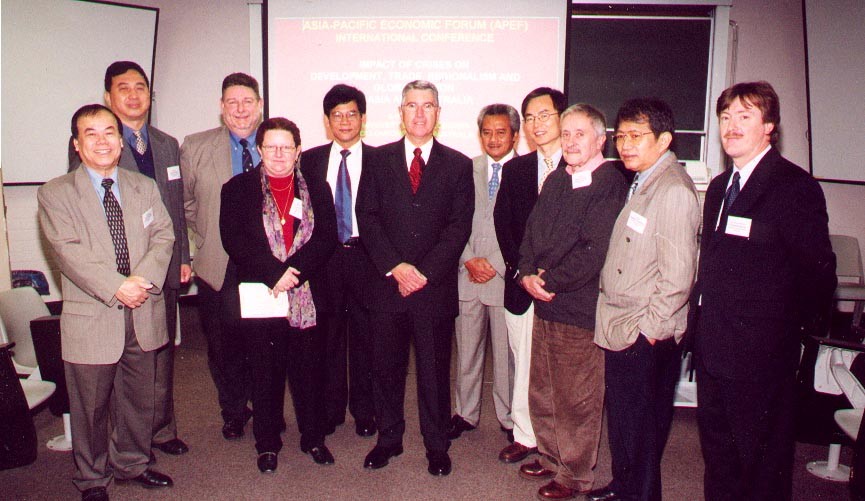
Can the WTO Effectively Enhance World
Trade and
Improve Member-Country Welfare?
29-30 June 2002
While globalisation and the WTO have the
common objectives of increasing world trade and standards-of-living, the
conditions required to achieve these are numerous, burdensome and may be
difficult to meet for many member-countries or countries that aspire to be WTO
members in the near future. These and other related issues were discussed at a
recent international conference at the
Organised jointly by Prof Karyiu Wong
(University of Washington in Seattle, USA) and Prof Guenter Heiduk (Gerhard
Mercator University - Mercator or Kremer, the inventor of the 16th century
Mercator world map-projection system), the conference brought together
well-known economic experts world-wide to discuss those important issues,
recent advances in international trade theory underlying the WTO objectives and
globalisation, the problems faced by WTO members in implementing the
organisation’s basic principles, issues in dispute settlements, and WTO and
China. The conference organisers plan to publish the presented papers as a
book.
Representing the
In the photo below are, from left to right,
Professors Karyiu Wong, Tran Van Hoa and Guenter Heiduk at the
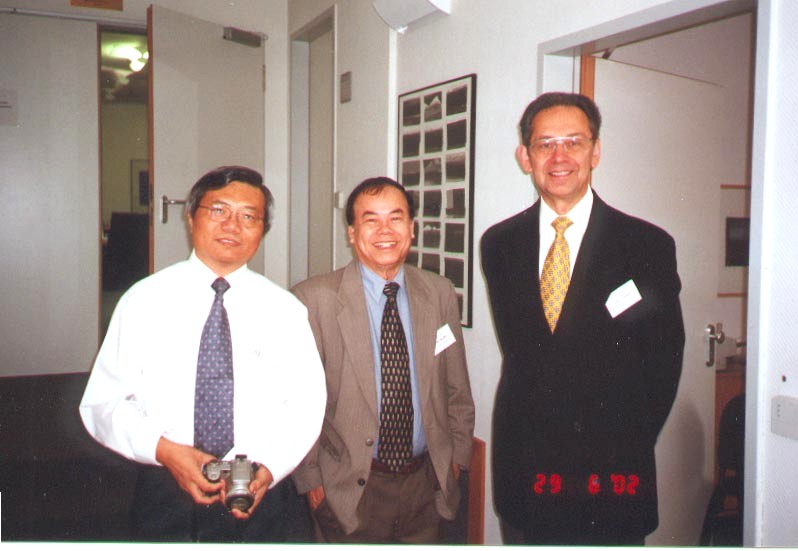
Problems with
Lessons in Our Recent Economic Crisis Management
April 2002
During 2000/01, more than a few national and especially international
economic and financial analysts, advisers and consultants made a rather bold
assertion that, after more than four years of a damaging slowdown in crisis
economies in Asia in particular and in other major economic or free-trade blocs
in general, there were promising signs of a strong economic recovery in Asia.
This prediction did not, however, turn out to be correct as we have come to
experience a great deal of old and new problems, economic, financial, social
and political, unfolding in crisis economies and beyond since then. The
bottom-line effect of all these problems is unfortunately that it has portrayed
a mismanagement of economic and financial crises and this has been seriously
hampering a real recovery in these economies. What kind of lessons have we
learned then from the 1997
Some of the major issues associated with or
conducive to a real Asia recovery and new ideas to develop better or more
appropriate economic and financial crisis management in the years to come are
discussed or dealt with in two new books (The Asia Recovery, 2001, and Economic Crisis
Management, 2002). Both books were edited by Prof Tran Van Hoa and published by Edward Elgar in the
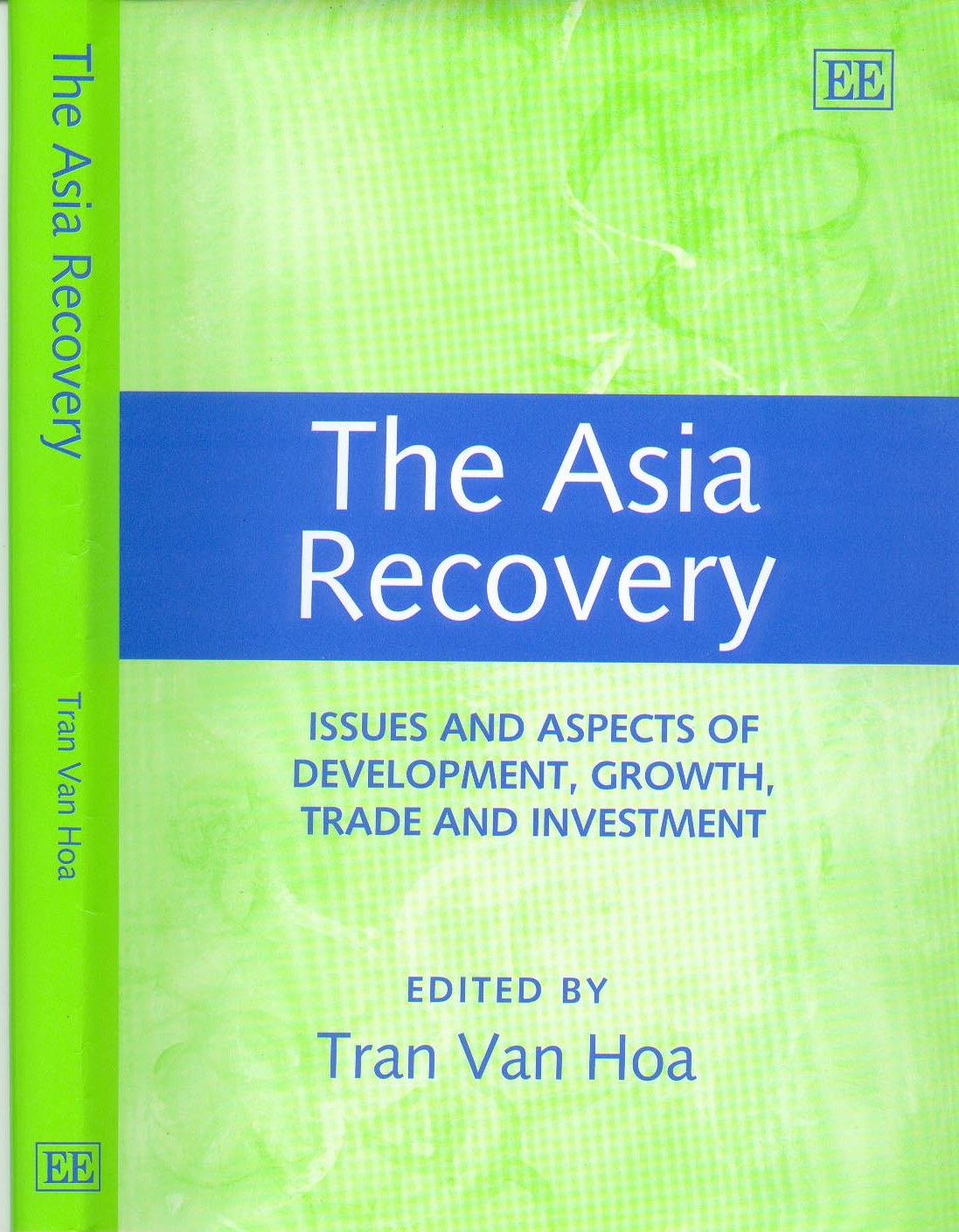
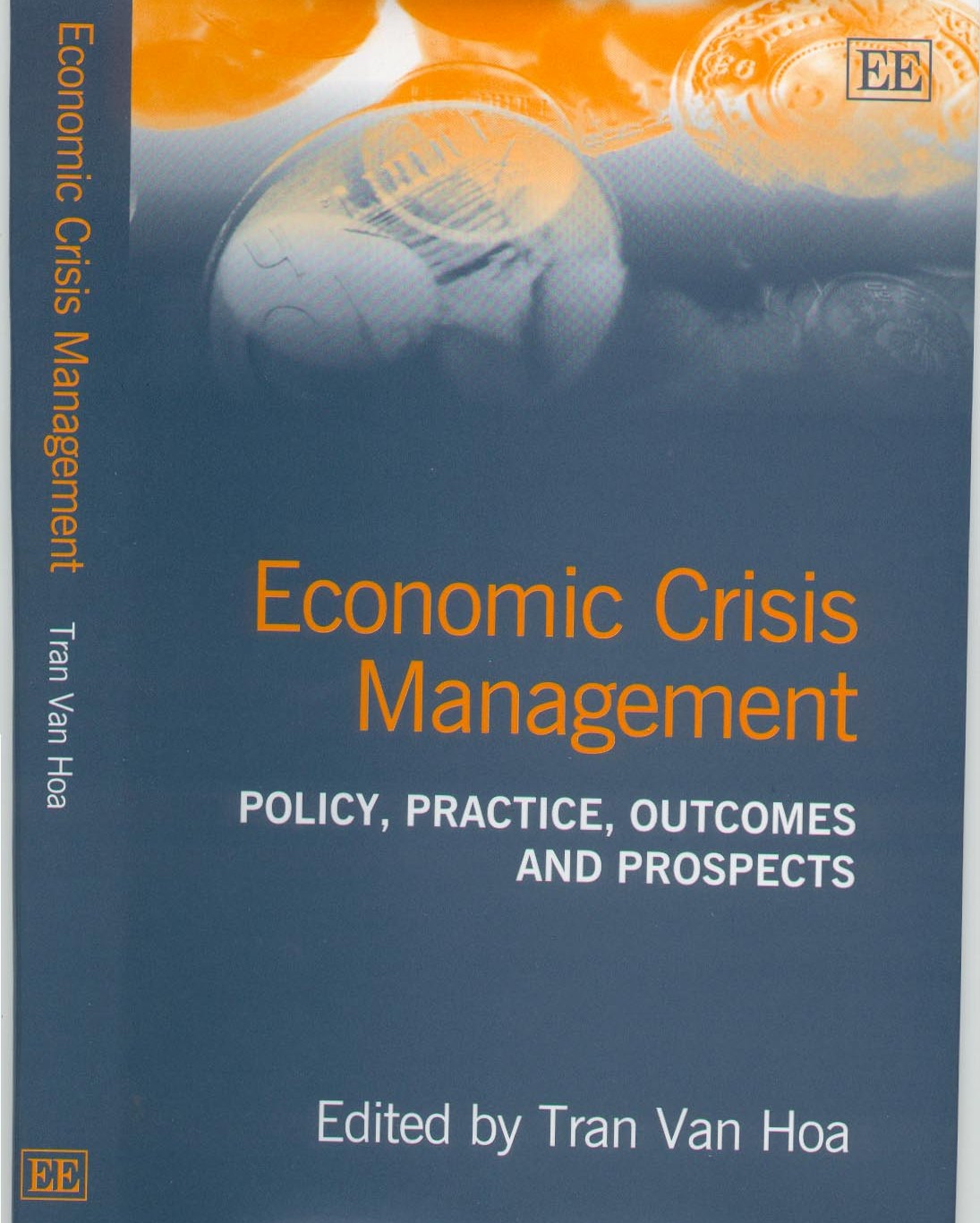
Asia Crisis: What Crisis for
May 2002
A recent important book, edited by Prof Tran Van Hoa (
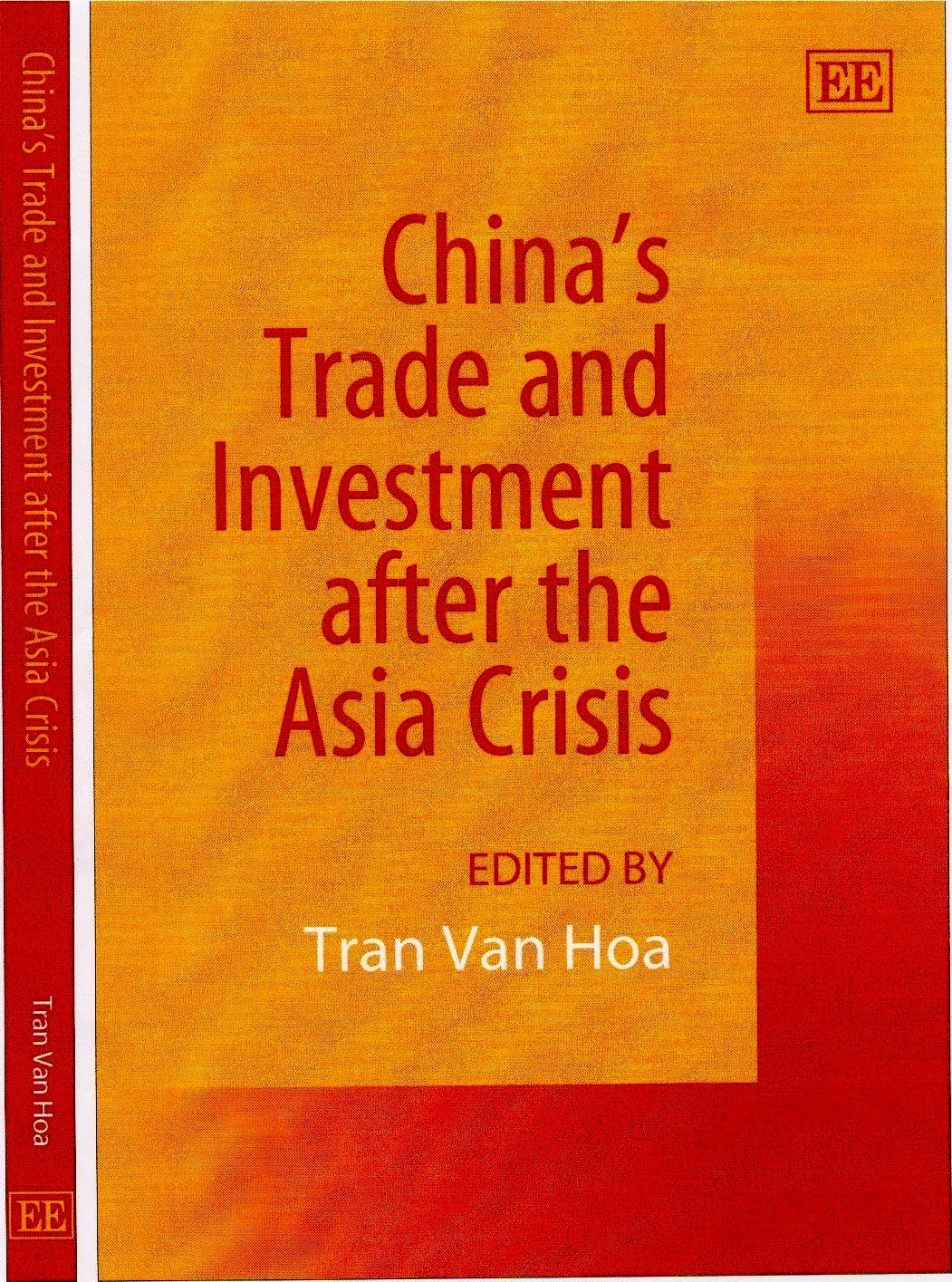
AUSAID WORK AND FUTURE STRATEGIES
IN
27 March 2002
Prof Tran Van Hoa, Director of the Vietnam and
ASEAN+ Research Program at the University of Wollongong, recently attended the
2002 New South Wales-Vietnam Chamber of Commerce Annual General Meeting in
Sydney to discuss an executive report on Ausaid work and its future strategies
for Vietnam. The AGM was co-ordinated by Mr Laurence Strano, President of the
NSW-VN Chamber of Commerce, and the report was presented by the
Prof Tran Van Hoa’s recent work on
The AGM function was attended by over 70
business leaders, academics, and diplomats from
In the photo are, from left to right, Prof
Tran Van Hoa, Miss Tran Thuy Nga (a Master of International Business student at
Wollongong University), Dr Dinh Thi My Loan (Vietnam’s Commercial Consul and
Head of Vietnam Trade Office in Sydney), and Mr Bill Costello (Vietnam
Director, AusAID-DFAT in Canberra).
ASEAN+ and SME Research Centres at
2002
8 March 2002
The Department of Economics in the Faculty of
Commerce at Wollongong University was prominently represented at an important international
conference 2002 CHINA UPDATE at the Australian National University on 8 March
(International Women Day) 2002. The conference’s objectives were to assess
up-to-date economic and reform developments in
Representing the
The 2002
Present at the Conference were members of
parliament, academics, business leaders, senior government officials, diplomats
and doctoral students. Notably present were the Hon Dr Stephen Martin (an
Economics Graduate from UOW and an MP for Cunningham and Shadow Minister for
Trade and Tourism), Sir Arvi Parbo (Australia’s top businessman and Chairman of
Western Mining Corporation), and senior representatives from, among others, the
Department of Foreign Affairs and Trade, the Embassy of the Philippines, the
Embassy of Vietnam, Citigroup, and the Commonwealth Bank of Australia.
In the photo taken in the Peninsula Foyer
(overlooking Lake Burley Griffin) at the National Museum of Australia in
Canberra are (from left to right), Ms Sarah Wong (ANU), Dr Mei Wen (RSPAS,
ANU), Prof Tran Van Hoa, and Ms Tracy Simms (Marketing Manager, Ganlo Pty Ltd).
UOW’s
University of
The celebration was not only for
the traditional annual Spring festive season observed in
The
Attending the celebration were
business leaders from the Vietnamese-Australian community in NSW, academics and
In the photo taken at the
Vietnam’s Consulate-General in Sydney were, from left to right, Professor Tran
Van Hoa, Dr Dinh Thi My Loan (Vietnam’s Commercial Consul and Head of Vietnam
Trade Office in Sydney), Mrs Nguyen Van Tho and the Hon. Nguyen Van Tho,
Vietnam’s Consul-General.
Focus on e-commerce, e-business
and e-trade
in ASEAN+3 economies
19-20 November 2001
E-commerce, e-business and e-trade and their
other related areas including B2B, B2C, B2G, regulation, protection and uptake
have recently been discussed at a conference organised by the Australian
Competition and Consumer Commission (ACCC) on 19-20 November 2001 in Melbourne,
Australia. These are the current issues relevant not only to Australia but also
to other major economies in Asia who are trying to adapt and reform in order to
catch up or restructure to deal with emerging problems in economic development
and growth, expanding borderless trade, and increasing globalisation.
Prof Tran Van Hoa, Director of the Vietnam+
Research Program at the University of Wollongong, attended the conference to
exchange ideas and to gather experiences on e-commerce, e-business and e-trade
and also on relevant and effective ways to assist major developing economies in
Asia (such as Vietnam, China and Thailand) in capacity-building and infrastructure
setting-up in these areas. A major training project on e-commerce skills
standards and operability for e-experts in these countries with expected
AusAID-APEC funding is being prepared by him in collaboration with Vietnam
Ministry of Trade, the ACCC and other educational institutions in
In the photo are an ACCC Commissioner on IT, Dr
David Cousins, and Prof Tran Van Hoa, in the e-commerce conference hall at the
Melbourne Conference Centre, South Bank,
PROMOTING INTERNATIONAL NETWORK,
COMMERCE RESEARCH COLLABORATION AND EDUCATION IN
December
2001
The international
network, research collaboration and education standing of the Faculty of
Commerce at the University of Wollongong were further significantly enhanced
recently in two major Asian transition countries, namely China and Vietnam,
with two important lectures (1-4 December 2001) and a major conference (19
December 2001) organised and delivered by senior staff in the Department of
Economics on current top world economic and commerce issues. During the
lecturing visits, important areas and issues on future research and education
collaboration were also discussed.
In China, the first
lecture was on Implications for Asia and Australia of
the ASEAN+China Free Trade Agreement
(which was endorsed by the (10-member) ASEAN Leaders at their 7th ASEAN Summit
and 5th ASEAN+3 Summit in Brunei on 5 November 2001) and given by Prof Tran Van
Hoa, Coordinator of the Vietnam and ASEAN+ Research Program in the Faculty’s
International Business Research Institute (IBRI), to the prestigious Financial
Policy Research Centre of the People University of China in Beijing.
The second lecture
was on Measuring the Impact of China’s World
Trade Organisation Membership (WTO
143rd member, which was endorsed by the WTO at its 4th Ministerial Meeting in
Doha on 11 November 2001 and ratified by China on 11 December 2001) on its Investment and Growth
and also delivered by Prof Tran van Hoa to the Aetna School of Management of
the Shanghai Jiaotong University. Shanghai Jiaotong University is China’s top
university and the alter mater of China’s current President, Jiang Zeming, as
well as other leaders of China’s government departments,
state-owned-enterprises and private businesses.
In
These high-profile
activities by University of Wollongong's internationally well-known senior
academics with China’s top-rung universities and Vietnam’s economic policy
think tank attracted a large number of attendants (academic staff, postgraduate
students, government officials and corporate executives) as well as
several international students from the University of Wollongong who were on
holiday or on study fieldtrip in China and Vietnam during the southern Summer
2001.
In the photo below
on RUC’s Haidian campus are (on the left) Prof Yulu Chen, Vice-Dean of the
School of Finance and Director of China's Financial Policy Research Centre of
the People University of China in Beijing, and Prof Tran Van Hoa.
In the photo below
at a reception in the Faculty Club of
In the third photo at
the Opening Ceremony of the Conference on Competitiveness and Globalisation at
the headquarter of CIEM, Ministry of Planning and Investment, in Hanoi,
Vietnam, are (from left to right) Prof Charles Harvie, Prof Chaiyuth
Punyasavatsut (Thammasat University, Bangkok, Thailand), Ms Sonya McKay (a
lawyer and Australia's Green Party MP Candidate), Prof Tran Van Hoa, Dr Le Dang
Doanh (President of CIEM and Adviser to MPI Minister), and Dr Dinh Van An
(incoming President of CIEM).
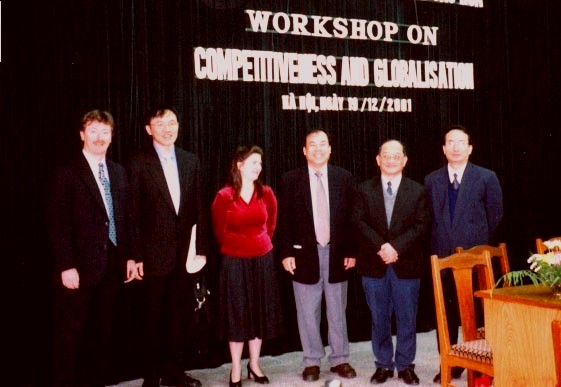
VIETNAM
8TH ANNIVERSARY AT THE ICTC, VIETNAM MINISTRY OF TRADE
AND THAMMASAT UNIVERSITY (ECONOMICS)
LINK
The Director of
During its 8 years of operation, the ICTC, with the collaboration from
foreign experts and institutions, especially the
In the photo taken in front of the ICTC Activity Picture Gallery on 1
October 2001 at the headquarter of the ICTC in Hanoi are (from left) Dr Nguyen
The Hung (Director of ICTC), Prof Tran Van Hoa, Miss Thu Huong (ICTC Executive
Assistant), and Dr Ho Trung Thanh (Vice-Director of ICTC).
During his field-trip to Thailand and Vietnam, Prof Tran Van Hoa also
visited Thammasat University in Bangkok to discuss with staff in the Faculty of
Economics on further links and collaboration between the University of
Wollongong and Thammasat on post-1997 crisis economics research and e-commerce
courses and IT training for major developing countries in Asia (such as China,
Thailand and Vietnam).
The initial link and collaboration with
In the photo taken at the Faculty of Economics at
Dr Sukanya Nitungkorn (Dean of Economics)
and Prof Tran Van Hoa.
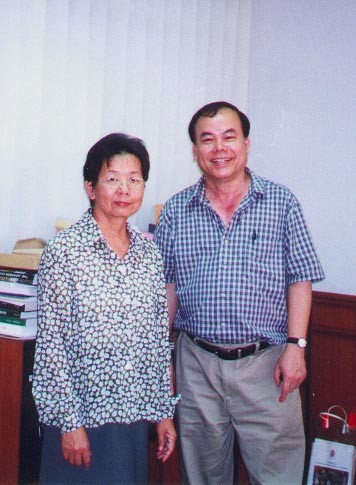
AUSAID AND UNIVERSITY OF WOLLONGONG
IN TRAINING IN COMPETITION LAW FOR VIETNAM
Hanoi
A major international workshop on
competition policy with the participation of well-known experts from Australia , Korea
and Vietnam was held early
in July 2001 at the campus of NATI (National Advanced Training Institute),
Ministry of Trade, in Hanoi USA
The workshop was opened by His
Excellency Do Nhu Dinh, Vice Minister of Trade, attended by a number of
Directors-General of Vietnam’s MOT and other ministries, and by Directors and
Senior Experts of state-owned and private corporations. Representatives from
the Australian Embassy were also present. Speakers at the 2-day workshop
were senior academics from the University of Melbourne, University of
Wollongong, Kangwon National University (Korea), Korea Industrial Research
Institute (Chunchon, Korea), and senior officials from the Australian
Competition and Consumer Commission (ACCC), Vietnam Competition Law Drafting
Committee and Vietnam think-tank, the Central Institute for Economic Management
(CIEM), Ministry of Planning and Investment (MPI).
The workshop was nationally televised by
VTV2 and VTV3 (Hanoi
Competition Policy is a priority area of
APEC, an Australian initiative with 21 of the world’s most important economies
being members. Capacity building and knowledge sharing and transfer in the
Competition Policy area in developing economies in Asia
are two focuses of the 2001 APEC action plan for the next two years. Vietnam Vietnam Vietnam but also for other APEC countries in Asia that plan to introduce anti-trust law and
competition policy to more effectively deal with an increasingly complex
globalised market.
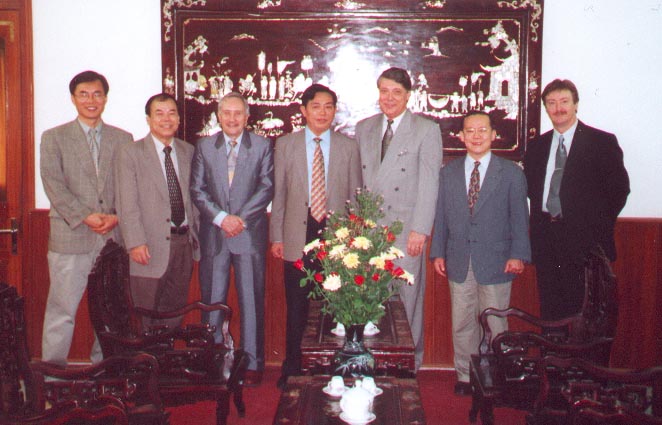
In the above photo at NATI reception hall on
the opening day of the workshop are (from left) Prof Hyun-Hoon Lee (KNU), Prof
Tran Van Hoa, Prof Peter Lloyd (University of Melbourne), H.E. Vice Minister of
Trade Do Nhu Dinh, former ACCC Deputy Chairman, Mr Hank Spier, Prof Chung Koo
Mo (KIRI), and Prof Charles Harvie (UOW).
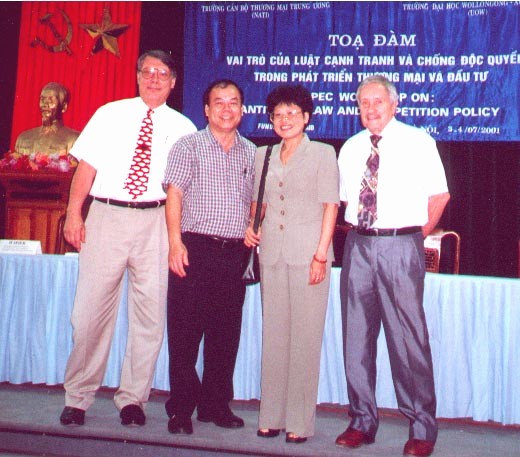
In the photo (above) at NATI Conference
Centre after the round-table discussion on Vietnam Competition Law Draft are (from
left), Mr Hank Spier, Prof Tran Van Hoa, Vice Minister/Deputy Secretary General
of Vietnam Department of Posts And Telecommunications, Ms Tran Ngoc Binh,
and Prof Peter Lloyd.
ASIA-AUSTRALIA-EUROPE ECONOMIC
CO-OPERATION LINK
Prof Tran Van Hoa, Department of Economics and Director, Vietnam
Research Program, at the University of Wollongong, visited in June 2001 the
Centre d'Etudes Prospectives et d'Informations Internationales (CEPII), Prime
Minister’s Department, in Paris, France, to discuss with senior staff there on
its work and activities related to strengthening the long-awaited economic
cooperation link between Asia and the European Union. The visit was part of his
field-trip to present a paper on Bayesian Analysis of Welfare Policy in
Developing Economies at the international conference on Applied Stochastic
Modelling and Data Analysis (ASMDA) organized by the Universite Technologie de
Compiegne in the town of the same name in Flanders, an historic site featured
prominently in both World Wars I and II.
The visit was important in two aspects. First, while North America has
played an important role in assisting growth in many Asian economies in the
past three decades or so, the EU has focused chiefly on its intra-territorial problems,
monetary and political (eg, the EU and Germany reunification), and lagged
behind its NA partner in establishing crucial links with Asia. Second, while NA
and the EU seemed to have been two major markets to alleviate somewhat the
damages (in Asian exports) of the 1997 Asia Crisis, the EU has not taken
advantage of this situation to improve its link with
During his visit, Prof Tran Van Hoa met with CEPII Deputy Director, Mr
Michel Fouquin, and specialist staff on Vietnam, and very useful interaction
and discussions were carried out on the above-mentioned issues especially in
relation to major ASEAN economies such as Vietnam where France still has an
important stake resulting from its 100-year protectorate of the country.
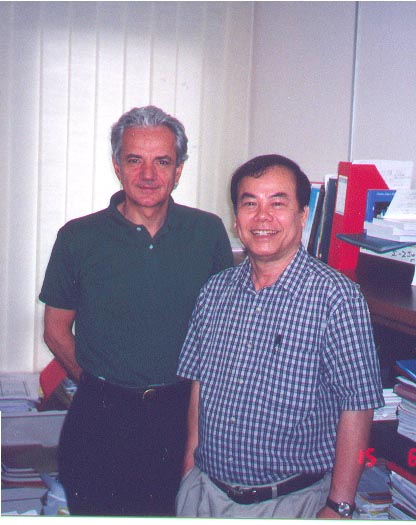
In the photo above at the CEPII headquarter in
Post-1997 Asia Economic Crisis Development:
Why Can't
ASEAN and
Asian Monetary Fund Initiative
11-12 May 2001,
(by
Tran Van Hoa)
A strong link in high-level academic economic research between
well-known economists at the University of Wollongong and the major countries in
North East Asia (namely, China, Hong Kong, Japan and South Korea) was
established recently at a Conference on New Regionalism in East Asia, taking
place at the Shilla Hotel in Seoul and at the Kangwon National University,
Chunchon, in Korea, during 11-12 May 2001.
The Conference’s theme was vision and strategy in economic regionalism
in North East Asia after the damaging 1997 Asia crisis and the subsequent
ineffective rescue packages by the International Monetary Fund, and their
impact on the US, the European Union, the Association of South East Asian
Nations (ASEAN) and the Asia-Pacific Economic Cooperation Forum (APEC). The
Conference was jointly co-organised and co-sponsored by Korea Industrial
Research Institute (
Representing the University of Wollongong were Professor Tran Van Hoa,
Director of the Vietnam Research Program and Professor Charles Harvie, both of
the Department of Economics and the IBRI, who also acted as session chairs and
moderators, discussants and presented invited papers.
At the conclusion of the Conference and at the initiative of two
Conference co-organizers (Charles Harvie and Hyun-Hoon Lee), a new
international economic society ‘The Asia Pacific Economic Forum (unofficially
known as the Soohiyan Club)’ was established by majority voting to develop and
promote further APEF initiatives and activities. Professor Tran Van Hoa was
unanimously elected the Foundation President, with Professor Inchul Kim (
In the photo at the conference reception at the Shilla Hotel in Seoul
are (from left) Professor Inchul Kim (Director, Korea Industrial Research
Institute), Professor Young Ho Kim (Sungkyunkwan University and Korea’s former
Minister of Commerce, Industry and Energy, who, while in office, first
proposed the ASEAN+3 initiative), Professor Tran Van Hoa and Professor Chung Mo
Koo (Kangwon National University).
I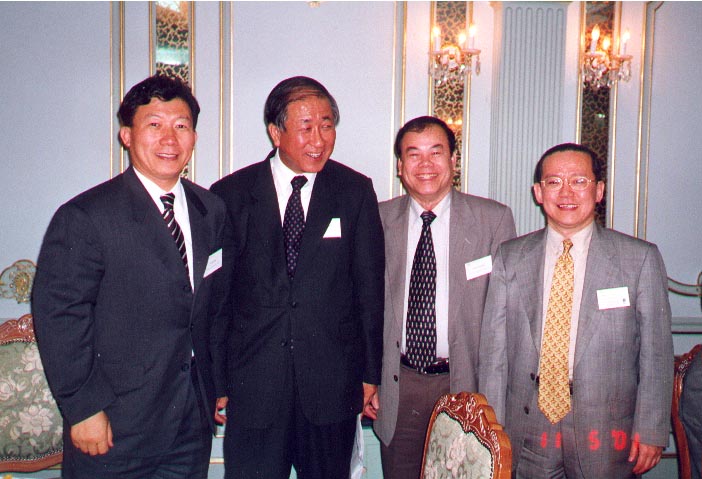
MEDIA
RELEASE
6 November 2000
WARNING
ON LONG-TERM ASIAN FINANCIAL CRISIS
The Asian financial
crisis is not yet over and its real recovery is nowhere in sight, according to
an analysis by
According to
Professor Tran Van Hoa and Professor Charles Harvie of the Department of
Economics and the International Business Research Institute (IBRI) at the
University of Wollongong, the Asian crisis has generated economic and political
turmoil and untold hardship for more than 200 million people in the once
miracle Asian economies.
Australia escaped
the short-term effects of the crisis, but the long-term impact upon trade,
investment and economic relations has not been adequately studied. Professor
Tran Van Hoa's analysis reveals complex issues facing policy-makers in a
culturally and politically diverse region. The religious extremism and
separatism in
'International
policy-makers such as the International Monetary Fund and the World Bank must
understand this complexity in their prescriptions for effective outcomes.
Australia should also take these predictions seriously and consider its
position and long-term relationship with neighbouring Asia in a growing
globalised economy,' Professor Tran Van Hoa said.
Professor Tran Van Hoa said the
pro-Europe trade policy of the present government might be detrimental to
‘The recent rebuff of CER (Australia-New
Zealand Closer Economic Relations) wishing to join the Association of
South-East Asian Nations at a recent ASEAN meeting in
The launch at the
University bookshop was well attended by the University’s top executives and
numerous staff and students. In the photo taken at the launch of the books are
(see photo below, from left to right, standing) the Hon Dr Stephen Martin, MP,
Shadow Minister for Defence, Deputy Vice Chancellor, Professor Peter Robinson,
and Vice Chancellor, Professor Gerard Sutton, and (from left to right, sitting)
Professor Tran Van Hoa and Professor Charles Harvie, with a collection of the
launched books.
At
the Launch of his Six New Books on Asia and the
in November 2000
"Warning
on the long-term impact of the
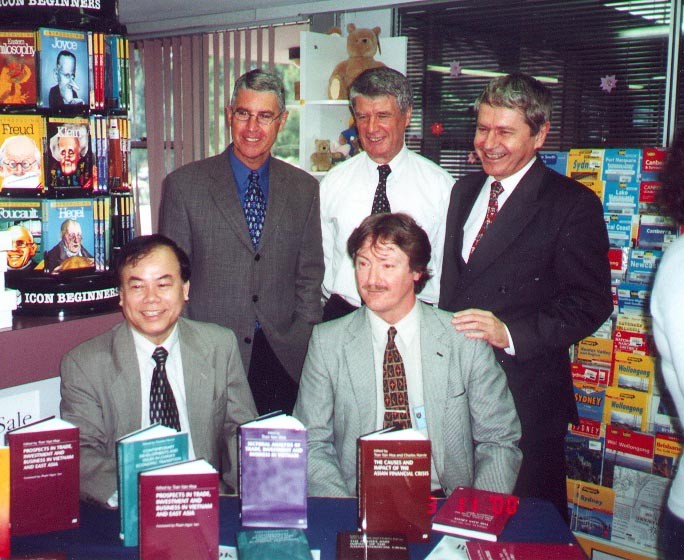
APEC WORKSHOP AND
NATIONAL DAY AND FEDERATION DAY IN
17-18 January 2001
A joint international APEC workshop organised by Professor Tran Van Hoa
of
The workshop is part of an important nationally competitive training
project Development and Promotion of Vietnam Trade: The Role of Anti-Trust Law
and Competition Policy, funded by Australia’s AusAID-APEC for the financial
year 2000/2001. The project focuses on
The project is led by Professor Tran Van Hoa, an international
high-profile expert and author of numerous books on Vietnam’s economic, trade and
social development, and Director of the Vietnam Focus Research Program (IBRI
member) at the University of Wollongong (Australia). It has the collaboration
of other top-level trade and economics specialists from the University of
Wollongong, the University of Melbourne, the National Kangwon University in
Korea, the Central Institute for Economic Management (CIEM), Vietnam’s
Competition Law Drafting Committee, and other divisions of the Ministry of
Trade.
At
the Australian Embassy's Celebration of
(With Professor Peter Lloyd (Former Dean
of Commerce,
H.E Michael Mann, Australian Ambassador
to
"Australia-Vietnam
Relations: Centenary of Federation in
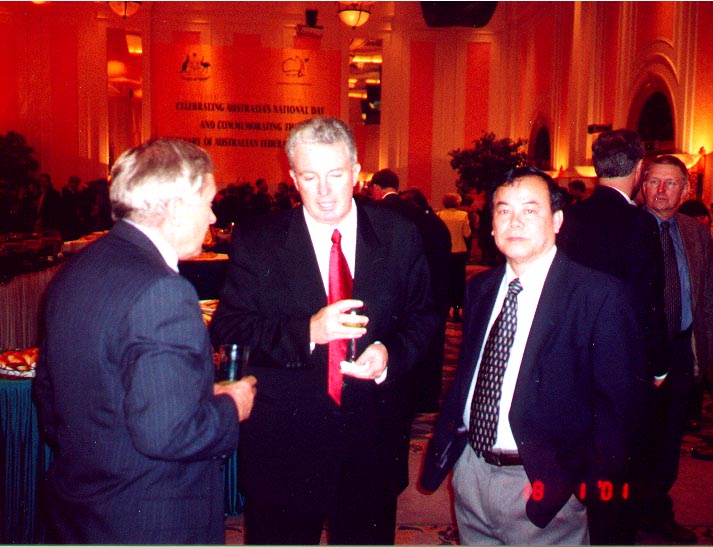
AusAID-APEC
workshop and Australia Day in Hanoi, Vietnam
At the National
Advanced Training Institute (January 2001)
Ministry of Trade,
"Competitiveness
and Drafting Competition Law in
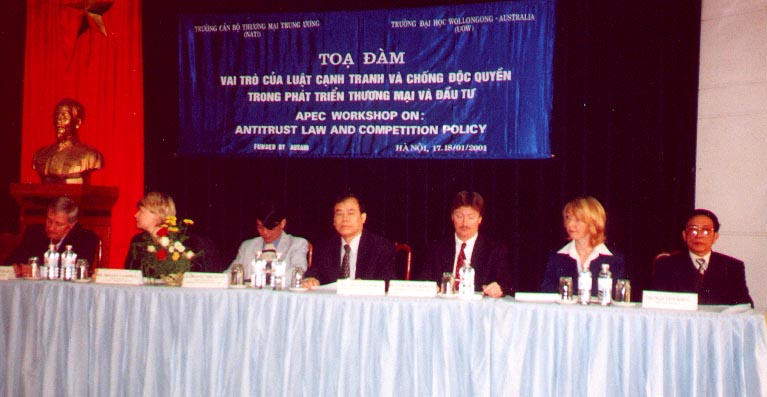
At
the
Financial Crises and Global Governance
October 2000
"200 million people made
poor in
With
Ann Petitfor (Director of Jubilee 2000) and Lord Meghnad Desai
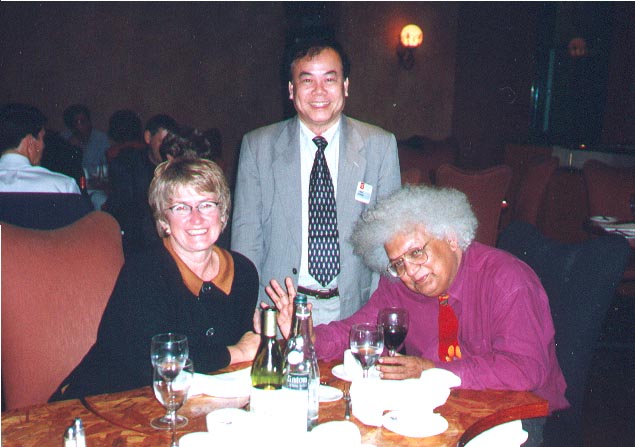
SUMMARY
BIOGRAPHY
Professor Tran Van Hoa holds higher degrees from the
Dr Tran Van Hoa has published 17 books and over 88 refereed articles in
the major applied and theoretical areas of economics, business, economic
development, finance, energy, foreign investment, international trade and
econometrics in Australian and international professional economics, finance,
and statistics journals, and over 130 other discussion papers and commissioned
reports. He is listed in Who’s Who in the World, Who’s Who in Asia and Pacific
Nations, Who’s Who in Science and Engineering, 2000 Outstanding People of the
20th Century and in Dictionary of International Biography.
He also is a Director of T&M Enterprises P/L (
SELECTED
LIST
OF SIGNIFICANT JOURNAL PUBLICATIONS
by
TRAN
VAN HOA
Tran Van Hoa, "Consumer Demand and Welfare
Indicators: A Comparative Study for the
Tran Van Hoa, "Additive Preferences and Cost of
Living Index: An Empirical Study of the Australian Consumer's
welfare", Economic Record, Vol. 45 (1969), pp. 432-440.
Tran Van Hoa (with Fels, A.), "Causal
Relationships in Australian Wage Inflation and Minimum Award Rates",
Economic Record, Vol. 57 (1981), pp. 23-34.
Tran Van Hoa, "The Integrability of Generalized
Working Models", Economics Letters, Vol. 13 (1983), pp. 101-104.
Tran Van Hoa, "The Inadmissibility of the Stein
Estimator in
Perkins, J.O.N. and Tran Van Hoa, The Macroeconomic
Mix in the Industrialised World,
Tran Van Hoa, "Econometric Tests of the Macromix
Theory", in Perkins, J.O.N. and Tran Van Hoa, The Macroeconomic Mix of the
Industrialised World, London: Macmillan, 1985.
Tran Van Hoa, "The Inadmissibility of the 2SLS
Estimator in some Linear Structural Equations", Economics Letters, Vol. 21
(1986), pp. 337-341.
Tran Van Hoa, "Some Dominance Theorems on the
Double-k Class Estimator in Linear Models", Economics Letters, Vol. 22
(1987), pp. 237-240.
Tran Van Hoa (with Perkins, J.O.N.), "Towards the
Formulation and Testing of a More General Theory of Macroeconomic Policy",
Weltwirtschaftliches Archiv (Review of World Economics), Vol. 123 (1987), pp.
199-215.
Tran Van Hoa (with Chaturvedi, A.), "The
Necessary and Sufficient Conditions for the Uniform Dominance of the Two-Stage
Stein Estimators", Economics Letters, Vol. 28 (1988), pp. 351-355.
Tran Van Hoa, "System Estimation of Generalized
Working Models: A Semiparametric Approach", Economics Letters, Vol. 31
(1989), pp. 363-366.
Tran Van Hoa, "Economic Inequality and Consumer
Behaviour: Theory and Applications", in Tran Van Hoa and Bewley, R.F.
(eds.), Contributions to Consumer Demand and Econometrics: Essays in
Honour of Henri Theil,
Tran Van Hoa, "Modelling Output Growth: A New
Approach", Economics Letters, Vol. 38 (1992), pp. 279-284.
Tran Van Hoa, "A New and General Approach to
Modelling Short-Term Interest Rates: With Application to Australian Data
1962-1990", Proceedings of the Journal of Economics and Finance, Vol. 16
(1992), pp. 327-335.
Tran Van Hoa, "The Mixture Properties of the 2SHI
Estimators in Linear Regression Models", Statistics and Probability
Letters, Vol. 16 (1993), pp.111-115.
Tran Van Hoa (with A Chaturvedi), "Performance of
the 2SHI Estimator under the Generalized Pitman Nearness Criterion",
Communications in Statistics (Theory and Method), Vol. 26, Issue 5, 1997, pp.
1227-1238.
Tran Van Hoa (1997), "Improved Forecasts of
Investment and Growth in Some Major ASEAN Economies: An Economy-wide
Approach", Journal of Economics and Finance (Proceedings), Vol. 21, pp.
271-280.
Tran Van Hoa (with H Hasegawa and A Chaturvedi),
"Bayesian Unit Root Test in Normal AR(1) Model", Journal of Time
Series Analysis, Vol. 21, No. 3, 2000, pp. 261-280.
Tran Van Hoa (2001), "Modelling and Forecasting
Investment in
Tran Van Hoa (2002), “New Asian Regionalism: Empirical
Foundation and Growth Prospects for ASEAN+3 Free Trade Agreement”, Journal of
the Korean Economy, Vol. 3, No. 2, 2002, pp. 317-343.
Tran Van Hoa (2002), “Economic Crisis Management in
Asia”, Social Sciences Research Journal (India). Vol. 10, No. 3, 2002, pp.
21-38.
Tran Van Hoa (2004), "Australia-Thailand Free Trade
Agreement: Challenges and Opportunities for Bilateral Trade Policy and
Closer Economic Relations", Thammasat Economic Journal (
Tran Van Hoa (2004), "
Tran Van Hoa (2005), “New Asian Regionalism:
Econometric Evidence on the Impact of the ASEAN+3 Free Trade Agreement on Its
Member Countries”, Journal of Quantitative Economics ((
Tran Van Hoa (2005), “Gender and Growth in Major
Asian Economies”, Thammasat Economic Journal, in press
Tran Van Hoa (2005), “Income Convergence and Growth of
Asian Regional Trade: Empirical Evidence for ASEAN+3 Free Trade Agreement”,
Chulalongkorn Journal of Economics (
Tran Van Hoa (2005). “New Asian Regionalism and
ASEAN+3 Free Trade Agreement: Theoretical and Empirical Foundation, Policy
Challenges and Growth Prospects”, Chulalongkorn Journal of Economics (